
Lithuania has passed legislation to make it legal to deny entry to asylum seekers at the border. Rights groups and NGOs said it is tantamount to sanctioning widespread violence against refugees and migrants.
Lithuania’s parliament passed legislation on April 25 allowing border guards to turn back migrants who cross into the country irregularly, a move that was heavily criticized by Lithuanian NGOs and rights organizations.
The amendment passed with 69 votes to 7 against the measure and 24 abstentions. Parliament is scheduled to give final formal approval on Tuesday (2 May).
"Today is a dark day for justice as Lithuania’s Parliament has voted to enshrine in law illegal and abusive practices. By codifying what is illegal and forcibly returning refugees and migrants to places where they face a risk of torture and other ill-treatment, the government is trampling on their rights and on Lithuania’s own international obligations," Amnesty International’s Europe Director, Nils Muižnieks said in a statement.
International laws and treaties such as the European Convention of Human Rights Protocol and the 1951 Refugee Convention prohibit collective expulsions and the return of anyone to a country where they could face serious human rights violations.
Over 300 organizations and individuals warned that the law's provision of civilian border guards which it called "border hunters" was dangerously similar to the Hungarian model.
Hungary ranks as the top country to use what rights groups have described as "systematic violence" against migrants. Amnesty International reported more than 157,000 pushbacks in Hungary by the end of December 2022.
Last month, the Council of Europe’s Committee for the Prevention of Torture, published a report revealing the widespread use of violence, intimidation, prolonged detention, and practices that amount to torture by authorities in countries across Europe carrying out pushback operations.
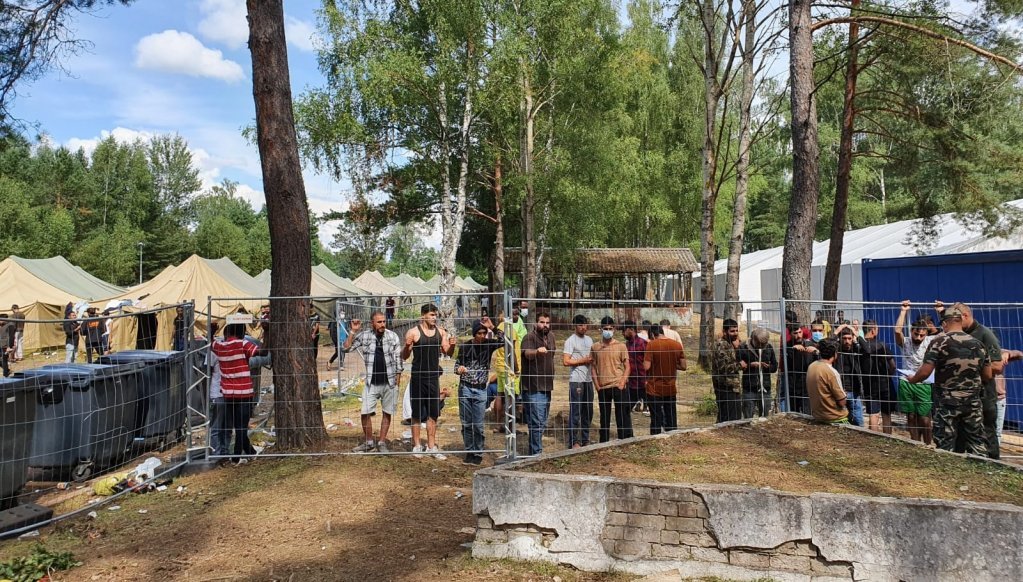
Forced to return
Lithuanian border guards had already been pushing back migrants, based on a government regulation dated August 2021.
Rights group European Council on Refugees and Exiles said that now "pushbacks” or the illegal practice of forcibly returning migrants back to Belarus has now been voted into law.
Medecins Sans Frontieres (MSF) reported that migrants who are pushed back at the borders of Latvia and Lithuania are left with nowhere to go. They are stranded in dense forests where temperatures can drop to near freezing, without access to sufficient food, water, or medical treatment.
The organization added that "in 2022, there were also over 8,000 pushbacks and over 4,000 by Lithuanian and Latvian border guards respectively."
According to MSF, at least 27 people died at the borders last winter, though the real number may be higher. MSF closed its operations in Latvia and Lithuania in December 2022, citing “restrictions and circumstances prevented our teams from providing care to migrants with full confidentiality and in accordance with our principles.”
Earlier this month, a 40-year-old Indian man died close to the border between Lithuania and Belarus.
Lithuania's Interior Minister Agne Bilotaite blamed Belarus' authoritarian leadership under President Alexander Lukashenko for the man's death.
European Union (EU) member states accuse Belarus of encouraging irregular migrants from the Middle East, Afghanistan, and Africa to cross the border into the European bloc in retaliation for sanctions imposed on Minsk over human rights abuses.
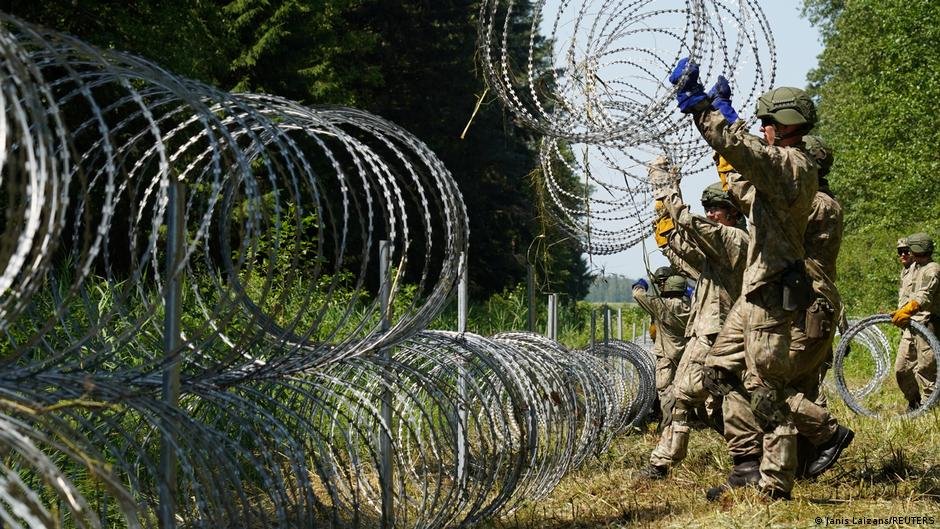
Struggling to curb migrant crossings
Lithuania has been struggling to stem the flow of migrants trying to enter the country from neighboring Belarus. Government statistics indicate that the number of irregular arrivals in Lithuania reached 4,115 in 2021, which is 55 times higher compared to the previous year.
Lithuania's legislation comes in the wake of a series of measures aimed at sharply reducing migrant crossings. Lithuania declared a state of emergency along its 175- kilometer border with Belarus from August 11 to November 10. Neighboring countries Poland and Latvia also declared a statement of emergency.
In addition, Lithuania bolstered border protection by erecting a razor-wire fence and setting up electronic surveillance on its border with Belarus.
A June 2022 report by Amnesty International revealed that Lithuanian border guards subjected non-European refugees and migrants to violent pushbacks to Belarus, despite the risk of torture and other ill-treatment by Belarusian authorities, as well as to arbitrary detention and other violations.