
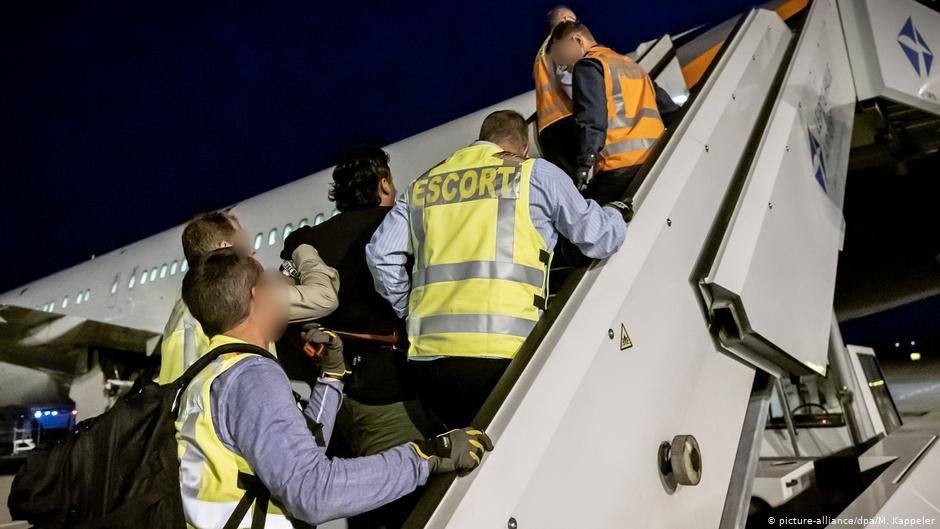
Data published by the German government indicates that roughly two thirds of all attempts to deport people whose asylum applications have been rejected fail. Government members cite logistical issues, such as canceled flights, or failure to locate the individuals on the day of departure, as possible explanations of the high rate. Meanwhile, positive asylum decisions are on the rise.
The strategy of deporting individuals who have failed their asylum application is increasingly being adopted by EU nations looking to curb irregular immigration.
The idea is to lower the number of people without legal status in the EU while also signaling that people from certain countries are unlikely to be given protection.
However, this tactic continues to yield little result.
According to the German government, a total of 36,282 deportations were supposed to be carried out last year. But new data shows only one in three of these proposed deportations were actually facilitated -- a total of 12,945 cases.
That leaves 23,337 deportations not carried out.
Furthermore, as of December 31 last year, the Central Register of Foreign Nationals listed an overall number of 304,308 people in Germany who were subject to an enforceable obligation to leave the country.
Of those, however, around 81% (248,145 people) had their deportation order temporarily suspended.
Read more: Thousands of deported migrants reenter Germany — report
A failed policy?
The government compiled and issued the statistics in response to a parliamentary question asked by the conservative faction in opposition to German Chancellor Olaf Scholz's coalition government.
The interior policy spokesman of the Christian Democrats (CDU) party, Alexander Throm, told the weekly Bild am Sonntag newspaper that focusing on repatriation policies had to be a priority to deal with immigration trends.
"Germany is in the midst of the most serious migration crisis since 2016," Throm said, accusing the governing coalition of Chancellor Scholz of not implementing its planned "repatriation offensive," which is part of the government's plan to deal with irregular migration.
Throm's statement was made in reference to the coalition government agreement, which states that "(n)ot every person who comes here can stay."
"We are launching a repatriation offensive to implement departures more consistently, especially the deportation of criminals and those posing a threat to the public," the document further specifies.
Read more: Germany debates tougher deportation rules
Most asylum requests granted
Against that background, however, the number of people who manage to make their way to Germany and receive at least a temporary right to remain in the country is also on the rise -- as is the number of applications submitted.
Last year, almost three-quarters of people applying for protection in Germany were successful. This rate represents the so-called "adjusted protection quota," which excludes formal decisions and only takes into account those cases in which the content of the asylum application itself was examined.
The Federal Office for Migration and Refugees (BAMF), normally only publishes statistics on the overall protection rate, which also includes rejections for formal reasons, such as when it is decided that another EU country is responsible for taking in the person. These decisions say nothing about eligibility for asylum.
That overall protection rate in 2022 was 56.2% while the adjusted protection quota stood at 72.3%.
Clara Bünger, a Left Party MP, told the epd news agency that this record protection rate shows just how much help asylum seekers need in the face of a globally deteriorating security situation:
"There is no use in holding unlawful, unrealistic and inhumane debates about limiting refugee migration," she said.
Read more: Germany rejects conservative party request to restrict irregular migration
with dpa, epd, Bild am Sonntag