
Judges could announce this week if authorities broke the law when they combed an asylum seeker's phone to find out where she was from. The searches are common practice — and the ruling could have major consequences.
What right to data privacy do asylum seekers have? That's the question at the core of a little-noticed lawsuit in Germany, a country known as a world forerunner on data protection — and a landmark ruling could land as early as this week.
On Thursday, the country's highest administrative law court in Leipzig is hearing a case over whether authorities broke the law in 2019 when they scanned the phone of an Afghan asylum seeker with no passport for clues about where she was from.
"The court is making a decision over one individual case, but what happened to our client is common practice in Germany," Lea Beckmann, one of the woman's attorneys and a member of the legal team at the nonprofit Society for Civil Rights (GFF,) told DW. The plaintiff's name is being kept secret at her lawyers' request for fear of repercussions.
Supported by the GFF, she sued Germany's Federal Office for Migration and Refugees (BAMF) over the search of her phone in 2020. In June 2021, a regional court in Berlin ruled in her favor, arguing that authorities had violated the law because they had not exhausted less intrusive means first. But the BAMF appealed the decision and asked the country's top judges at the Federal Administrative Court to take a second look.
The court could announce its ruling as early as the end of this week's hearing, and either throw its weight behind the regional judgment or quash it.
The decision will be watched closely by migration authorities around the world, where similar technology is often used in asylum applications. Ahead of this week's trial, the BAMF said it stood by its practice.
"Clarifying the identity and nationality of asylum seekers who cannot present identity documents by analyzing mobile devices is fundamentally important for the security of our country and for the accuracy of asylum decisions," a spokesperson for the BAMF told DW in a written reply to a list of questions.
Beckman, the plaintiff's attorney, said a ruling could have far-reaching consequences for phone searches. "Should the judges agree with the Berlin court in their reasoning, that would mean that the BAMF would no longer be allowed to analyze cell phones unless the agency has previously exhausted all other measures available to verify information about citizenship," she said.
How phone searches work
Underlying the controversy is a paragraph Germany added to its asylum law in 2017 that allows authorities to demand access to the cell phones, laptops, and tablets of asylum seekers if they cannot provide any valid passport or ID card and if an identification "cannot be achieved by milder means."
Once inside the devices, authorities use software to scan files for clues about where the phones have been. Such digital evidence includes location metadata attached to photos, country codes of numbers saved on the phone, or the language used in text messages.
The program automatically compiles results in a report. That document is kept confidential until a lawyer at the BAMF grants the office's case workers access. They can then factor in the results when they decide whether to grant asylum.
Between 2018 and 2021, the office searched over 47,000 devices of asylum seekers, according to data provided by BAMF.
That was necessary to "ensure a high-quality and secure asylum procedure," said a BAMF spokesperson. At the same time, he stressed that the searches were just one among several tools for "obtaining additional information to prepare the conduct of the asylum interview and, thus, placing the asylum decision on a broader and better basis."
Backlash from Germany's civil society
Since the practice was first introduced, it has met harsh criticism from civil liberties advocates in Germany — a country where the experience of two authoritarian regimes has made people particularly sensitive about privacy, and where the world's first data protection law was passed in 1970.
At the forefront of that fight is the Berlin-based nonprofit GFF. In 2019, the group published an investigation arguing that phone searches are both ineffective and intrusive.
By 2020, the group had convinced three asylum seekers from Syria, Afghanistan, and Cameroon to sue the BAMF. In three separate lawsuits, they argued that the agency had demanded access to highly intimate data stored on their phones without meeting the legal requirements. That, they said, encroached on their fundamental right to privacy.
During the very first hearing on June 1, 2021, held in an inconspicuous administrative court building in central Berlin, regional judges upheld the Afghan asylum seeker's complaint, a decision that came as a surprise to both parties.
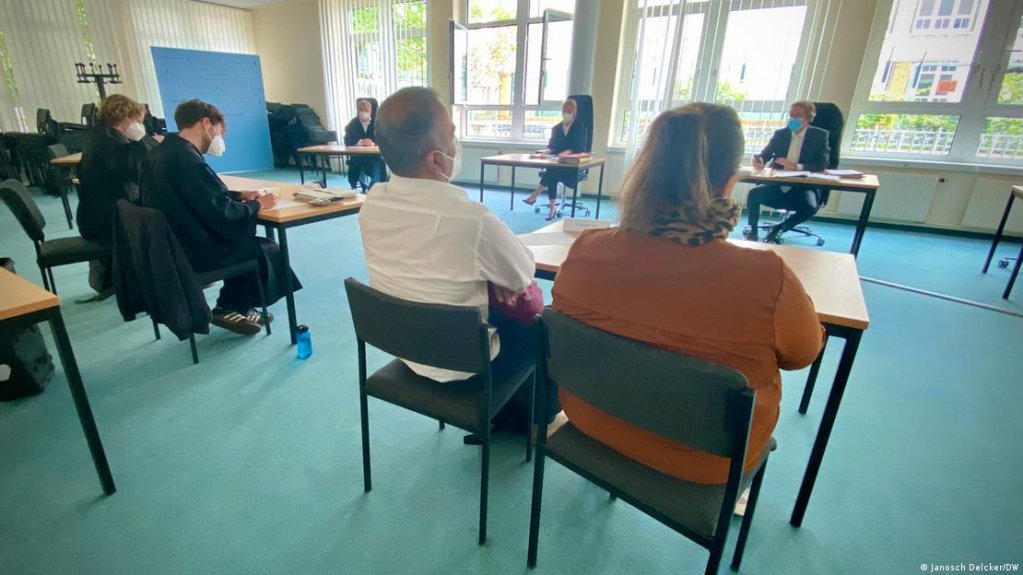
On the spot — and aware that the practice affects tens of thousands of refugees — both the GFF and BAMF agreed that an appeal would go directly to the country's highest administrative judges in Leipzig. Shortly after, the GFF decided, together with the plaintiffs from Syria and Cameroon, to pause the other two lawsuits until the top court's decision.
The BAMF, meanwhile, has not changed its practice in the 20 months since, arguing that "the first-instance ruling represented an isolated case."
What about Germany's data protection watchdog?
The upcoming decision will likely have a greater legal impact.
"The Federal Administrative Court will deal with the question of whether the relevant paragraph in Germany's asylum law is a sufficient legal basis for what authorities are doing," court spokesperson Carsten Tegethoff told DW. "In this respect, the lawsuit is of fundamental importance."
At the same time, the ruling will also impact a separate complaint filed by the GFF that could put an end to the phone searches as they're conducted today.
In early 2021, the nonprofit asked Germany's data protection watchdog, the Federal Commissioner for Data Protection and Freedom of Information, to look into the phone searches. Unlike the courts, the office has the power to directly order the BAMF to cease the practice.
Two years later, the watchdog has not yet reacted on the issue — something attorney Beckmann described as "disappointing."
But Christoph Stein, a spokesperson for the agency, confirmed to DW that the case was still pending. The office, he added, "intends to take the pending decision into account in its further actions."
All eyes are on what judges in Leipzig will decide.
Author: Janosch Delcker
First published: February 13, 2023
Copyright DW - All rights reserved
DW is not responsible for the content of external websites
Source: dw.com