
Ukrainians who have fled their country in the 10 months since the Russian invasion are facing their first festive season in Germany. Many have only one Christmas wish.
"It is all very difficult emotionally," Natalia says. "This year, Christmas is definitely very different for me." She comes from the city of Kharkiv in north-east Ukraine, where hundreds of people were killed, and many areas were devastated in Russian attacks early this year. A few months later, she fled west with her daughter and ended up in Berlin. Her daughter has since found work in Cologne and moved there.
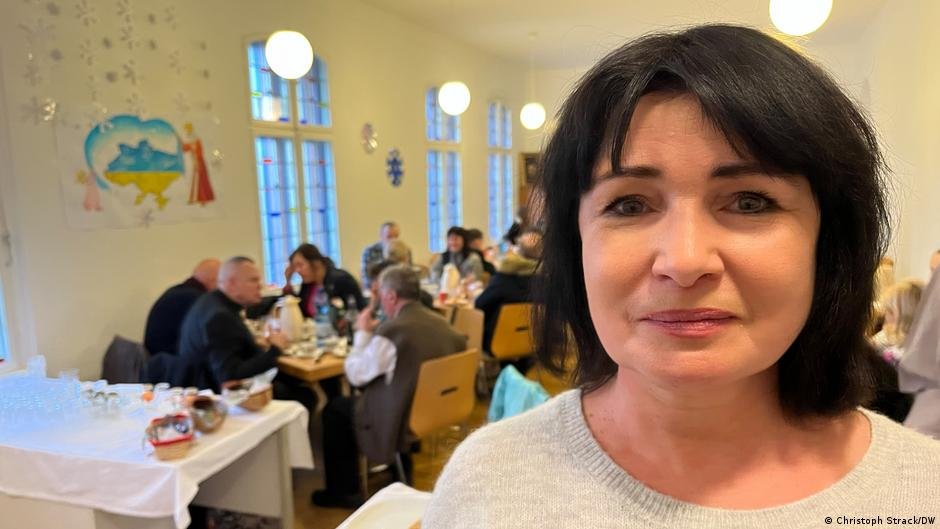
On this Sunday afternoon in mid-December, Natalia stands in the bustling parish hall of the St. Nikolaus Church in Berlin-Johannisthal, in the east of the German capital. Catholic Christians from Ukraine have been using this church for many years. On this day, two weeks after the western date, they celebrate the festival of Saint Nicholas, who the church is named for. This parish has now become something of a home for Natalia from Kharkiv.
"I cannot imagine what would have happened if I had not found this here. Everything would have been incredibly difficult for me," she told DW: "Here, I have support, here I can talk, and meet other refugees. And I pray a lot." Natalia has started volunteering in the congregation and preparing children for confession.
It is a feast day at St Nikolas. Bishop Bohdan Dzyurakh has come from Munich. A small choir accompanies the mass, singing in harmony. The pews are full and at the back of the church the faithful crowd in, including many women, many with children. They also stand in the vestibule and pray. Some even wait on the street.
When the bishop walks around and sprinkles the people with holy water toward the end of the two-hour service, he also goes up to the parish halls on the first floor. There, too, people listened to the service on loudspeakers and prayed along.
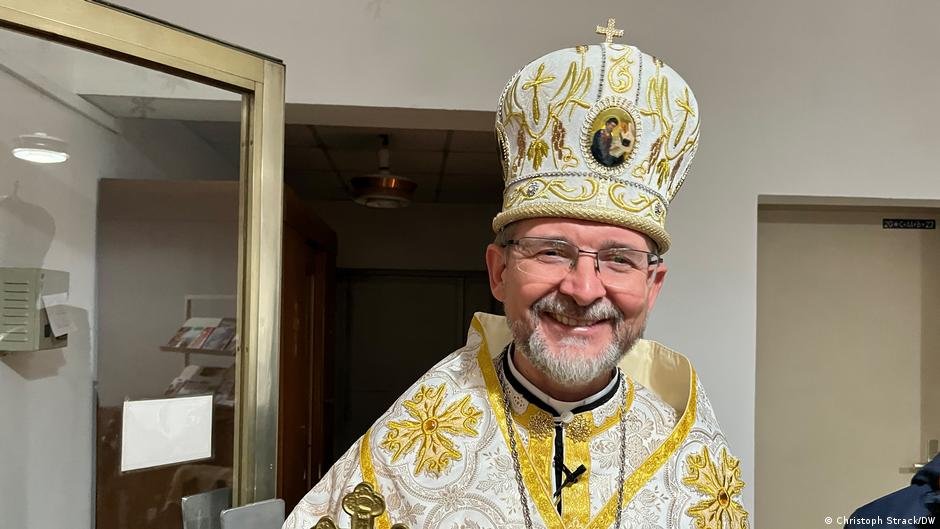
Bohdan Dzyurakh is Bishop of the "Ukrainian Greek-Catholic Church" (UGCK); his full title is Apostolic Exarch of Germany and Scandanavia. This means he has a large diocese. In Germany, this includes about 50 congregations spread across the country. The parishes, bishop, and pastors have been in a state of emergency since February 24 — the day Russia invaded Ukraine. As an aside, the priests of this church, which is in full communion with Roman Catholicism, are allowed to be married.
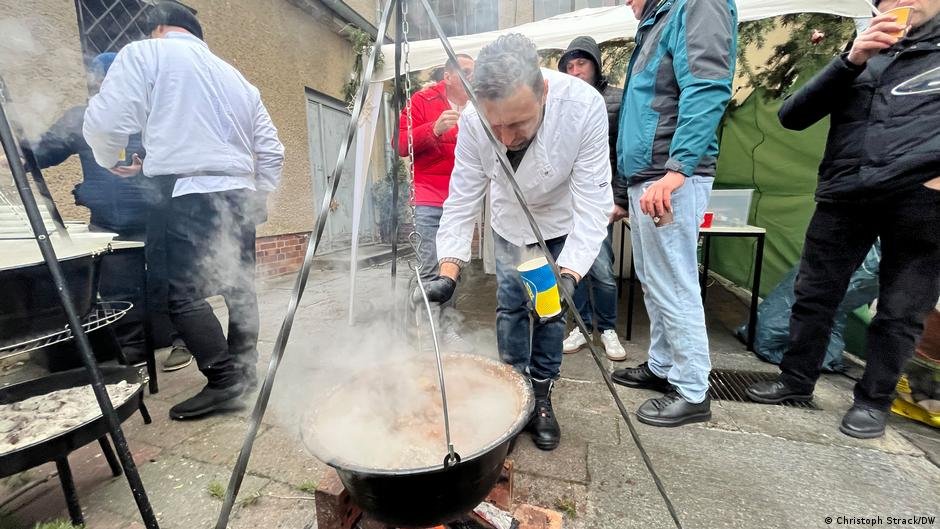
The congregations are growing. Nobody knows by exactly how many, but it is surely by several thousand. Many of the people attending mass this Sunday in Berlin speak no German or only a little. But after the service, they celebrate together. In the courtyard, there is bograch soup cooking on an open fire. Nearby, a barbeque sizzles.
The bishop remains in the church for almost two hours, hears confession, and speaks with people one-on-one. He spends a long time with a young woman who, supported by an older companion, talks through a stream of tears, and shows him a photo on her phone.
'We pray for our defenders'
"Everyone is asking themselves whether they have the right to be happy," Dzyurakh later tells DW. "As pastors, we encourage the people to let the Christmas joy into their hearts. That is why God's son came down to earth so that we can experience joy and hope. We need this joy. We pray for peace in Ukraine, we pray for our defenders. But we also want to celebrate this festival with joy."
In many places, priests are encouraging their parishes to first celebrate Christmas via video call with their relatives in Ukraine, often the men, and then come together for worship and fellowship. During Advent, the Catholic church in Stuttgart has published several texts online to explain Ukrainian customs to German communities or share a Christmas carol.
They describe fates such as that of the family of Svitlana Hnativ, who fled the war with her mother and son. They want to at least have a video call with Hnativ's brothers and father in north-western Ukraine, where they are looking after internally displaced people. "Our hearts are at home, and yet we are looking forward to Christmas here," she said. The 36-year-old expressly thanked the Stuttgart family who had taken her in and cared for her.
Christoph Strack/DW
'Many Germans support us'
This is also important to Natalia in Berlin. As the conversation with her ends, she wants to make one more point. "It is so nice that so many Germans support me. People I hardly know, even when filling out forms for the authorities. Many strangers help, it is fascinating," she said.
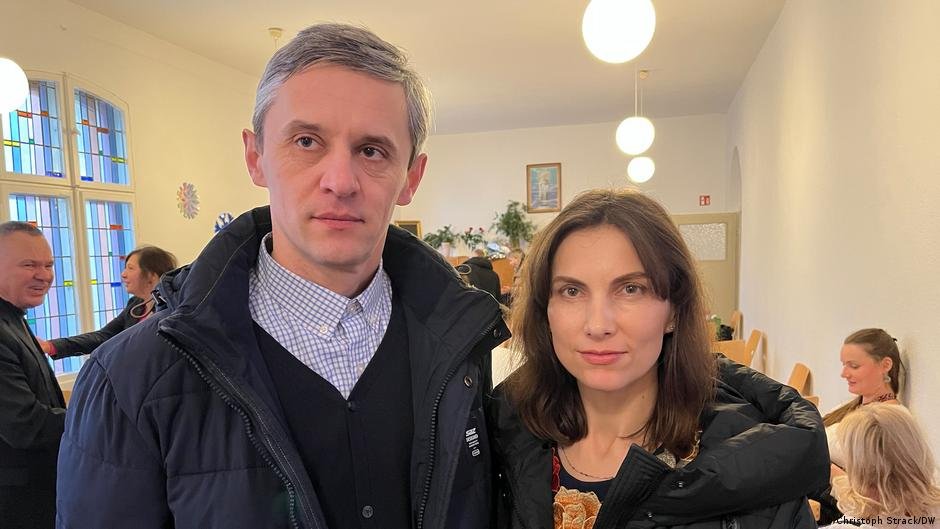
Myroslav (43) and Anna (42), refugees with four children, also emphasize this: "We have had such amazing experiences. Strangers have often helped us, or people we met by chance," they said. "In the congregation here, we receive support every day."
They traveled separately from Ivano-Frankivsk in the west of Ukraine to the Czech Republic — the mother with one child, the father with three. There, in safety, they researched which German cities had highly active church communities.
"We decided on Berlin," Myroslaw told DW. Meanwhile, the children have started school, both parents are learning German and he leads the small parish choir. But he adds: "It will be much sadder this year. Our parents and many friends are still there. It [Christmas] will be much lonelier here."
The fear of loneliness. The pastoral care workers in the nearly 50 church communities are also concerned with this topic. "We are all human," Bishop Dzyurakh says. The stories "that are brought to us, challenge us." But it is true: "When we comfort others, we also experience divine comfort."
The established UGCK congregations in Germany had wanted to align their church calendars with the other Christian churches in the country from 2023, to celebrate Christmas and Easter at the same time as Catholics and Protestants. Now they have paused this move because the refugees from Ukraine celebrated according to the calendar of Eastern tradition and orthodoxy, and nobody wants to take that away from them. That is why some UGKK parishes celebrate Christmas on December 24 and others, such as in Berlin, on January 6.
'People disappear without a trace'
Many congregations were stretched to their limits in the first few months of the war. The parish priest in Berlin was already looking for psychological support in March. Now it is Serhiy Oliynchuk's job.
The 48-year-old UGCK priest is a studied theologian and holds a doctorate in psychology. He has many one-on-one conversations. Sometimes he is conducting a church service, other times he is a contact person in the psychosocial institutions of the Catholic aid organization Caritas. "And sometimes I have been needed as an emergency chaplain." He works with grief. Most refugees experienced the loss of their peaceful lives and the separation from their husbands and parents, he said. It was terrible whenever the brutal war took the lives of their loved ones. "And the absolute nightmare is when relatives simply disappear without a trace."
Oliynichuk comes from Lviv. His parents and siblings live there. The chaplain explains the significance of Christmas as a family celebration for Ukrainian Christians: "You always celebrate with extended family, with parents and grandparents." It is sad when that is missing. So "this year will be difficult," and a challenge for the congregations. "Of course, we cannot replace everything. But through the church services and praying together we are united."
In Berlin-Johannisthal they gather for a long time over food from their homeland and stories of their escape. The children receive small parcels full of chocolate — it is Saint Nicholas after all. Natalia finds the conversations with others in her situation helpful. What is her Christmas wish? "My only wish is for the war to end. That would be the best thing that could happen at Christmas."
This article was originally written in German.
Author: Christoph Strack
First published: December 23, 2022
Copyright DW - All rights reserved
DW is not responsible for the content of external websites
Source: dw.com