
Italy plans to launch a compulsory code of conduct for NGOs involved in rescues of migrants in the Mediterranean. Humanitarian groups warn that it will stop them from saving lives at sea.
The Italian government is pressing ahead with its agenda to stop irregular migration, which has seen more than 90,000 people arriving at the country's ports this year.
At the weekend the interior minister, Matteo Piantedosi, confirmed that new laws will be introduced that will force charity ships to deliver rescued migrants to port immediately, without waiting to pick up more people at sea or transferring migrants to larger vessels.
The government aims to have the so-called 'Flow Decree' in effect by the end of the year, Piantedosi told the media. Unlike an earlier voluntary code of conduct for private rescue boats introduced in Italy in 2017, the new code will be enshrined in law.
'In line with international conventions'
Piantedosi said the main objective of the provisions is to draw a clear distinction between ships that carry out rescues and those engaged in "systematic searches for people in cahoots with traffickers."
"Often the behavior of some non-governmental organizations seems to be geared towards an organized campaign to bring migrants departing from Libya and other countries to Italy, rather than to carrying out actual rescues," he said.
Piantedosi said the rule that migrants be disembarked immediately is in line with international conventions which state that a rescue is only complete once people are brought to a place of safety. He also said it will help to ensure that migrants receive the care they need without delay.
NGOs that wait to request a place of safety following a rescue will not be allowed to enter Italian ports, the minister explained. If they continue to enter Italian waters in violation of the code, they may be fined and even have their ships impounded.
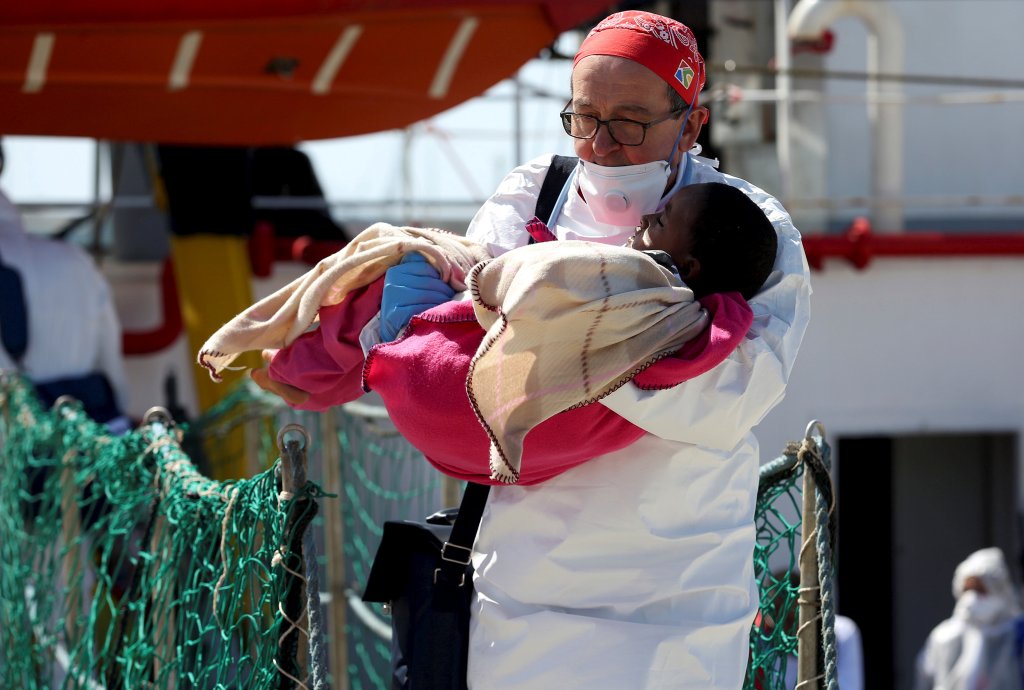
Warning from rescue NGO
The announcement provoked a swift response from the German NGO Mission Lifeline, whose small rescue boat the Rise Above is currently in the Mediterranean.
On Friday (December 16), the Rise Above picked up 63 people in distress at sea and immediately transferred them to a larger humanitarian boat, the Sea-Eye 4, which was nearby. On the following day the Rise Above rescued another group of 27 people – all of Syrian origin -- from a rubber dinghy. It immediately requested a port of safety and was quickly granted authorization to disembark all 27 in the Calabrian port of Gioia Tauro.
But the authorization, which had come as a pleasant surprise, especially in light of the normally long delays in being allowed entry into a port, turned out to be an ominous sign of what was to come.
As is now clear, under the new rules the actions of Rise Above in transferring rescued migrants to Sea-Eye would put the NGO at risk of sanctions. In the future, it will have no choice but to return to port after each rescue, costing it valuable resources.
"The interruption of our missions after every minor rescue and the immediate return to shore will also inevitably result in significantly higher fuel costs and a lot of time lost," warned Mission Lifeline’s Hermine Poschmann.
According to the NGO, the draft decree also fits with an action plan recently presented by the European Union, the aim of which it claimed is to impede civilian rescue at sea.
Axel Steier, a board member at Mission Lifeline, added: "There is a risk that the obligation to comply with the International Law of the Sea will be completely undermined."