
The EU has opened a 400-bed hospital on the Turkish border with Syria. The initiative is one of the largest EU funding projects in Turkey, which has received more than €10 billion in funds since 2014 for its hosting of several million refugees.
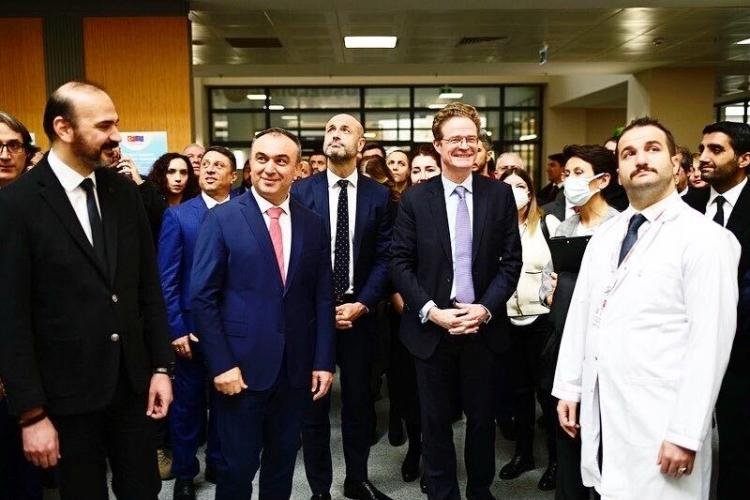
"Turkey has been hosting the biggest refugee population in the world for more than 10 years," explained Nikolaus Meyer-Landrut, the EU’s ambassador to Turkey, who helped to unveil the 400-bed hospital in Kilis, about five kilometers from the Syrian border, on November 6.
The hospital was constructed with European Union funding and will be managed by the Council of Europe Development Bank CEB, stated a press release from the EU. It is designed serve the entire province whose population has doubled since 2011 with the influx of refugees from Syria.
"The hospital can serve more than 3 thousand people at the same time with its 24 operation units equipped with modern health equipment, advanced technology imaging systems, 24/7 emergency services, service units in 19 areas and structured intensive-care units," explained the EU delegation to Turkey.
Unstable region
The region, because of its proximity to Syria, is notoriously unstable and according to the French news agency Agence France Presse (AFP) the hospital was unveiled during "a lull in exchanges of artillery fire."
Since mid-November, there has been a military escalation between Turkish government forces and Kurdish troops, who had previously been working with the Americans against IS and other Islamic forces in Syria.
A bomb blast in Istanbul, which was blamed on the outlawed PKK [Kurdistan Worker Party] provided the reason for the Turkish government to step up their activity in the area. The PKK denied involvement in the blast.
Turkish President Recep Tayep Erdogan has been threatening a ground invasion in Syria for weeks, although it hasn’t yet materialized.
Region's largest and most modern hospital
The hospital is reported to be the region’s largest and most modern hospital, and is reported to have cost €50 million, one of the largest funded by the EU.
The funding comes under the ongoing EU-Turkey deal, which was signed in 2016. Since 2014, the EU has paid more than €10 billion to Turkey to help support refugees, mostly fleeing the war in Syria, on its territory, reports AFP.
A second hospital, according to the EU delegation to Turkey, is also being funded by the EU in Turkey. This second hospital is in Dörtyol-Hatay, costs €40 million and has a 250 bed capacity. The EU, through various bilateral programs, is also funding further health projects throughout the most affected regions in Turkey.
According to the EU delegation to Turkey, there are currently four migrant health centers in Kilis, with a total of 122 personnel working there, including doctors, nurses, psychologists and social workers.
More than four million refugees in Turkey
It is estimated that Turkey now hosts more than four million migrants and refugees -- about 3.6 million of them are from Syria.
At the unveiling ceremony, Meyer-Landrut praised the deal and said that EU funding of Turkey was in both the EU’s and Turkey’s interests. He claimed that the funding had cut the numbers of migrants and refugees reaching EU borders "dramatically."
Meyer-Landrut said that he believed a "political solution" was needed for the entire Syria conflict. He expressed the wish that migrants and refugees would be allowed to return home once things have stabilized in Syria.
In recent months, Turkey, as well as Lebanon, have made frequent announcements of programs to return Syrians back to their homeland, some have already taken up the offer, while others feel forced to leave the relative safety of their host countries to return to a country still partially torn apart by war.
With AFP