
Following two stints of church asylum and over three years of uncertainty, a blind Syrian asylum seeker has been awarded refugee status and can therefore remain in Germany. The 27-year-old no longer has to live in fear of getting deported to Spain.
"On exactly this day last year, I was very scared, but this year there's a lot of peace and joy in my heart."
After receiving the news that his asylum request was approved three and a half years after he first had lodged it, Syrian asylum seeker Mheddin Saho shared the good news on Facebook this week in German along with a photo of a letter confirming his refugee status.
The letter, dated June 24 and signed by Bavaria's Interior Minister Joachim Hermmann, says that the "national asylum process is completed with a positive result for Mr. Saho."
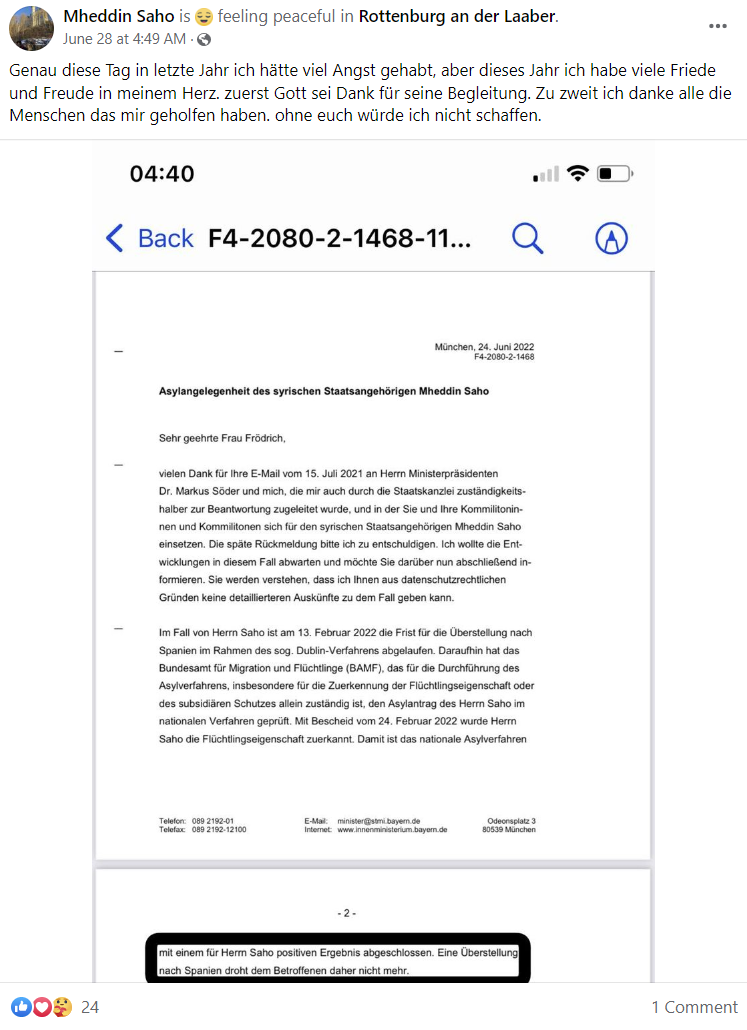
"I'd like to thank all those who helped me. I couldn't have done it without you," the 27-year-old wrote on Facebook. Among his supporters are a group of students and professors of the Ludwig Maximilian University of Munich, where Saho is pursuing a Master's Degree in English Studies and developing a program to help blind and vision-impaired people learn and teach foreign languages.
Also read: Ruling in church asylum case creates legal precedent in Germany
A narrow escape
Saho's journey to Europe took several stages: he first arrived in Spain on a student exchange from Turkey in 2019, where he had received top grades in English Studies at the prestigious Middle Eastern Technical University in Ankara. From there, he made his way to Germany.
In Germany, the story of 'the blind Syrian' made national headlines: Saho came very close to being sent back in July 2019 when he actually was put onto a plane going to Barcelona. As he took his seat in the aircraft, he suffered a panic attack and was allowed to deboard, he confirmed to InfoMigrants earlier this year.
According to news agency epd, his supporters argued that deporting him to Spain, where he had first entered the European Union, amounted to "undue hardship."
After a lawsuit against the deportation order failed at an administrative court in Bavaria, he sought refuge at a church -- twice. Finally, in February, during Saho's second church asylum period, the deadline for deporting him under Dublin rules expired, meaning that the responsibility for processing his asylum application defaulted to Germany.
Germany's Federal Office for Migration and Refugees (BAMF) thereupon assessed his asylum application and finally approved it, according to epd.
In addition to his university and the protestant (Lutheran) church, Saho also enjoyed the support of the church asylum advocacy charity Matteo. The Syrian national now lives with his host family in Lower Bavaria.
with epd