
As countries like Italy, Greece and Malta are increasing their border security along the Mediterranean, Spain is taking a different approach to migration. A German study explains why.
Spain's approach to migration could serve as a model for the entire EU, says Germany's Social Democrat-affiliated Friedrich-Ebert-Stiftung (FES) foundation for political education. In a recently published study, FES examined Spain's history of immigration and its response to various trends over the years, looking closely mainly at the last two decades.
The document also points out aspects in which Spain's history of immigration may differ from other EU states, making future developments somewhat more difficult to predict.
An unlikely destination for migrants
The FES study points out that unlike other northern and western EU-countries, Spain only witnessed high levels of immigration by the mid-1990s, making Spain a relatively new destination for immigration. For many years, especially under the dictatorship under General Francisco Franco, there was actually a negative sum of immigration measured in Spain, meaning that more people left the country than people immigrating there.
The document says that the reason for this late development was mainly the economic boom that Spain started witnessing from the mid-1990s onwards. Many unskilled migrants entered the work force, finding employment in the growing construction industry at the time. Nearly half of all jobs in construction went to immigrants between 1995 and 2005. Many immigrants also found employment in the tourism industry and housekeeping.
By the mid-2000s, immigration to Spain had peaked at numbers that were eight times higher than the rate of immigration measured in neighboring France. However, with the onset of the financial crisis in 2007, the FES study explains, many of those opportunities fell apart, leaving second-generation immigrants now having to face challenges that their parents' generation largely didn't have to deal with.
With nationwide youth unemployment peaking at 50 percent just a few years ago, the issue of economic uncertainty poses challenges that Spain will likely still have to address for years to come.
Not-so-diverse diversity
Another factor that sets Spain's immigration landscape apart is the fact that large parts of immigrants coming to Spain originated from other Spanish-speaking countries in Latin America, making their cultural integration easier. With no linguistic barriers, many of those immigrants found easy access to the local job market in Spain, where many temporary jobs lack any sort of regulatory oversight.
There are also many immigrants from within the EU, who have chosen to start new lives in Spain. While some of them are retirees from wealthier EU states like the UK, there were also many immigrants from Romania in particular, which shares the same language family with the Spanish language.
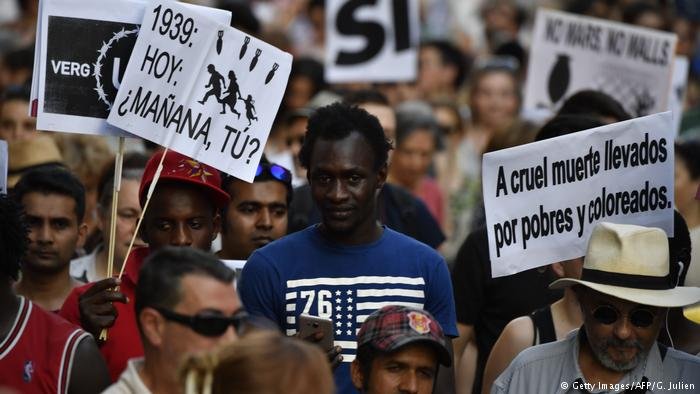
In fact, immigration from Africa and Asia remains low; only about 15 percent of immigrants to Spain come from neighboring Morocco, making Moroccan immigrants in fact the smallest group of migrants in Spain. Their arrivals, however, are increasing, and with that come new challenges that need to be met: The FES paper stresses that with growing migrant arrivals on Spanish soil and with repeated border breaches along the Spanish-Moroccan border at the North African Spanish enclaves on Ceuta and Melilla, there could be future conflict in store for Spain.
Controversial policies to curb migration
With growing numbers of migrants from Africa trying to reach Europe and using the Spanish border with Morocco as one of their routes, the Spanish government has also had to change its approach to its border control: instead of continually fortifying its border, the government in recent years has quintupled its foreign aid spending to eleven countries in northern and western Africa in a bid to try to curb migration where it happens. The majority of those funds have gone to beefing up police and military services in those nations.
Spain has also teamed up with Moroccan security forces as well as Frontex to patrol the border fence together and return any migrants intercepted along the border back to Morocco immediately – a model praised by Spain's interior minister as a potential export to the rest of Europe.

However, the practice has also attracted some criticism, as it doesn't allow migrants to lodge an asylum application when they enter Spanish territory; under EU law, even illegal migrants have a right to launch asylum processes as soon as they reach EU territory.
In addition to manning and managing the land border with Morocco, Spain also has to address the influx of arrivals by sea; since 2006, roughly 35,000 refugees and migrants have managed to make their way to Spain on boats and dinghies. Under the EU's Resettlement Scheme, Spain is supposed to take in 18,000 asylum seekers from other parts of Europe each year, making immigration an increasingly important issue.
No significant populist response
Despite having experienced such a spike in immigration, the FES study says that Spain is one of the few EU nations that does not have a noteworthy right-wing populist movement, attributing this phenomenon to the successful integration of foreigners coming to Spain.
It also highlights that the worst Islamist attack on European soil to date, the 2004 Madrid train bombings, also occurred in Spain – while stressing that despite this traumatic national experience, there was no significant formation of right-wing extremist groups in response to the attacks.
And with the main organizers behind the August 2017 Barcelona attacks being second-generation immigrants from Morocco, Spain may still have to address a series security issues - not just with regard to its immigration policy.
Meanwhile, the city hall in Madrid continues to show a massive banner that summarizes the majority of Spain's experience with immigration thus far, saying "Refugees welcome."