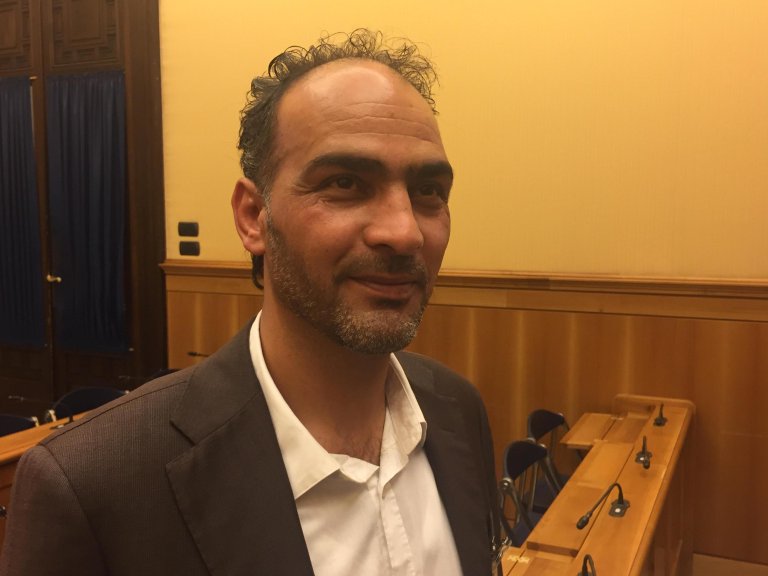
Abu Rabiah fled Homs and the war with his family. He had a difficult life at a refugee camp in Lebanon and arrived in Italy thanks to humanitarian corridors. He is now an activist for peace.
''It was wonderful to live in Syria'', Abu Rabiah says. ''I was the head of a group of construction workers. We built homes, I had a car, a motorcycle, and a large piece of land. I worked together with my four brothers''. All this happened before the war, before he fled to Lebanon to survive and before his new life in Italy. Abu Rabiah Satouf comes from Homs, Syria. He arrived in Italy in February 2016 and now lives in Trento. ''We were scared in Syria'', he told ANSA.
''We couldn't talk about politics, it was dangerous. The government doesn't want others to be in power, it does not want freedom. When our youths asked for freedom for the people, the response was armed repression and death''.Abu Rabiah's family didn't want to be enrolled in the army to kill nor to be killed by bombs. ''We don't like war, we want peace and we were scared for our children, so we fled to Lebanon''.
A difficult life in Lebanon
The trip from Syria to Lebanon wasn't long although it was very dangerous. ''There were lots of checkpoints, they killed people.'' Abu Rabiah and his family found shelter at a refugee camp in Tel Abbas, a few kilometers from the Syrian border. ''I was there for three years," he added. The camp in Tel Abbas was informal but ''we built there a small school because Syrian children don't attend Lebanese schools, many families don't have documents or permits. This also means that you can't have a job nor money to live''. Thanks to this project, children could learn to read and write in Arabic, English and French.
Arrival in Italy
Since April 2014, refugees have benefited from the support of volunteers working for ''Operazione Colomba'', a peace corps of the Pope John XXIII Community, who live with refugees at the camp. The organization provides support to refugees for their immediate needs and tells organizations organizing humanitarian corridors who is most in need. Thanks to this job, Abu Rabiah, his wife, their four children, his mother and brothers were able to reach Italy. ''I arrived here thanks to humanitarian corridors''. Abu Rabiah was part of the first group who reached Italy together with 30 other people from the refugee camp. ''It's great here because children can go to school. It's important for them because they never went in Lebanon''. Today, his priority is ''working for peace in Syria because I want to go back to my homeland'', he explained. ''Meanwhile I am looking for a job, I am learning Italian to make the voice of Syrians heard here too''.