
Senegal might be Africa's fourth largest economy but it's also experiencing political and economic instability, which has led to an increase in emigration. As part of a series of measures, the EU has announced a 30 million euros funding package to help it combat migration.
The European Union announced a 30 million euros package to manage migration from Senegal, news agency Agence France Presse reported on Wednesday (16 October).
Jutta Urpilainen, European Commissioner for International Partnerships, made the announcement and also told journalists in the Senegalese capital Dakar that the funds will go mainly to bolstering Senegal’s capacity to curb migrant smuggling and human trafficking in addition to raising awareness about the dangers posed by using sea routes to enter Europe.
A shipwreck off Senegal's coast in September killed at least 39 people, prompting President Bassirou Diomaye Faye to pledge to "relentlessly" crackdown on migrant traffickers.
Most of the passengers who perished are believed to be from Mbour, a coastal city approximately 80 kilometers (50 miles) south of Dakar. Grieving families have reported losing multiple loved ones in the tragedy.
Read AlsoSenegal vows to tackle sea migration after latest incident at sea
From country of destination to country of emigration
In Mbour, migration is seen more as an escape than a risk. Residents might be aware of the dangers of routes across the Atlantic Ocean, but they are also bombarded by smugglers who promise opportunity and photos of those who have successfully crossed. Many, especially young people, continue to set sail for Europe.
Often, these journeys end in tragedy, tragic shipwrecks that leave many dead or missing. Even those who succeed in entering Europe can face asylum rejections, homelessness and years of struggle.
Data collected from the United Nations High Commission for Refugees (UNHCR) indicate that 10,580 people left Senegal in 2023 and applied for asylum in other countries. The most common destination countries for international protection in Europe are Spain and Italy. About 82 percent of the asylum applications filed by Senegalese nationals were rejected.
As the fourth largest economy in Africa, migration think tanks such as the International Labor Organization (ILO) classified Senegal as a country of destination for many other African nationals seeking better economic opportunities. However, from holding a position of stability in a volatile region, Senegal is now seeing an increase in emigration because of its worsening political and economic conditions.
Data from the German-based statistics portal Statista indicate that Senegal’s 2023 youth unemployment rate or the share of the population between the ages of 15-24 looking for work, remained unchanged at 4.3 percent, indicating that job prospects for this age group are not improving.
In addition, the underdevelopment of the agricultural sector is seen as crippling poverty reduction efforts with almost 75 percent of people living in rural areas being dependent on agriculture as a source of livelihood.
The lack of employment opportunities at home has compelled many Senegalese nationals to make their way to Europe. Previously, the oil industries in Libya and Mauritania made the two countries popular destinations for economic migrants.
Read AlsoSenegal: Where disenchantment and disillusion breed migration
Senegal: A jumping off point for Europe
Senegal, located on the western coast of Africa, is a main jumping off point for thousands of people attempting to enter Europe via the Spanish Canary Islands, which is about 1,500 and 2,100 kilometers (up to 1,300 miles) away.
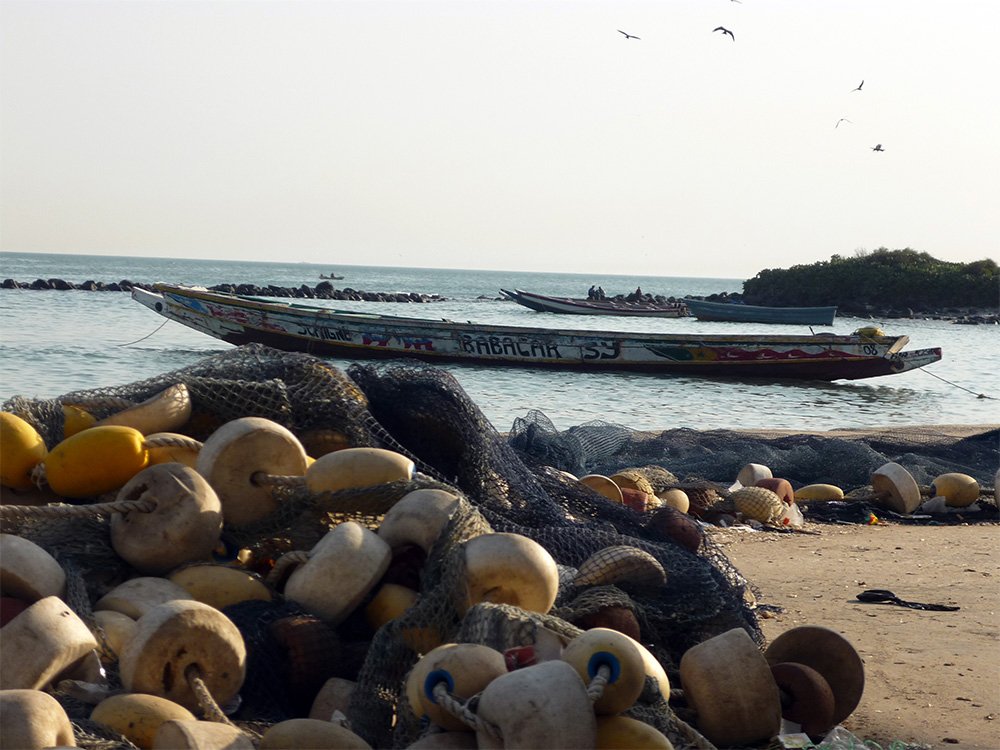
People often embark on treacherous journeys in artisanal canoes called pirogues that are no match for the rough Atlantic currents. Lacking navigation gear, many boats vanish, with others having drifted as far as Brazil's coast, leaving countless dead or missing.
The United Nations migration agency (IOM) has cited the Atlantic route connecting West Africa with the Spanish Canary Islands as a route fast becoming the deadliest migrant journey in the world. The IOM recorded the death or disappearance of 959 people traversing the West Africa Atlantic route last year. In the first nine and a half months of 2024, that figure has already reached 839.
The Spanish human rights organization Caminando Fronteras has estimated the numbers of deaths far higher. They believe that on all routes towards Spain, the numbers of those who died in the first five months of 2024 could number as many as 5,054.
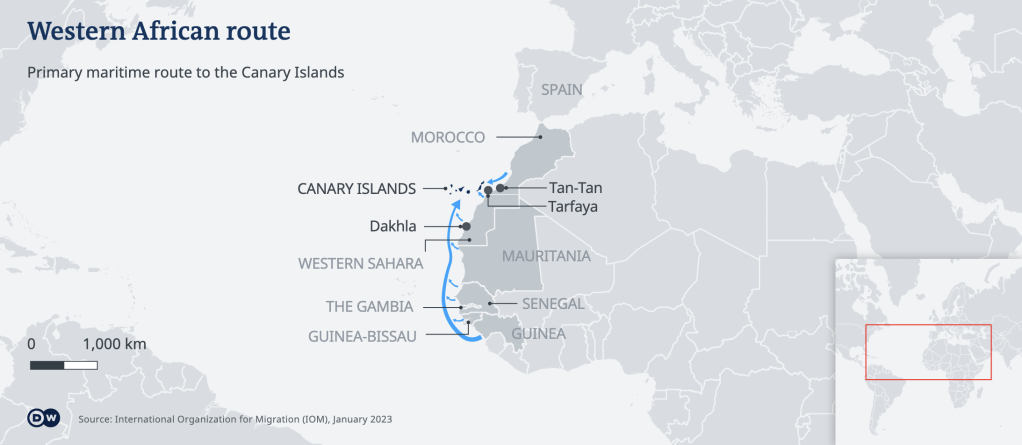
Earlier this week, the BBC reported that Fernando Clavijo, President of the Canary Islands, said that a person dies roughly every 45 minutes attempting the perilous journey to the Spanish archipelago off the northwest coast of mainland Africa.
The EU provided an estimated 222 million euros in grants to support multi-sectoral development in Senegal between 2021 and 2024. This funding is part of a broader partnership which also includes Senegal in several regional EU programs.