
The number of migrant deaths around Spanish territory continues to rise. Two further instances of mass fatalities occurred in the Western Mediterranean over the weekend. The Spanish government has launched an appeal to the EU to speed up new rules on migration but is facing an uphill battle against far-right member states.
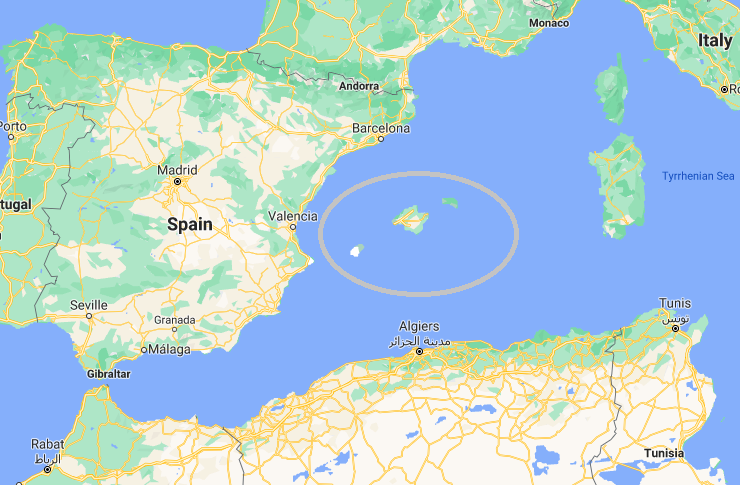
At least 11 migrants are believed to have died in a boat accident near the Spanish tourist island of Mallorca on Friday evening. Local media said that French sailors had spotted the migrant boat in distress, alerting Spanish authorities to the site.
According to local authorities, only three occupants of the boat could be rescued alive by the Spanish maritime rescue service, and were taken to a hospital in the capital of the island, Palma, by helicopter.
According to initial accounts given by the three survivors to the police, the boat had reportedly set off from the Algerian coast with 14 people on board around three weeks ago, reported the German press agency dpa.
The three survivors — two 15-year-olds and a 21-year-old — told authorities that 11 fellow passengers had drowned when the boat capsized between the nearby Balearic Island of Menorca island and the Italian island of Sardinia.
The search for the bodies has so far not been able to yield any results, especially since the area in question between the two islands spans a distance of roughly 450 kilometers.
Three more deaths close to mainland Spain
In an unrelated incident, three migrants were found dead on a dinghy off the coast of southern Spain, the Spanish coastguard announced on Sunday (October 13).
A total of 29 migrants of North African descent, however, could be rescued, according to a Maritime Rescue spokesman, who spoke to the AFP news agency.
The migrant boat was found floating off the coast of the city of Almeria in the south of Spain's Andalusia province. Both the survivors and the bodies of the deceased were immediately moved to Almeria, authorities added.
Read AlsoBalearic Islands and Canaries: Ongoing migrant arrivals further strain reception capacities
Weeks of deaths at sea
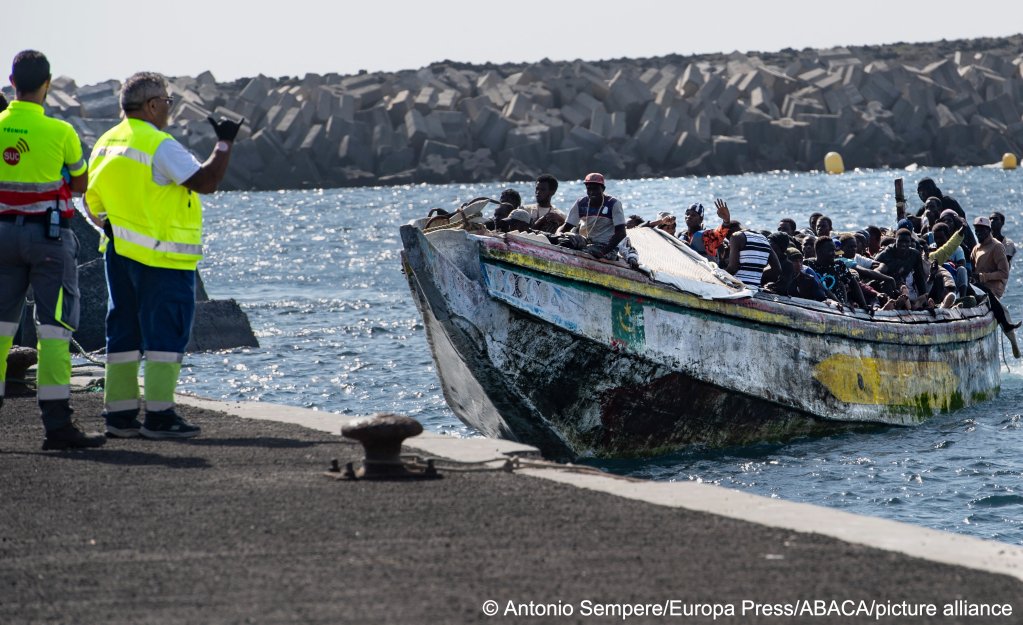
These tragic events come just weeks after a shipwreck in Spanish waters is presumed to have left more than 50 missing, presumed dead.
That accident took place off the Spanish archipelago the Canary Islands in the Atlantic Ocean — the main gateway to Spain for tens of thousands of irregular migrants each year. About three quarters of all migrant arrivals to Spain take place in and around the Canary Islands.
The event marks the heaviest death toll off the Canary Islands in three decades of migration from Africa, amid growing concerns about the country's ability to handle irregular arrivals.
Read AlsoSpain: Prime Minister Sanchez in Canary Islands as migrant reception crisis worsens
Sobering numbers
According to the NGO Caminando Fronteras, more than 5,000 migrants are believed to have died trying to reach Spain by sea in the first five months of this year alone.
The NGO bases this estimate on survivors' testimonies, stressing that most shipwrecks go unnoticed and unreported. If the numbers put forward by Caminando Fronteras are correct, this could hint at a mortality rate of 20 - 25 percent of all departures towards Spain.
Since the beginning of the year, over 40,000 have so far managed to make their way to Spain, according to information from the Ministry of the Interior; if this rate of arrivals continues until the end of the year, the number of irregular arrivals will likely be double that of last year, surpassing the mark of 50,000 for all of 2024.
Read AlsoSpain's deputy PM calls for 'regularizing 500,000 migrants'
Spanish PM wants to move deadline for EU pact forward
With such rising arrival numbers, the Spanish government is scrambling to find a solution to better manage migration.
Bilateral agreements with some of the main countries of departure intended to prevent migrants setting off in the first place have so far yielded little results.
The numbers of unaccompanied minors arriving in the Canary Islands has also caused difficulties for the regional government there. Authorities on the Canary Islands have repeatedly told Spain's Madrid government they feel overwhelmed and don't have enough accommodation places to look after all the youths arriving. There are around 5,500 migrant minors now in its care — far above its maximum capacity of 2,000.
Read AlsoSpain: Canary Islands protocol 'violates migrants' rights'
Against this backdrop of slow progress in saving lives, Spanish Prime Minister Pedro Sanchez has called for the EU to step in and help. In addition to requesting help from the EU border agency Frontex, Sanchez also expressed that he wished to bring forward the introduction of new rules on handling irregular arrivals.
Last week, he said that he would like the new EU pact on migration to be functional by the summer of 2025 — one year ahead of schedule.

Read AlsoSpain asks Frontex to patrol African waters to curb migration
Rising anti-migrant sentiment
However, other EU governments meanwhile are trying to backtrack on the deal and other EU solidarity mechanisms on migration. The far-right governments of Hungary and the Netherlands announced recently that they were seeking an opt-out from the bloc's asylum rules.
The new right-wing government of Austria is also likely to block any further progress on related issues.
The divisive asylum and migration pact is built on a set of rules designed to share the hosting responsibilities of irregular migrants across the 27 countries that make up the EU, while also speeding up deportations of those deemed ineligible to stay.
But regardless of the timeline set for the application of the pact, public opinion in Spain is already turning sharply against migrants; a poll published in the daily newspaper El Pais last week found that 57 percent of Spaniards now believe that there are too many immigrants in Spain.
Read AlsoCanary Islands: EU to allocate funds to support hosting of migrants
with dpa, AFP