
Morocco has said it will take back its own nationals who are found to have migrated irregularly into Europe and have been issued with an expulsion order.
The Moroccan foreign minister, Nasser Bourita, said his country was "ready to repatriate any irregular migrant who is certified to be Moroccan and who left from Moroccan territory," reported the French news agency AFP.
The announcement comes after French MPs called for a tougher policy on Moroccan migrants, following the arrest of a Moroccan undocumented person in September on suspicion of murder.
Despite having already been issued with a deportation order in relation to a previous conviction of rape, the man had not been removed. Moroccan authorities were blamed for failing to issue the correct "laissez-passer" (a kind of emergency passport to return someone to their country and bypass normal border controls).
Later, Moroccan authorities said that the request had not been correctly issued.
'Morocco is ready, but is the other party also ready?'
Glossing over these accusations, Bourita said Morocco had been ready, and questioned whether "the other party is [also] ready" to conduct returns. The minister added that he did not believe his country needed "to receive any lessons" regarding migration management.
The Moroccan suspect in question was arrested in Switzerland on September 25, four days after the body of a 19-year-old female student was discovered in woods in western Paris. The suspect’s previous conviction for rape dates back to 2019.
After a pause to form a government following elections in early summer, France now has a right-wing interior minister, Bruno Retailleau, who has vowed to implement stricter migration regulations in order to "protect the French," and clamp down on migration.
According to a study carried out by a an independent Moroccan journalism platform ENASS (Media for those without a voice – Le média des sans voix au Maroc) in 2021, over 41,000 migrants left Morocco for European countries like Spain. Some later migrated towards France because of the shared language and familial connections and networks.
Read AlsoCeuta: Moroccan security forces stop 'hundreds' entering Spanish enclave
Only Moroccan nationals accepted for returns
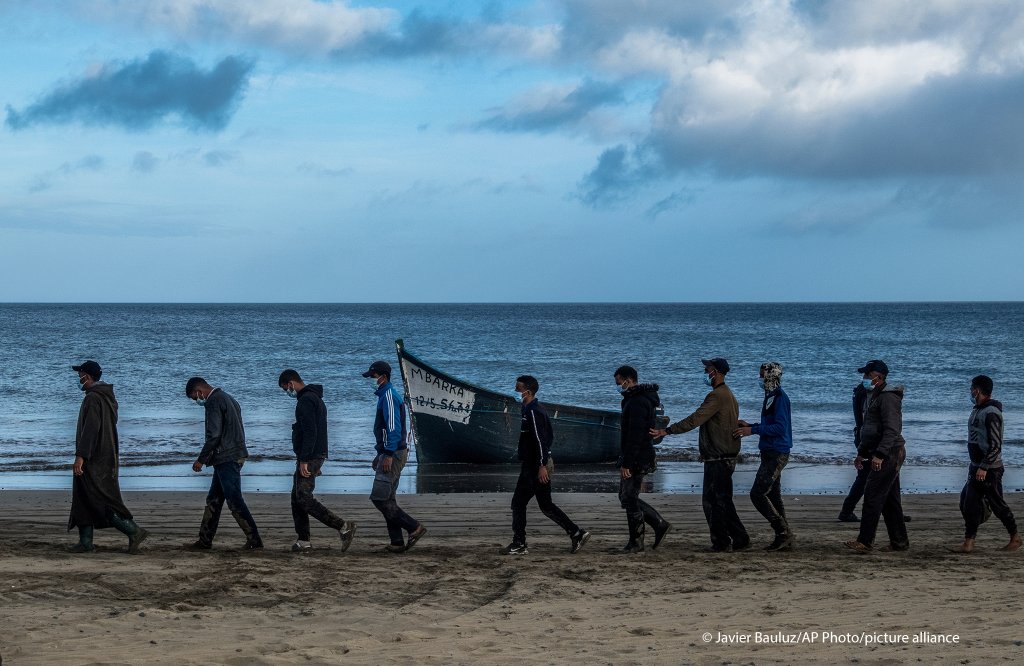
About half of those who left Morocco in 2021 were Moroccan nationals. The other half came mostly from French-speaking African countries such as Algeria, Mali, Guinea and Ivory Coast. Some who leave Morocco cross the Mediterranean directly towards Spain, or attempt to enter the Spanish enclaves on the African continent, Ceuta and Melilla, but many more set off across the Atlantic towards the Canary Islands.
When the European Pact on Migration and Asylum was finally agreed earlier this year, Europe stepped up its discussions with Morocco over repatriating migrants who had received a notice to quit countries in Europe.
The Moroccan authorities have held firm on not wanting to accept migrants from third countries, mostly sub-Saharan African countries, who may have used their territory as a jumping off point for Europe.
In May, Medhi Alioua, a professor of sociology at the International University of Rabat, told the French news portal TRT Francais that Morocco would refuse to have European rules imposed upon it, and especially not when it came to "accepting the return of non-Moroccans, just on the pretext that they had transited through Morocco."
'A question of dignity'
Alioua added that, although Morocco had signed several agreements directly with Spain and was cooperating on the question of migration management, it was hesitating on a blanket deal with the whole of the EU. "That would be unbalanced," he said.
Another Moroccan commentator, lawyer Mustapha Sehimi, described Morocco's signing readmission agreements with Europe as "a question of dignity," reported TRT Francais.
Alioua said that even before this latest announcement, Morocco was already readmitting around 20,000 of its nationals from the EU every year.
In return for accepting a more wide-reaching readmission agreement, Morocco would hope to gain political advantages such as recognition of its sovereignty over Western Sahara and concessions on fishing and agriculture, he added.
Cooperation on migration between the EU and Morocco began in 2004 and was stepped up in 2013 with the signing of a mobility partnership.
Read AlsoMoroccan Navy intercepts boat bound for Canary Islands amid increased migration control efforts
EU-Moroccan migration agreements
Between 2014 and 2022, the EU provided Morocco with a total of more than 2.1 billion euros in funding. Much of it went towards 'migration support' according to the EU.
All the funding pots are difficult to quantify, since Morocco receives funding from Europe in various forms, including via the EU Emergency Trust Fund for Africa (EUTF), neighborhood development funds, and international cooperation instruments, as well as the Asylum, Migration and Integration Fund.
Some of these funds are expected to go straight to strengthening border controls and patrols, while others are targeted at supporting labor migration, training and development within Morocco.

The EUTF is the main tool to support Morocco in the area of migration, according to the EU.
Between 2015 and 2021, 234 million euros was committed through this fund via bilateral and regional contracts. This money helped fight against smuggling and trafficking, provided "community stabilization" and assisted voluntary returns. The current EUTF package is expected to run until December 2025.
The EU said the funds have provided a series of tangible results, including – as of February 2023 – more than 2,900 people who had been assisted to return voluntarily to their country from these funds, and just over 30,000 people who had been given information on their rights, including healthcare, child protection and protection for women.
Over 22,000 people were offered "improved access to basic social benefits," according to the EU, while a further 1,785 staff were also trained in migration governance, conflict prevention and human rights.