
A group of about 40 migrants were reportedly expelled from Tunisia's coastal city of Sfax and abandoned near the country's border with Algeria. Rights groups are reporting rising numbers of such forced displacements from Tunisia and its neighbors.
The group of people was reported to include children as well as pregnant women, according to the Tunisian Forum for Economic and Social Rights (FTDES).
The spokesman of the rights group, Romdhane Ben Amor, said that they were left with "no water or anything to eat … in a very isolated area."
"We have been following up with them for three days, but this morning we lost contact with them," he added.
Right groups have reported a rising number of such forced displacements from Tunisia and its neighbors.

Also read: Sub-Saharan migrants abandoned in the Tunisian desert: "We are going to die of thirst, help us"
The group "Refugees in Libya" posted a series of videos allegedly showing the group of people stranded in an arid-looking area, with the organization asking for "immediate medical assistance." However, the veracity of the video has not been independently verified.
In the video, some of the people seen are heard claiming that they are asylum seekers.
Deserted in the desert
Tunisia, alongside neighboring Libya, is a key departure point for irregular migrants and refugees trying to reach Europe by crossing the Mediterranean Sea, where hundreds of people drown while trying each year.
Many migrants end up spending prolonged periods of time in Tunisia – either because they get turned back during repeated attempts to cross the sea by coast guard vessels or because they run out of funds to finance their remaining journey.
According to FTDES, more than half of the migrants and refugees stuck in Tunisia have to live in "unsuitable conditions;" most of them come from sub-Saharan Africa.
Also read: Italian NGO claims it has 'video proof' of migrant deportations in desert
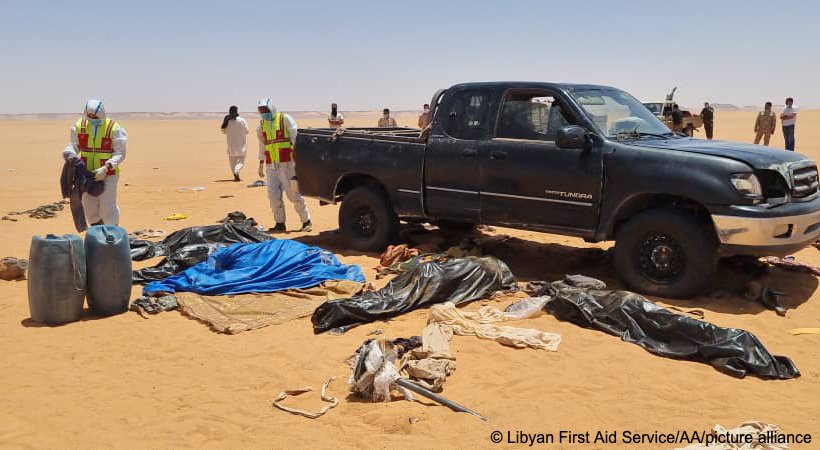
Amid growing anti-migrant sentiment in the country, Tunisian authorities are increasingly deporting people from urban centers back to the desert areas from where they are presumed to have entered the country irregularly.
President Kais Saied alleged in a speech last year that "hordes of illegal migrants" posed a demographic threat to the country, echoing far-right sentiments like the so-called "Great Replacement" theory, which has repeatedly been debunked.
According to some accounts, the migrants are left to die in the absence of any infrastructure in these areas.
Tunisia is a key partner of the EU to curb migration into the bloc. However, it faces criticism for being complicit in migrants being mistreated in the country after signing a 1 billion euro deal in July 2023 despite human rights concerns.
Also read: Why is the Tunisian president going after sub-Saharan migrants?
More expulsions into desert
But this practice is not unique to Tunisia. Other countries in the region, chiefly Libya and Algeria, are also accused of resorting to similar methods.
According to a UN report published in July, twice as many people are alleged to die in the North African desert than those who are known to drown at sea during their attempts to reach Europe.
"Everyone that has crossed the Sahara can tell you of people they know who died in the desert," said UNHCR special envoy Vincent Cochetel on the occasion of the publication of the report, which is titled "On this journey, no-one cares if you live or die."
The exact number of people who suffer this fate is not known. However, the AFP news agency says that according to information it had ascertained through local rights groups, at least 5,500 migrants had been expelled towards Libya and more than 3,000 towards Algeria between June and September of 2023.
At least a hundred were known to have died at the Libyan border, according to the same information.
With AFP
Also read: Algerian desert: The 'point zero' where migrants are abandoned