
On Thursday, the crew of the Humanity 1 rescued 60 migrants in the Mediterranean. The crew of the ship Life Support disembarked 41 migrants in Naples. And on Friday, the Kurdish authorities arranged the return of the bodies of 40 Kurdish migrants who had died in a shipwreck from Italy.
On Thursday (August 1), 60 migrants were rescued from an overcrowded wooden boat in the Mediterranean by the crew of the Humanity 1, a rescue ship operated by the organization SOS Humanity.
According to a post on the social media platform X, the crew said that the 60 people were on board a fiberglass boat and were discovered in the early hours of Thursday morning. SOS Humanity said "survivors are weak, but they are in a stable state of health."
The crew of Humanity 1 was told to sail towards the Italian port of Civitavecchia, not far from the capital Rome. SOS Humanity underlined that the port was almost 1,000 kilometers (953.78 kilometers) away from the point of rescue.
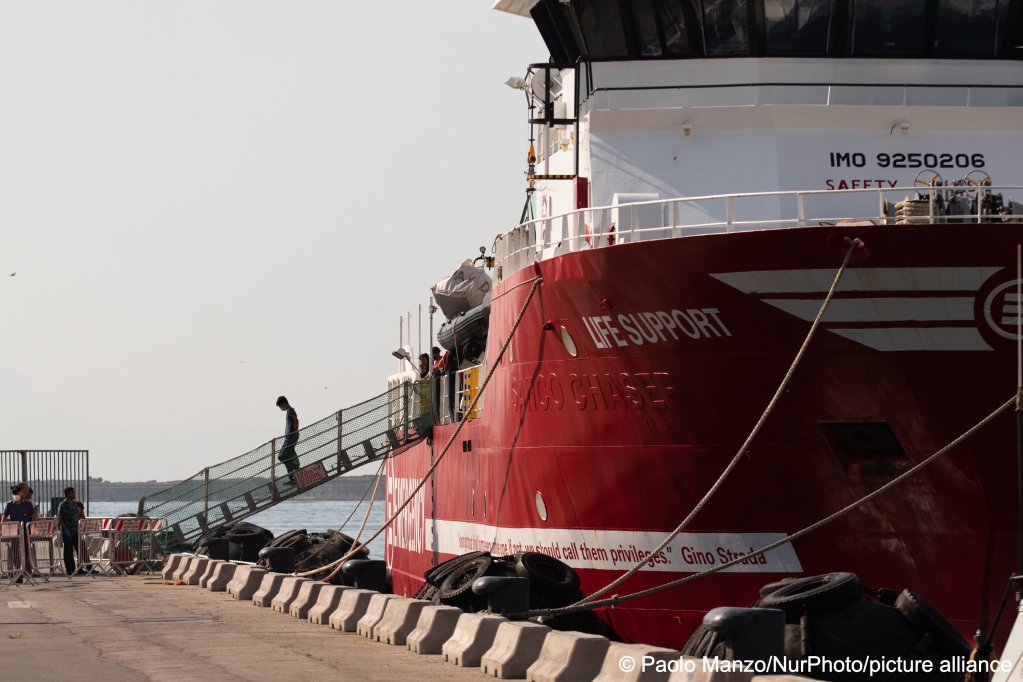
Also on Thursday, the crew of the ship Life Support, operated by the Italian medical humanitarian NGO Emergency, disembarked 41 migrants in the port of Naples.
Also read: Majority of migrants in Tunisia aiming for Italy, research suggests
More rescues by Ocean Viking crew
The crew of the Ocean Viking, operated by the organization SOS Mediterranee, said they had spotted a fiberglass boat on July 31 with 29 people on board in the Mediterranean. They said that the Italian coast guards had asked for assistance and once the 29 were on board the Ocean Viking, they were transferred to an Italian coast guard vessel. The migrants on board this ship had been at sea for two days, according to SOS Mediterranee, and were "almost out of fuel and without food and water."
One day before, on July 30, the crew of the Ocean Viking came to the rescue of two separate overcrowded boats in the Libyan search and rescue region. They took 196 people on board, including nine unaccompanied minors. They have been assigned the port of Ancona for disembarkation, which is, according to SOS Mediterranee 1,497 kilometers away from the point of rescue.
According to Italian government data, more than 33,000 migrants have arrived on Italy's shores since the beginning of January this year. 442 arrived on July 31, 301 arrived on August 1, and 115 so far on the morning of August 2, the last available update.
Also read: Tripoli seeks to present itself as a migration hub
Return to Kurdistan
Also on Thursday (August 1), the Kurdish region Prime Minister Masrour Barzani, issued an order to the Kurdistan Regional Government (KRG) representation in Italy, to begin a transfer of 40 bodies of Kurdish migrants who died in a shipwreck on their way to Italy on June 17.
According to the Kurdish regional news portal Kurdistan24, the transfer is scheduled to take place on August 2. The Kurdish representation in Italy has been working alongside the Italian authorities to try and identify the victims of the shipwreck. So far at least 13 Kurdish nationals are confirmed to be among the deceased. Of those eight are from “Southern Kurdistan, Bashur (in Iraq) and five form Eastern Kurdistan (Rojhelat in Iran), reported Kurdistan24.
The KRG Foreign Relations Office told Kurdistan24 they had dispatched a dedicated team to Italy to help with the returns process.
A spokesperson for KRG, Peshawa Hawramani reportedly told Kurdistan24 that the KRG "is committed to ensuring the victims are brought back to their homeland with dignity."
Also read: Italy claims migration policy helping to prevent Mediterranean crossings
Note from the editors: Humanitarian rescue ships, when on mission, are only active in a limited area of the Mediterranean Sea, and only at arbitrary times. The presence of these NGO ships is no guarantee that individuals crossing the Mediterranean Sea on unseaworthy boats will be spotted and rescued. Distress cases are very common for boats unequipped to make a journey on the open sea, and shipwrecks and disappearances, including unrecorded ones, happen regularly. The Central Mediterranean remains one of the deadliest migration routes worldwide.