
Libya's interior minister has claimed the country is hosting over two million irregular migrants and refugees, calling for international cooperation to stop Libya from turning into a "country of settlement."
In a rare public statement, authorities in Libya have announced that the country cannot continue to harbor countless irregular migrants and refugees.
On Wednesday (July 10) Libya's official interior minister, Imad Trabelsi, made a statement claiming that there are approximately "2.5 million foreigners in Libya" at present, adding that "70 to 80 percent of them entered the country illegally."
It is unclear whether those numbers are based on official statistics, and to what extent they reflect reality, as the war-torn country has a population of under 7 million.
However, Libya is indeed one of the main departure points for migrants and refugees hoping to reach Europe by crossing the Mediterranean Sea, using irregular means of migration.
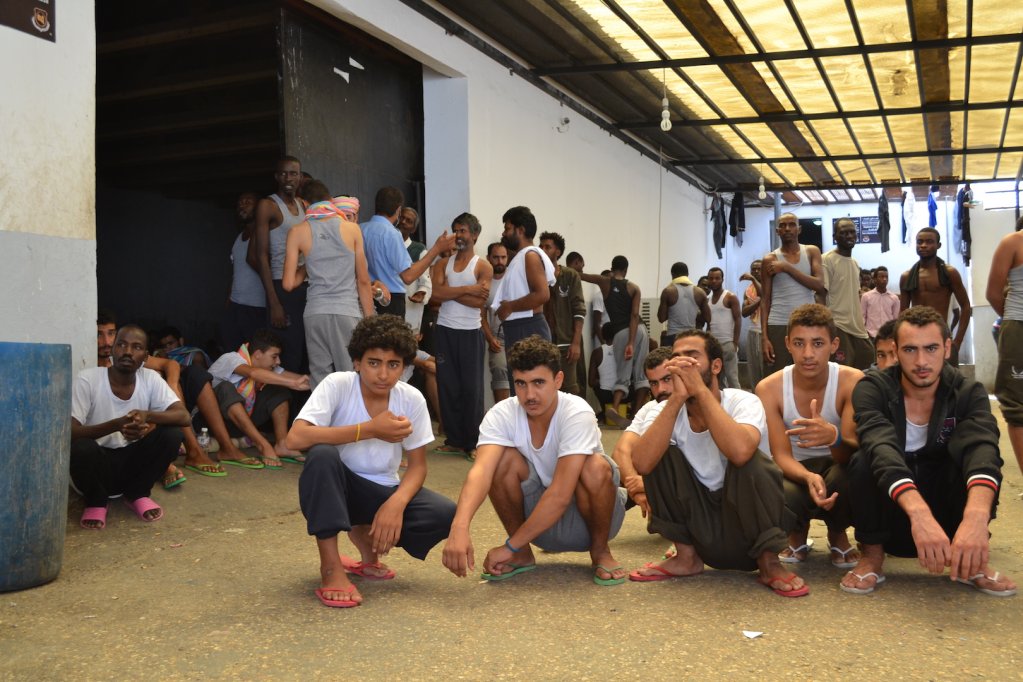
Many people get stranded in Libya, often because they run out of funds to finance their onward journey. This has also led to a skyrocketing growth in crime and illegal activities, of which migrants are often the victims -- reaching from extortion to forced sex work to slavery.
Also read: Videos of migrants being tortured in Libya published on social media
Migrants settling in Libya
Due to the increasing amount of people remaining stuck in the country, Trabelsi said Libya was turning from a "transit country to a country of settlement" for migrants, emphasizing that from the government's perspective, "(t)he resettlement of migrants in Libya is unacceptable."
However, rather than focusing on the price that migrants and refugees have to pay for being caught up in this dilemma, oftentimes ending up on the receiving end of the activities of criminal syndicates, the interior minister turned the issue into a matter of fiscal responsibility, highlighting that "undocumented migrants don't pay taxes."
He continued on a similar theme of ignoring the migrants' suffering, adding that "(t)he issue of immigration concerns our national security."
Also read: UN discovers mass grave of migrants along Libya-Tunisia border
Crime cartels abusing power vacuum
Meanwhile, the main problem of national security in Libya is the fact that there are two warring governments trying to assert control over what is the fourth-largest country by land mass in Africa.
Libya is still struggling to recover from the aftermath of the 2011 overthrow of longtime autocrat Muammar Gaddafi.
Years of chaos and political instability ensued, out of which two rival governments grew, with the internationally recognized one being seated in the capital, Tripoli, and the Government of National Stability (GNS), based in the city of Sirte.
This power vacuum has resulted in the country becoming a haven for smugglers and traffickers, making Libya the number one country of departure for migrants leaving from North Africa, being located about 300 kilometers south of Italy across the Mediterranean.
Libya to host migration conference
Meanwhile, the EU and various national governments in Europe have tried to strengthen Libya politically and financially as an ally in their attempt to stem irregular migration.
The government of Italy in particular has been reaching deals with the Tripoli-based government, exchanging large sums to keep migrants at bay.
Interior Minister Trabelsi, however, said that it was Libya that had to "continue to pay (the) price."
"It's time to resolve this problem," he added, not mentioning, however, that Libyan authorities and neighboring countries have proactively been abandoning migrants in the Sahara Desert, where they typically are left to die.
The minister also highlighted a UN repatriation scheme, which since the start of the year had already "repatriated 6,000 migrants," but failed to assess whether this rate of help was enough.
Next week, Libya will be hosting the Trans-Mediterranean Migration Forum, where leaders from Europe and Africa will come together to discuss current migration issues.
According to a statement from the Libyan government, the main goal of the even is to forge "a new strategy for development projects in the countries of departure."
Also read: Tens of thousands of migrant testimonies reveal dangers of land routes in Africa
with AFP