
On June 19, a luxury cruise ship rescued 68 migrants who were attempting to reach the Spanish Canary Islands in a fishing boat that had drifted in rough seas. Five people were found dead. A week later, the NGO Caminando Fronteras reported that the boat had originally carried around 150 people. This suggests that the death toll from this tragedy is closer to around 80.
On June 19, bulk carrier Philipp Oldendorff sighted a fishing boat adrift 440 nautical miles (815 km) south of the island of Tenerife and provided first assistance to the migrants, while the Insignia cruise ship was diverted to the area to pick up the survivors, the Spanish Coast Guard said in a statement.
The Insignia, owned by Miami-based Oceania Cruises, has a capacity of up to 670 passengers and has been on a 180-day world tour since January.
The crew rescued 68 people from sub-Saharan Africa, including three minors and three women. The crew also found five bodies. While three of the bodies were recovered by the Insignia crew, adverse weather conditions hindered the recovery of the remaining two bodies.
Crew members decided to leave the boat adrift, attaching a tracking device to facilitate a later retrieval by Spanish rescuers.
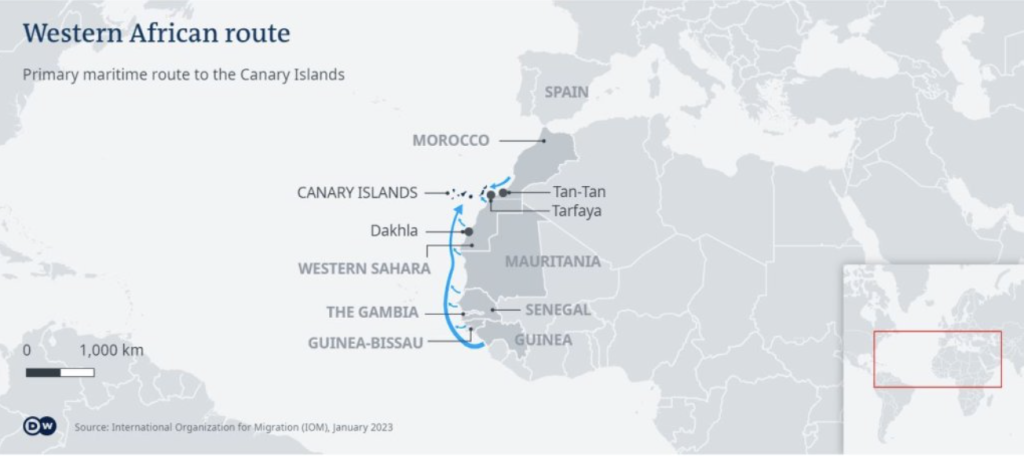
The Canary Islands have become the primary entry point into Spain for irregular migrants from the African continent in recent years, making this route the deadliest.
Death onboard cruise ship
According to a spokesperson for Oceania Cruises, the 68 migrants received "medical assistance, along with food, beverages, clothing, and a safe place to rest" on board. Despite these efforts, one of the rescued individuals succumbed to their conditions on the Insignia, bringing the total number of fatalities to six.
"One of the survivors was in critical condition and had to be evacuated, but unfortunately, the on-board doctor confirmed that he had passed away," Salvamento Marítimo, the Spanish sea rescue service, announced on social media.
After a two-day journey to reach the Spanish archipelago, the cruise liner docked at the port of Tenerife on Friday, disembarking the rescued individuals. According to testimonies from survivors collected by the health service upon arrival, "more than 100 people" had been on board the drifting boat. This suggests that 33 people perished during the voyage, with the bodies of the deceased being thrown overboard by the remaining passengers.
However, the NGO Caminando Fronteras, which monitors crossings to Spain, reports that, based on their information, the boat originally carried around 150 people. This would indicate that the death toll from this tragic journey is closer to around 80. Helena Maleno, head of Caminando Fronteras, posted on X that "86 people died in a boat that spent 22 days adrift in the Atlantic".
The overloaded boat departed from Nouakchott, Mauritania, on May 30. After four days at sea, the engine failed, leaving the boat adrift. In the Atlantic, strong winds and currents can cause migrant boats to drift thousands of kilometers off course, far from their intended destination.
Fishing boats frequently run aground on the shores of Cape Verde, more than 1,500 kilometers from the coasts of Africa and the Canary Islands. In early March, Cape Verdean authorities discovered a small boat carrying five survivors and five bodies. A sixth individual passed away after being transferred to a hospital. According to the survivors, the boat had departed from Mauritania with around 65 people on board.
Some fishing vessels have drifted even further. In mid-April, fishermen off the coast of Brazil discovered the bodies of nine migrants, approximately 6,000 kilometers from the African coast. The fishing boat, which had also set sail from Mauritania, was carrying about twenty passengers. None of the passengers were found alive.