
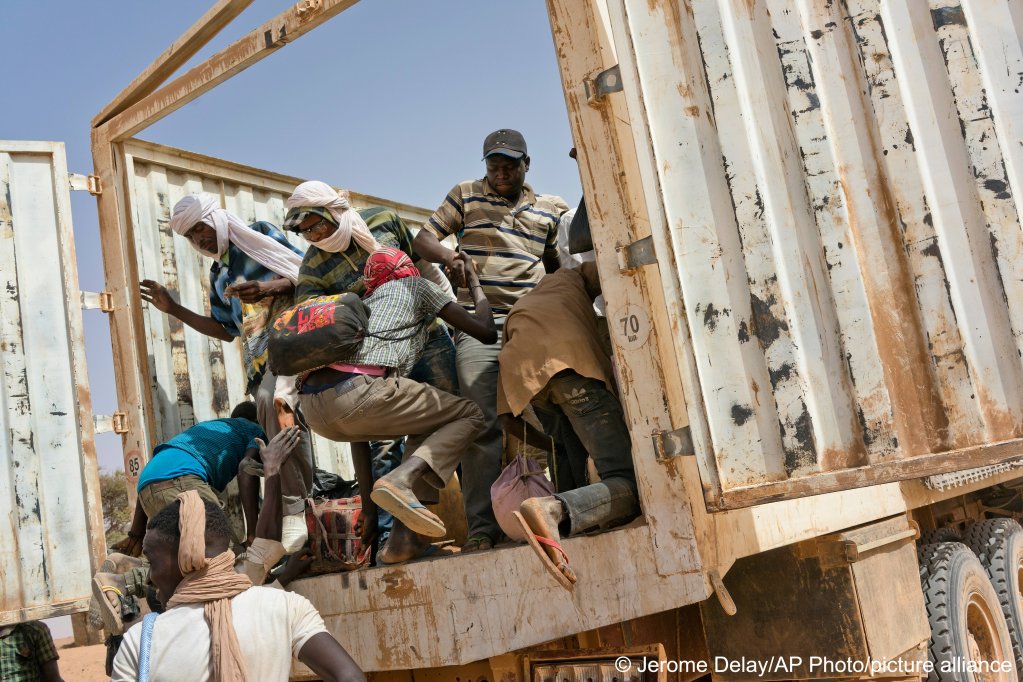
A new UN report highlights the dangers of irregular migration in sub-Saharan Africa. The risks of violence and kidnapping are highest in desert regions, it says.
"Many underestimate the risks and dangers and many die while crossing the desert or near borders," the UNHCR said in its report, stressing that most migrants and refugees "also suffer serious human rights violations, including sexual violence, kidnappings, torture and physical abuse" on such migration routes.
The document, titled "Mapping for Protection Services Report -- A routes-based approach to protection services along mixed movement routes" also said that conflicts in Sudan and across the entire Sahel region have further "compromised protection for migrants."
In the past, the IOM has estimated that for every migrant known to have died while crossing the Mediterranean Sea, as many as two were lost in the desert and presumed to have died.
Also read: 'Migrants abandoned in the Sahara Desert have no chance of surviving' - Border Forensics
UNHCR envoy: Better partnerships needed to save lives
At a press briefing in Geneva on Tuesday (June 4), UNHCR Special Envoy for the Central Mediterranean Situation Vincent Cochetel said that while there was a lot of talk about sea rescue, there is little focus on saving lives in the desert.
To ensure the safety of people on such migration routes, he advocated for better cooperation with local partners.
He stressed that since the major transport hubs for migrants and refugees were well known — such as the Nigerien city of Agadez -- UN agencies needed to work more closely with local actors.
"Yet, those local authorities are there, they are located on those routes that are used for migrants and refugees, they are located in places where humanitarian actors cannot be present, either because of safety concerns or because authorities don’t want humanitarian actors to be present," he told reporters.
"Many don't go to capital cities where humanitarian actors are based and well represented. They embark on secondary routes, reaching smaller cities in hard-to-reach areas. This is where services should be located," Cochetel added.
Also read: Niger: Migrants return to the route towards the Mediterranean
'Too few legal migration pathways'
Cochetel also renewed calls to establish more legal pathways for migrants and asylum seekers to reach places of safety.
"This includes better access to legal pathways to safety and improving protection services for victims, as well as those at risk of becoming victims along the routes," he said.
Meanwhile, UNHCR also stressed that voluntary return programs also remained as an option but "should not be the only solution considered, as it may lead to risks of re-trafficking upon return."
Also read: Niger's repeal of migrant smuggling law worries EU over efforts to curb immigration flows
Almost 400 million people displaced worldwide
According to UNHCR, three-quarters of the more than 108 million forcibly displaced people worldwide live in low- and middle-income countries.
According to figures from the UN migration agency IOM, more than 280 million people (3.6% of the global population) are considered to be international migrants.
Cochetel stressed, however, that these numbers are not reflective or indicative of any migration trend toward Europe. He highlighted that most displaced individuals sought new homes and shelter close to their home countries rather than seeking to migrate to Europe or beyond.
Also read: Left to be forgotten: EU accused of being complicit in migrant 'dumping' in North Africa