
A Polish border guard was stabbed at the border with Belarus on Tuesday, allegedly by a migrant on the Belarusian side. Polish Prime Minister Donald Tusk has promised to "defend the border with all available means."
On Tuesday (May 28), a Polish border guard was stabbed with a makeshift spear, a knife attached to a long stick, reported ABC News and the European news portal Euroactiv, as well as most of the Polish press. According to officials, the assailant was a migrant who reached across the bars of the 5-meter high metal wall separating Poland and Belarus and stabbed the soldier in the ribs, AP reported.
According to Polish news sources, the officer is in a critical condition in hospital.
The same day, Polish Prime Minister Donald Tusk reacted to the incident on the social media platform X (formerly known as Twitter), stating that "soldiers and officers defend our border, risking their lives." He added that the wounded soldier was being "well cared for, as is his family."
Tusk said his administration had sent "additional forces to the border," and promised to be there "first thing tomorrow [Wednesday] morning."
'We will defend our borders with all available means'
On May 29, Tusk added that "we will defend our border with all available means. The army, border guard and police can count on my full support. I am impressed by your courage, professionalism and dedication."
After visiting the area, Tusk announced in the Polish press that he would be instigating a new emergency buffer zone around the border of around 200 meters. Back in 2021, Poland had a buffer zone of a couple of kilometers, where humanitarian groups, the press and the public were forbidden from entering.
According to Euractiv, some Polish commentators, including former MEP Janusz Korwin-Mikke, have reacted more strongly to the news of the stabbing, calling on border guards to shoot asylum seekers attempting to cross the border.
Aid groups express concern
Bartek Rumienczyk, the media officer for the Polish border monitoring coalition group Grupa Granica, is worried about this latest development. "This kind of state of emergency declaration and creation of a buffer zone prevents us from delivering humanitarian aid and properly monitoring what is going on at the border," he explains.
Humanitarian groups emphasize the importance of monitoring, stating that their presence generally ensures border guards act in accordance with the law and humanitarian principles. But they worry about what might happen if no one is looking.
The stabbing comes at a time when humanitarian groups working with migrants and monitoring the borders in the area are reporting increasing numbers of attempts of migrants to cross into Poland and the EU. Part of that is a result of the warmer weather they admit and happens every year as spring turns to summer.
Rumienczyk told InfoMigrants that his group are receiving "hundreds of calls" every week from people on the move asking for help in the border region. Although he doesn’t have official figures yet from the Polish border guards for May, he said the group had already noted an increase in the number of crossing attempts as well as official returns registered by the border guard in April. He suspects May will continue that trend.
Also read: Polish detention centers reportedly harm some migrants' mental health

'April was a busy month'
Rumienczyk explained that April in particular was a busy month. "The border guard told us they had registered more than 2,000 pushbacks during that month. As a comparison, between December 13 and the end of March, the border guard registered 1,700 pushbacks. We expect May to be busy too."
Rumienczyk added that the official estimates they have don’t even cover all the people who may have gotten through or been pushed back without being registered, and that the actual numbers are likely much higher.
Rumienczyk fears that following this stabbing incident, and even before, the situation at the Polish border is returning to the kind of emergency state Poland declared in 2021. Back then, Poland established an emergency buffer zone of several kilometers around the border, where humanitarian groups, the press, and the public were forbidden from entering.
"This acts as an obstacle to deliver humanitarian aid and to monitor what is actually going on at the border," explained Rumienczyk.
Also read: 'There is fear, but also solidarity,' Poland's attempts to welcome migrants
'Eastern shield'
Next Monday, Tusk is due to announce an increase in funding to strengthen the country’s eastern border with Belarus and its northern one with the Russian enclave Kaliningrad, reported the regional news portal Balkan Insight on Monday (May 27).
According to Balkan Insight, Tusk will pledge about 2.3 billion euros towards a package of measures to be known as the "Eastern Shield." The measures are, Tusk explained, designed to "significantly limit the mobility of the potential aggressor."
However, migrants crossing through Russia, Belarus and on into Poland, have been branded by many politicians and commentators, including Tusk, as part of Russia and its allies 'hybrid warfare' attacks against the West. These accusations have resurfaced in recent months.
In the past, Tusk linked migrants with aggression
In May 2021, before becoming Polish Prime Minister, Tusk said in a press conference, as reported by Balkan Insight, that "90 percent of the people who illegally cross our border are in possession of Russian visas. Today, it is the Russian state that is behind the recruitment, transport, and smuggling of people."
Tusk continued: "Those are not refugees, those are less and less migrants, families, poor people needing help. In 80 per cent of the cases, these are organized groups of men, aged 18-30, very aggressive."
Katarzyna Czarnota, from Poland’s human rights branch of the Helsinki Foundation, begs to differ, as do most of the activists monitoring the border, who help migrants when they call for help in the forest.
According to Czarnota, Rumienczyk and Agata Kluczewska from the Voluntary Humanitarian Service POPH (Podalaskie Ochotnicze Pogotowie Humanitarne), there are more and more women, children and unaccompanied minors also attempting to cross into Europe.
Some are now applying for asylum within Poland, rather than hoping to cross Poland to arrive in Germany and other Western European countries.
Also read: Poland, new year, new government but is there a new migration policy?
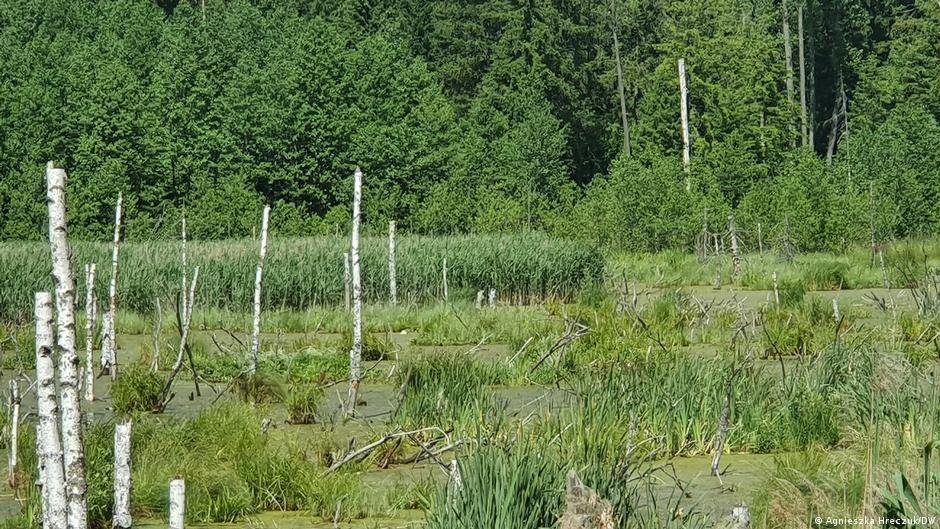
The situation at the border is 'getting worse' say activists
Kluczewska told InfoMigrants on Wednesday that volunteers from her group regularly deliver asylum applications to the Polish border guard on behalf of unaccompanied minors who are attempting to enter Poland. Last week, there were several young Somali women hoping to seek asylum.
According to the activists, many of these people wait on Polish soil, but on the Belarusian side of the border fence. Small tent camps have even sprung up along some parts of the fence. The activists say the situation at the border is "getting worse." In line with increased numbers of attempts to cross, come more pushbacks, and with it more allegations of violence.
Last week, volunteers with POPH filmed what they say are pushbacks at the border fence, involving migrants, some of whom were hoping to seek asylum, who had fallen ill. The migrants can be seen in the footage being dragged through the gates in the fence by what look like the Polish military officers. Kluczewska says four out of five of the group checked like this after falling ill and were pushed back through the gate. Only one was taken to hospital.
InfoMigrants cannot independently verify this footage. We asked the Polish border guard for comment on Tuesday, but at time of writing, they had not yet replied.
Also read: Hila's tale, 'if no one wants me, then I want myself'