
Ireland has reportedly sent the first 50 migrants who traveled there from the UK back to Britain. The announcement comes just weeks after UK Prime Minister Rishi Sunak declared he would refuse returns from Ireland unless France accepted returns from the UK.
According to reports in a variety of right-wing UK newspapers, citing the Irish Times, two separate groups of 25 migrants were detained by Irish police while crossing the land border from Northern Ireland (part of the United Kingdom) to Ireland (part of Europe) in the last six months and sent back to Britain. The newspapers said they had obtained the figures from "official data" without specifying whether that came from Irish or British sources.
Also read: Migrant tent camp returns to Dublin just days after clearance
The Irish Times itself reported on May 4 that Britain had previously agreed to accept the return of around 200 migrants since 2020 when the agreement to accept some returns began between the two nations. However, the accepted migrants had not actually been sent back after all. Ireland, reported the Irish Times, had agreed to accept around 80 returns.
The two groups making up the 50, which reportedly contained at least three children, "were stopped in October and February during two, four-day operations," reported the right-wing British tabloid The Daily Mail. They were later returned by ferry to Holyhead on the UK mainland, or by train to Belfast, the capital of Northern Ireland, also part of the UK.
Special arrangements between the UK and Ireland
The admission that the UK may already have accepted migrants and asylum seekers being returned to it from Ireland will make it more difficult for the UK government to refuse any future returns Ireland has promised to make by the end of May.
When he told the Irish authorities that he would refuse returns from Ireland, UK Prime Minister Rishi Sunak cited the refusal of EU countries like France to accept returns from the United Kingdom since the UK left the EU. His argument was that if Britain could not return people to Europe, then Europe -- in this case Ireland -- should not be allowed to make returns to Britain.
Also read: Ireland, police dismantle migrant camp in Dublin
However, because of their history and geographical proximity, Ireland and the UK have long had a closer relationship and special rules and agreements that go beyond the EU-British relationship. For instance, there are fewer controls and checks on passengers and goods passing between Ireland and the British Isles, and along with the Channel Islands and the Isle of Man, the countries have a kind of border-free Schengen-like arrangement in place, which allows for free-er trade and free-er travel for those with the correct travel documents.
NI High Court rules to disapply parts of 'Illegal Migration Act'
The news comes just days after a judge at the Northern Irish high court ruled that they might have to disallow some parts of the Illegal Migration Act in Northern Ireland because it did not respect the rights of migrants under European Law.
If enacted, this might mean that it would be difficult to deport asylum seekers to Rwanda who had traveled to Northern Ireland. The government in London insists that this will not be the case. Anecdotally though, it seems a number of asylum seekers are hoping that they might be afforded more protection if they not only travel to Northern Ireland from the UK, but perhaps over the land border to Ireland.
The Irish government has been claiming for a number of weeks now that the numbers of migrants and asylum seekers, many of whom are camping along the banks of a canal in Dublin, have arrived there after traveling from the UK, because of their fears of being deported to Rwanda. Some claims have put the figure as high as 80-90 percent of recent asylum arrivals in Ireland have come across the border from the UK.
Also read: UK migration policy under fire in courts
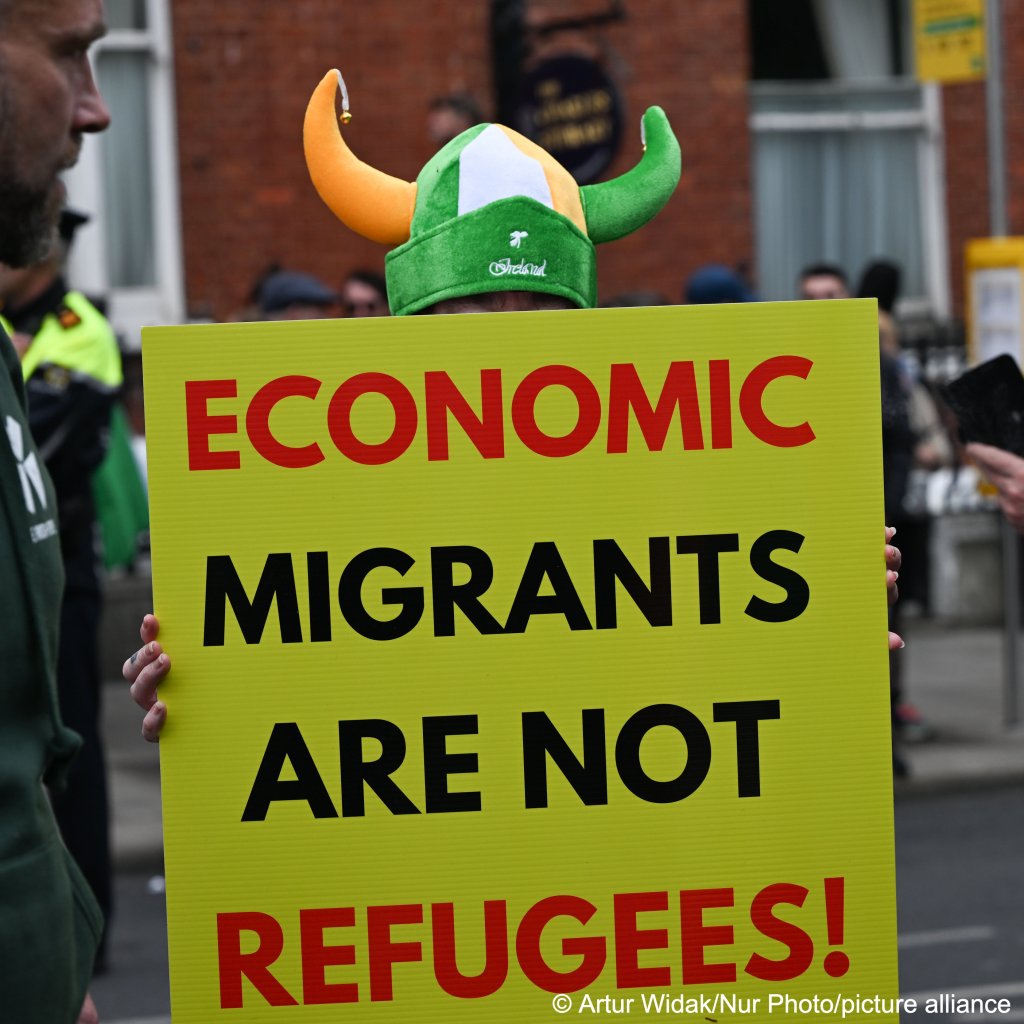
Tension is high in Ireland now regarding migration. The government has been unable to house many of the migrants arriving, which is partly what caused the makeshift camps to appear in the first place. There have also been a number of demonstrations across Ireland and acts of violence against migrants, with some people saying the government should look after its own population first, before helping migrants.
Former Home Secretary Suella Braverman criticized the government in the House of Commons on Wednesday saying that the kind of ruling the Northern Irish High Court passed on Monday would effectively mean that Northern Ireland be treated as part of the EU.
Also read: Britain and Ireland in cross-border migration row
Government claims Rwanda plan still going full-steam ahead
The Home Office (Interior Ministry) on Wednesday warned that migrants would "still be within the scope of relocation to Rwanda" even if they crossed the Irish Sea, to Northern Ireland, reported the Daily Mail.
The newspaper published a graphic illustrating how it said the UK government was advancing with its deportation plans towards Rwanda. It said the UK now had seven immigration removal centers around the country where migrants would be held pre-departure to Rwanda.
Around 2,100 migrants were on a target list for the first round of deportations, the Daily Mail wrote.
Meanwhile, on Wednesday, the left-leaning Guardian newspaper revealed it had information that the civil service, which is undergoing a recruitment freeze because of government cuts announced by Chancellor Jeremy Hunt, would also experience cuts and recruitment freezes in the Home Office department tasked with handling the Rwanda deportations.
The first flights to Rwanda, according to the UK government, are due to take off in the first weeks of July. But the dates have been disputed and have been changed over the past few months, even from within the government's own communiqués.