
Despite the huge wave of solidarity with Ukrainian refugees after the Russian invasion of Ukraine, welcoming Syrian, Afghan or African exiles is a more divisive issue within Polish society. Numerous observers attribute this to the former conservative government.
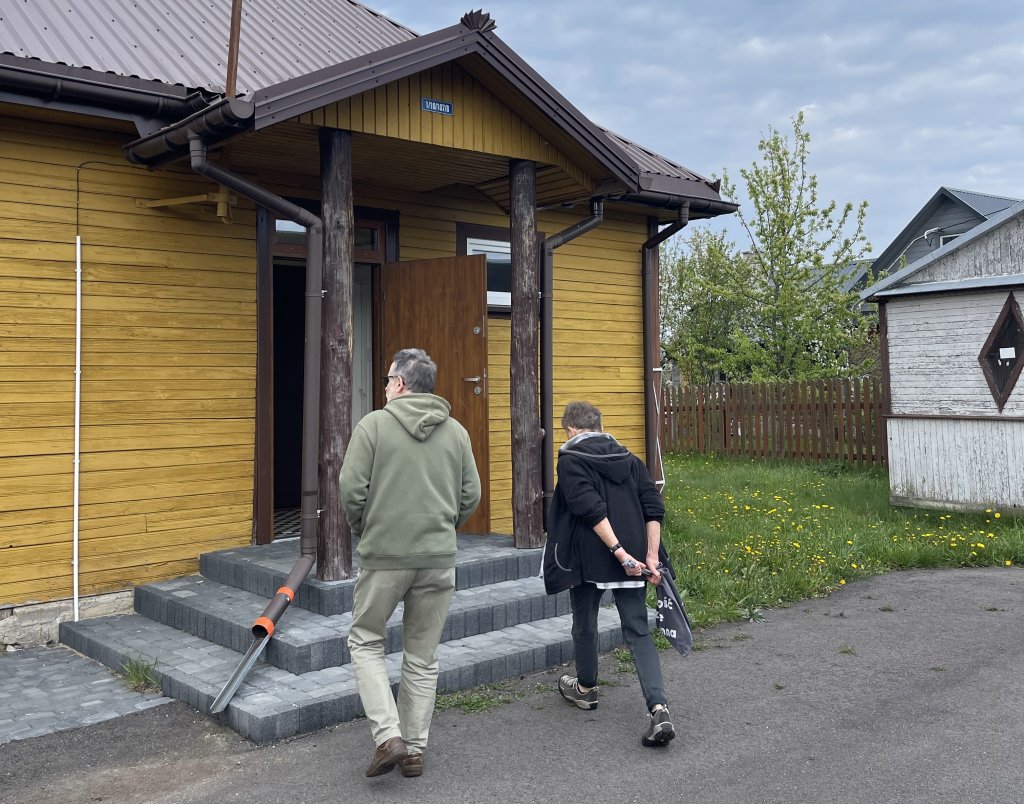
The road running through the tiny Polish village of Wojówka is lined with small, dark wooden houses. In well-kept gardens, tulips bloom and grass is freshly cut. The town has a single bus stop, where a bus halts once or twice per day.
The peace of the small village was interrupted one day in late April, when a meeting was held to discuss the migration situation at Poland's nearby border with Belarus. It was organized by Podlaskie Voluntary Humanitarian Emergency Service (POPH), a local NGO.
Of the 40 inhabitants who reside in the village, around half attended the late afternoon meeting.
Small groups of exhausted migrants pass through the village almost daily after crossing the forest and Belarusian border, located just two kilometers away. Thousands of exiles have taken this migratory route from Russia and Belarus since the summer of 2021. Most first enter Polish territory through the Podlaskie region in northeastern Poland, where Wojnówka is located.
A woman wearing a pink fleece jacket was the first resident to speak.
"For two years, I have seen border guards pass in front of my house every day," she said. "I also hear noises coming from the border, and my dogs are always barking."
She complained that she no longer feels safe; not because of the presence of migrants in the region, but because of "the police and soldiers who cross the village too quickly in their vehicles."
"I understand the predicament of migrants," she said. "But I also understand the dilemma of the government, which wants to protect our territory."
The participants discussed their feelings about the ongoing situation along the border for nearly two hours.
"We listen to everyone's opinion here,” said Malgorzata Rycharska, a member of POPH and the NGO Hope&Humanity Poland. "We hear what the government and activists think about what is happening in this area daily, but we rarely hear the people who live in the region.”
Read more: 'Anyone could be in this situation': Behi Djanati Ataï on refugees and the quest for a better life
Over one million Ukrainians hosted in Poland
The region’s capacity for solidarity was highlighted after the Russian invasion of Ukraine in February 2022 For several months, hundreds of thousands of people fleeing the war took refuge in Poland.
The country still hosts nearly a million displaced Ukrainians on its territory two years later. The extraordinary system of support offered to refugees is often held up as an example in Europe.
"I don't know a single person around me who hasn't hosted a Ukrainian citizen in their home," said Faustyn, a member of Grupa Granica, a Polish association that offers aid to migrants. "Why don't they do the same for Afghan, Syrian and African exiles?”
Yet Poles did make some efforts. In December 2021, some started placed green lights in their windows to indicate to migrants who had crossed the border from Belarus that they could come and knock on their door for assistance.
The help ranged from providing overnight shelter, food and clothes to offering migrants the opportunity to charge their phones. The solidarity slowed and eventually disappeared as the months passed.

NGOs regularly bring up the difference in treatment by the Polish government and the population of Ukrainians and non-European migrants.
A June 2023 survey by Ipsos for the Polish media OKO.press found that a large majority of Poles have “negative feelings” towards the latter. When asked what attitude they most strongly felt regarding migrants from Africa, Asia and the Middle East, participants mentioned feelings of anxiety (27%), fear (11%) and anger (11%).
In contrast, 62% of Poles said it would be "good for Poland if Ukrainian refugees remained in the country for many years."
The situation, according to associations, is one of the consequences of the anti-migrant discourse fueled by the conservative Law and Justice party (PiS), in power from May 2015 to October 2023.
Under PiS administration, Poland built a wall spanning 186 kilometers of the Belarusian border, sharply increased the number of police officers in the region and legalized "pushbacks" to Belarus -- a measure contrary to the Geneva Convention, which Poland has signed.
PIS’s hardline position on migrants was highlighted by former Prime Minister Mateusz Morawiecki in the party's summer 2023 campaign ahead of legislative elections.
In videos published to social media, Morawiecki listed the actions his government had taken to counter immigration.
"This instrumentalization of migrants never stopped over the course of two years," said Dorota Dakowska, a professor of political science at Sciences Po Aix, in August 2023.
Read more: In Briançon, migrants and volunteers under immense pressure
'No help'
Hostile attitudes toward migrants are sometimes expressed during meetings organized by POPH.
For example: at the Wojnówka meeting, an elderly resident said: "The migrants don’t need assistance: I often see them, and they are young and healthy."
Exiles have reported difficulty in finding help upon arrival to the Podlaskie region. Ali*, an Iraqi, tried to ask a farmer for water. "He looked at me, along with the other migrants I was traveling with, and simply said, ‘No help.'"
"Relationships with people are not always easy," said Abdou*, who arrived in Poland a few months ago. "The Poles are a bit harsh because there are very few foreigners here."

"There is sometimes fear and rejection from the population, but there is also solidarity," said Rycharska.
“Many of the residents we meet during our meetings tell us they have already come to the aid of migrants by offering them water, food or clothing, for example. This solidarity is not visible, but it exists.”
'People like me'
Some people, like former anthropologist Joanna Jarnecka, also find themselves unexpectedly aiding the exiles.
Jarnecka joined Grupa Granica in February 2022.
"Despite the seriousness of the situation at the border, people are not always aware of what is happening. One of the reasons I changed my life was to alert people on the fate of the exiles,” said the activist, who also produces works of art on the theme of migration.
At 17, Mateusz devotes all his free time to bringing food, water or new shoes to migrants in the forest. "The government was always saying, ‘The terrorists at the border have done this’, or 'there are more and more terrorists'; I wanted to see who these people really were. I discovered families and ordinary people. In other words, people like me.”
Read more: 'You shouldn't be attached to life to come here': Tales from the Polish-Belarusian border
Thanks to an online fundraiser, the high school student based in Hajnowka buys all the food necessary for the exiles. Since he doesn’t have a car yet, he gets his mother or father to take him to the edge of the forest “almost every evening after school” so he can drop off the supplies. “Before the arrival of the exiles, I partied a lot and rode my bike for miles. Today, it’s different, that’s for sure. But it makes me happy.”
In Warsaw, where he recently settled, Abdou ended up finding “a kind of peace”.
“Here, a lot of people helped me. I was touched. And although I initially planned to go to France, I tell myself that I am happy here after all,” he said.
*All first names have been changed to protect identities
Marlène Panara traveled recently to the Polish-Belarusian border