
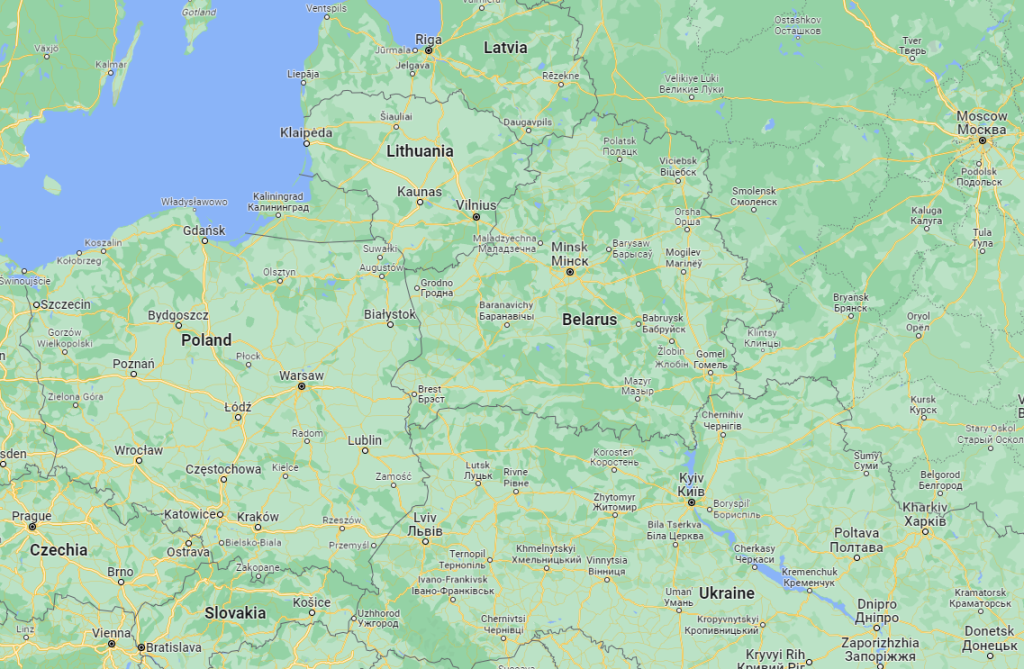
Investigators have broken up an international migrant smuggling network along Poland's border with Belarus, prosecutors say. Criminal proceedings have now been initiated against 36 suspected smugglers who reportedly hail from Poland, Ukraine, Iraq and Belarus.
An alleged migrant smuggling network at the Polish-Belarusian border has been dismantled, news agency AFP reported on Tuesday (May 7), citing prosecutors. The group is suspected of providing millions of dollars in funding to armed groups like Hezbollah.
36 Polish, Ukrainian, Iraqi and Belarusian alleged members of the network have reportedly been charged.
"The process consisted of organizing the illegal migration of Iraqis, Syrians and Palestinians via the Polish-Belarusian border towards the German border," prosecutors said, according to AFP.
Two alleged leaders of the network -- Syrian Ahmad R., who resides in Germany, and Mohammed A., known as Abu Josef -- were identified by prosecutors during the joint investigation.
Ahmad R., known as Abu Noh, was arrested in late April, AFP reported, citing Polish prosecutors.
Hezbollah, or "Party of Allah," is a Iran-backed, Shiite Muslim group in Lebanon with political and military branches that emerged after Israel's 1982 invasion of the country.
Also read: Germany: Police carry out two days of raids in search of smuggling suspects
30 million dollars to fund militant groups?
The investigation was reportedly led by the EU's criminal justice agency Eurojust, with German and Dutch police support.
Ahmad R. and Mohammed A., the two alleged leaders of the network, are also alleged to have been involved in smuggling Yemeni, Syrian and Iranian migrants via the Balkans, according to AFP.
Investigators discovered a reported total of some 581 million dollars in the organization's accounts. At least 30 million dollars had been transferred to the Hezbollah militia in Lebanon and to the radical Palestinian organization Islamic Jihad, which is deemed a terrorist group by Israel, the US, the EU and several other countries, AFP reports.
Moreover, the investigators reportedly found more than 13 million dollars funneled to a site subject to US sanctions, according to AFP reporting.
Migrant smuggling is a highly profitable and meticulously organized business -- especially in border regions. Some networks transport thousands of migrants into Europe each year.
The main difference between migrant smuggling and human trafficking, according to the UN Office on Drugs and Crime (UNODC), is "financial or material benefit" vs. the actual exploitation of the victim and their person.
Polish-Belarus border crisis
Western countries have long accused the Belarusian leadership of trying to destabilize the EU by smuggling migrants across the Polish border. The accusations are rejected by the Belarusian ruler Alexander Lukashenko.
Since August 2021, estimates suggest tens of thousands of mainly Middle Eastern migrants have crossed or tried to cross the European Union's external border into Latvia, Lithuania or Poland.
The ensuing humanitarian crisis left thousands stranded in border regions for months. Some were exposed to freezing weather conditions for weeks. NGO Human Rights Watch recently estimated that at least 55 migrants have died in the border region since August 2021.
Poland and other EU countries blame the increase of arrivals on Belarusian ruler Alexander Lukashenko and Russia, saying they orchestrate the influx in an attempt to destabilize the European Union.
Already in 2021, tens of thousands of migrants tried to enter Poland and other countries on the EU's external border via the so-called Belarus route.
Read more: 'You shouldn't be attached to life to come here': Tales from the Polish-Belarusian border
with AFP