
Germany's Interior Minister Nancy Faeser believes the government's migration policy is working: Border controls and integration measures for the job market are both showing positive results, she told reporters.
"Because of our border controls, we have arrested 708 suspected smugglers and stopped 17,600 migrants crossing the border illegally since October," Germany's Interior Minister Nancy Faeser told journalists from the Funke Mediengruppe newspaper group on Saturday, reported the German news agency EPD.
"Applications for asylum have gone down by a fifth during the same period," added Faeser.
The minister made the announcement just after the vote confirming the EU's New Migration Pact, underlining her hopes that the rules contained in the new pact would be implemented quickly.
Faeser stressed that although border fortifications had been strengthened across the bloc, the EU was very clear that people who were fleeing "war, torture and death must be protected."
"Just as clear though is that those who do not need our protection, cannot come to Germany, or should be asked to leave Germany even more quickly," she then added.
The EU's New Migration Pact in action
Faesar's stated approach reflects what will now be enshrined in the EU's New Migration Pact, which focuses among other things on establishing whether or not those seeking asylum have a likely case.
In order to process people's claims more quickly, migrants and asylum seekers could in future be asked to stay in closed facilities for up to 12 weeks while the authorities check whether they actually qualify for protection or not.
Under the new measures, countries that are experiencing greater than normal numbers of arrivals might also be able to activate emergency conditions, allowing them to keep people at the borders for longer than is currently possible, until their claims have been examined.
Faeser visits Bulgaria and Romania
On Monday (April 15), Faeser also visited Bulgaria to see how the reinforcements on the border between EU member state Bulgaria and Turkey were working in practice.
During her visit to Eastern Europe, Faeser met her Bulgarian counterpart, Kalin Stojanow, to discuss details about the implementation of the EU's New Migration Pact.
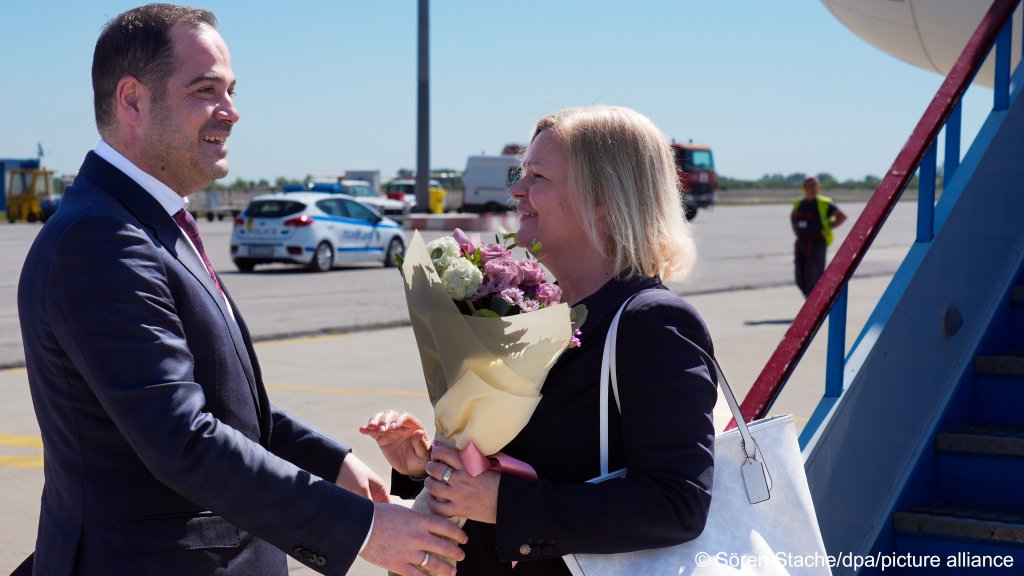
Later, Faeser is due to travel to Romania's capital Bucharest to visit the Romanian border police's camps.
Although Romania and Bulgaria became partial Schengen members at the beginning of April, border controls at the land borders will remain in place to manage immigration to the bloc.
Also read: Disputes over the EU's new tougher asylum reform
Domestic gains for German labor market
Meanwhile, German news agencies, including dpa, also reported that despite increasingly difficult economic conditions and a tricky labor market, Germany was seeing an improvement in the employment figures of refugees and asylum seekers.
According to Daniel Terzenbach, the German government's special representative for the labor market integration of refugees, the country's "job turbo" launched at the end of 2023 was beginning to show results.
The 'turbo' initiative was launched with the stated intention to help employers fill vacancies with refugees and thus speed up their integration into the job market, as reported by dpa.
"We can see that the job turbo is going in the right direction, the more intensively we work with people – even though the economy is currently poor," Terzenbach told dpa.
Also read: Germany to introduce border checks during UEFA football tournament
Ukrainians, Syrians and Afghans entering job market
The government representative also said that in March 2023 for instance, they had placed 2,500 Ukrainians in jobs, and a year later in the same month, they had doubled that figure to 5,000.
"Although we have over 170,000 more unemployed people than in the same month last year, the employment for Ukrainians is increasingly significantly," explained Terzenbach.
Meanwhile, employment figures for asylum seekers from Syria and Afghanistan have also risen. In March 2024, 13,076 people classed as refugees or asylum seekers entered the German labor market. In March 2023, that figure stood at 11,155.
Terzenbach added that the refugees who had come to Germany in 2015 and 2016 "during the first refugee movement" had by now been integrated into the labor market at an above-average rate, even by international standards.
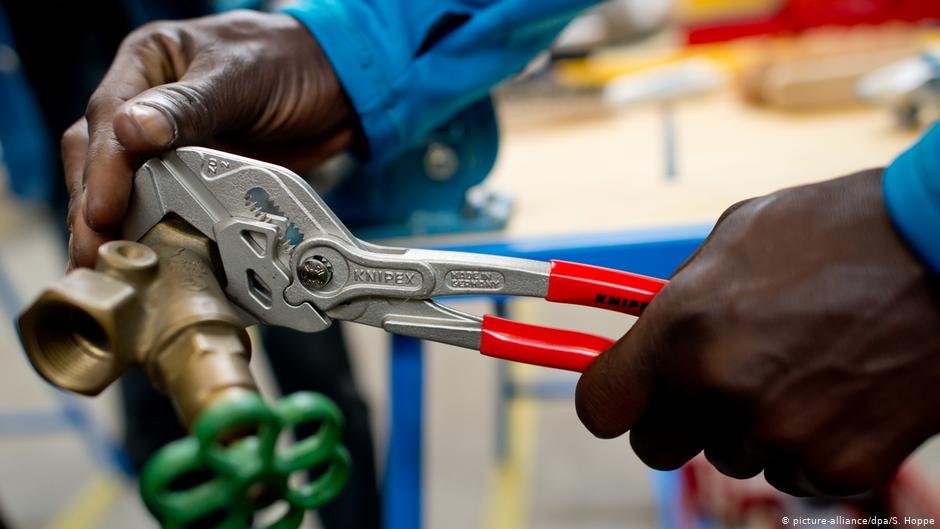
"A great deal of labor integration has taken place," assured Terzenbach, highlighting that Syrian war refugees were particularly successful with their job market integration, with about 70% of men from Syria are now employed in Germany.
Also read: Heated debate over compulsory work scheme for asylum seekers
Female asylum seekers still behind in job market
Terzenbach, however, also admitted that there still was "some catching up to do" when it comes to the employment of women, in particular those coming from Syria.
He underlined that the German government needed to continue promoting language skills and investing in training, in order to keep asylum seekers progressing in the job market, adding that employment is also shown to help with long-term integration.
Terzenbach said that German job centers meanwhile were working hard with migrant associations, charities and volunteer structures in order to help identify ways into employment for asylum seekers and refugees.
Also read: Longer wait to access healthcare does not reduce costs
With EPD, AFP and dpa