
A man identified as a migrant has died on top of a stationary train in Paris, which was due to head to London via the Channel Tunnel. Sources say that he was electrocuted to death when he came into contact with the live wire.
A police source in Paris told the AFP news agency that the migrant had been killed by electric shock after climbing on top of the stationary Eurostar train at the Gare du Nord station on Thursday.
The man was seen crossing over tracks from another platform at the station around 10pm local time on February 8, before suffering the electric shock. This later was corroborated by footage captured on security cameras.
He died at the scene half an hour later, prosecutors in Paris said.
Police confirmed that the man must have been a migrant, but added the condition of his dead body after the electric shock did not allow for more precise identification.
The daily Le Parisien newspaper reported that his body had burst into flames upon contact with the live wire on top of the train.
There were no other injuries, however, the incident was reported to have caused some disruption to the scheduled service of the Eurostar trains.
Prosecutors said they had opened an investigation into the circumstances of the death, which will be led by border police at the Gare du Nord station.
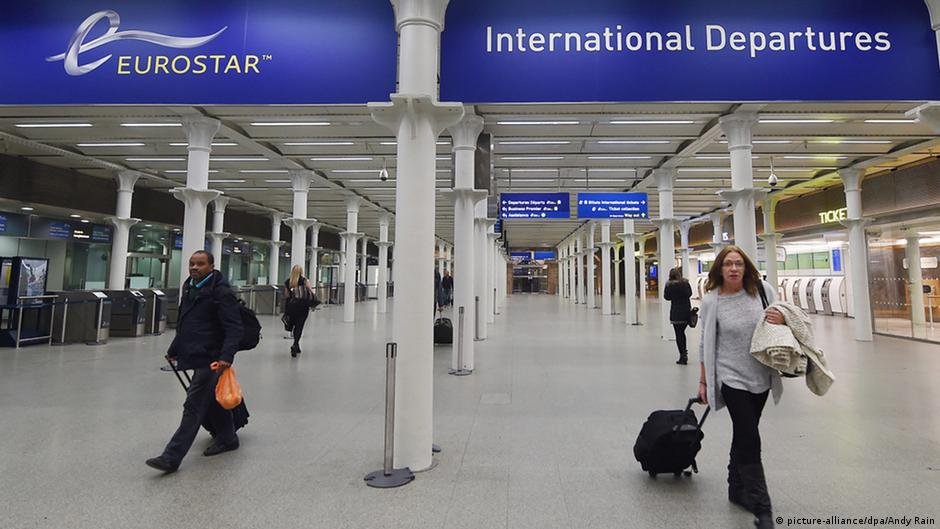
Migrants continue to seek irregular routes to UK
The stowaway death comes after Britain said last week that it would further step up efforts to stop irregular crossings by migrants from France to the UK.
Stowaway cases like this are rare but have happened in the past in connection with the Channel Tunnel, which has been in operation for nearly 30 years.
Usually, accidents like this take place near the northern French town of Calais, where the high speed trains enter the the tunnel to connect to the UK.
Most migrants who seek to reach the UK meanwhile depart from the northern French coast on small boats to cross the English Channel. Some also opt for a longer journey, departing from Belgium.
The Eurostar train links London's St. Pancras station with the French capital Paris on one line, and with the Belgian and Dutch capitals Brussels and Amsterdam on another.
Recently, it has signed an agreement to expand its network with French high speed operator Thalys.
Read more: Hidden from sight: The dangers of clandestine migration journeys
Deadly journeys of clandestine stowaways
Stowaway journeys are statistically among the most dangerous irregular crossing routes, regardless of mode of transport.
In addition to accidents involving trains heading to the UK, Britain also has a history of clandestine passengers suffocating inside trucks and even of stowaways in the landing gear of airplanes — most of whom suffer death during the journey or fall from the sky as planes descending into London's major airports open their landing gear boxes.
Migrant deaths on the sea route across the Channel are also common but not as frequent as those that take place on longer journeys — like migrants crossing the Mediterranean route to Italy or those taking the Atlantic route from West Africa to Spain's Canary Islands.
Read more: Fatal journeys: The realities behind travel as a stowaway passenger
Not the first incident at Gare du Nord
The last case of a migrant dying at Paris' Gare du Nord station was reported in 2017. Again, the man's death came as he tried to climb on top of a Eurostar train. Again, the man could not be identified due to severe burns.
Prior to this, an Egyptian teenager was reportedly involved in a similar incident in 2015 who, however, ultimately survived the incident after suffering life-threatening injuries.
Measures to step up security at the central train station in Paris have not succeeded in stopping such attempts.
Read more: British PM starts election year with long shadow of immigration hanging over his head
with AFP