
Rescue association SOS Humanity published data showing that in 2023, rescue ships in the Mediterranean lost 374 days making long journeys to reach Italian disembarkation ports. The report points to the Italian government’s responsibility in causing these hurdles.
At the end of last week, after rescuing 64 migrants in the Mediterranean, the Humanity 1 ship was instructed to dock and disembark its passengers at the port of Marina di Carrara, in northern Italy, not far from Genoa. The 1,200-kilometer journey took three and a half days.
For the first time, SOS Humanity reveals precise data measuring this recurring problem: the almost systematic assignment of migrant rescue boats to Italian ports far from where they operate, by Italy.
In 2023 alone, these vessels wasted 374 days – or more than a year – covering the distances, sometimes taking several days to reach ports as far as that of Ravenna, near Bologna, or even that of Genoa.
Ships covered distance needed to go around the world three and a half times
The rescue boats covered more than 150,538 kilometers -- more than three and a half times the distance of a trip around the world -- in one year to take “unnecessarily long” routes, the report said. These demands only target humanitarian boats, and not the Italian coast guard, the association stressed.
“This is not a coincidence, but a political tactic,” assures SOS Humanity.
The source of all these hurdles? The measures of the Italian government led by Giorgia Meloni seeking the “obstruction and criminalization of NGOs," the report says.
Activists say assigning rescue boats to remote ports is contrary to international maritime law, which says the responsible coastal states, Italy and Malta, should coordinate and allocate a docking place in the immediate vicinity of the ship in order to allow for disembarkation as quickly as possible in a safe place.
They also point to the Piantedosi decree, named after the Italian Minister of the Interior, validated at the end of December 2022.
This decree requires vessels to immediately reach the assigned port of disembarkation upon the first rescue. If crews do not comply, they face a fine of up to 50,000 euros. Their ship can also be immobilized for several days at the dock.
This is what happened to the Ocean Viking of SOS Méditerranée at the start of 2024, when the ship was blocked at the port of Bari for 20 days. Ships can also be confiscated by the authorities.
The Italian government justifies these measures as a way of “relieving congestion” in the south of Italy in the face of migrant arrivals.
"Projects like ours really have reasons to be afraid when we see how the Italian government is focused on us, while rescue NGOs only represent 10% of migrant arrivals in the country. We focus the debate on humanitarian ships, when the real question is what are we doing to prevent thousands of people from dying at sea?" Margot Bernard, deputy project coordinator of the Geo Barents, told InfoMigrants last November.
An additional cost of fuel for NGOs
The consequences are serious, both for migrants and boat crews. The extra kilometers needed to travel to distant ports induce "an additional psychological and physical burden for the rescued survivors, who have to wait even more to access shelter and medical care, even though they have faced mortal danger at sea for several days," SOS Humanity wrote in its press release.
Moreover, these long transits entail additional costs for equipment and especially fuel. Last year, SOS Méditerranée spent around 500,000 additional euros to supply the Ocean Viking with fuel. That is “not counting the additional working hours for the staff, and carbon emissions, up 0.5 tonnes compared to 2022,” Soazic Dupuy, director of operations, told InfoMigrants.
Above all, this means less time spent patrolling the search area to help the boats, and therefore more deaths at sea.
Careful calculation
SOS Humanity has meticulously reported the 107 missions that landed in 20 Italian ports in 2023, including the days and kilometers these assignments caused them to lose, via an interactive map published on its site.
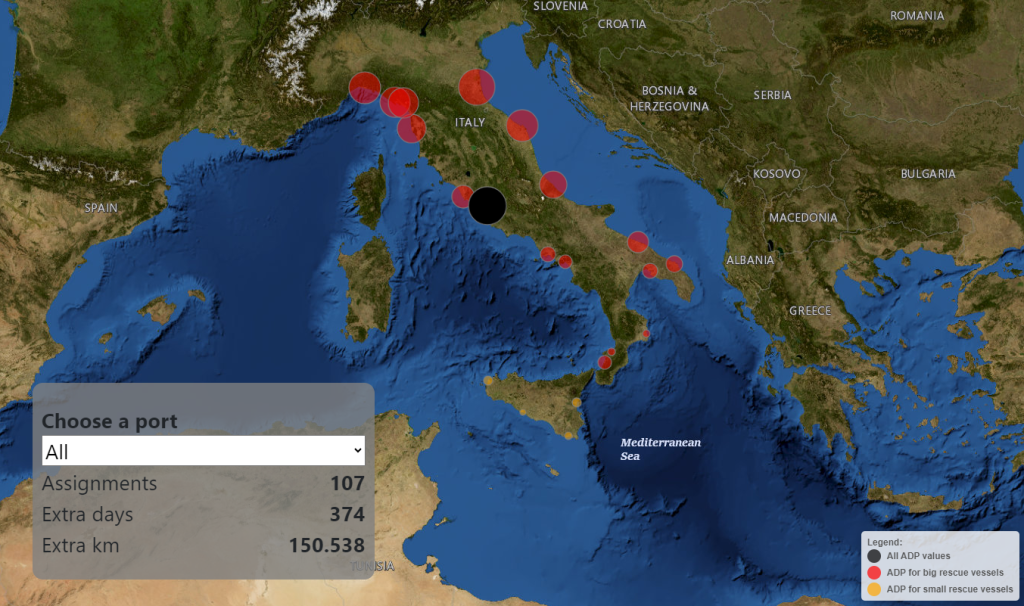
To compile their statistics, the German NGO took the two most ideally located ports as reference ports: The port of Lampedusa for the smallest boats, and the port of Pozzallo, in the far south of Sicily, to unload larger ships such as the Geo Barents, the Ocean Viking or the Open Arms.
Since its launch in August 2022, the Humanity 1 ship has only been authorized to anchor at a port in Sicily once.
The NGO compared the distances between these two reference points and the assigned ports further north in Italy. The average speed of the different boats in the area was used to assess the additional time to reach these more distant sites. The port of Brindisi, in eastern Italy, was assigned most frequently during the year – 10 times – and resulted in an additional 618 kilometers covered, or 29 wasted days.
The year 2023 was the deadliest in terms of deaths on the migratory route through the Mediterranean: At least 2,500 people died in the sea. That count excludes “invisible shipwrecks" -- boats that sink at sea without leaving a trace.