
The German leader has signalled an openness to study Italy's recent agreement to hold asylum seekers in centers in Albania. The deal has raised human rights concerns, including from the Council of Europe.
German Chancellor Scholz has said he will look "closely" at Italy's plans to establish centers in Albania to hold migrants. Speaking on the sidelines of the congress of European Socialists in the Spanish city of Malaga, he noted that Albania is a candidate for EU membership and that challenges like migration needed to be addressed on a European level, reported Reuters.
"Bear in mind that Albania will quite soon, in our view, be a member of the EU, implying that we are talking about the question of how can we jointly solve challenges and problems within the European family," Scholz told reporters on Saturday (November 11).
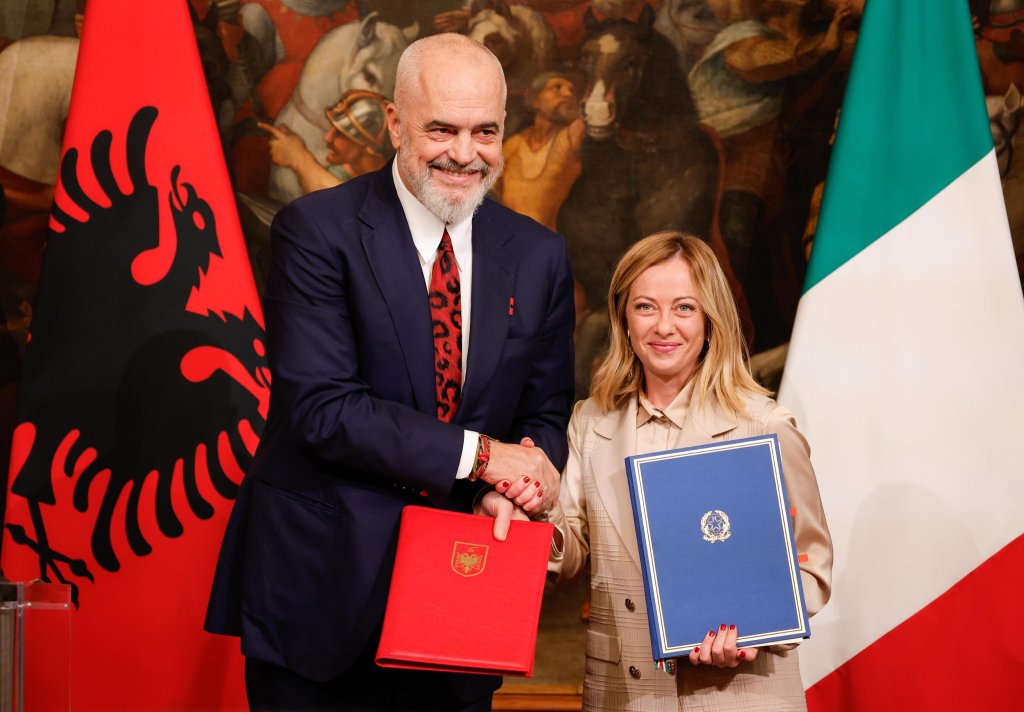
The Memorandum of Understanding between the Italian and Albanian governments, announced last week, will see tens of thousands of migrants who were rescued in the Mediterranean housed in closed centers in Albania while authorities assess their asylum requests.
"Such deals, that have been eyed there, are possible, and we will all look at that very closely," Scholz stated during the briefing, according to Reuters.
He emphasized that a clear European course in migration policy was needed "to correct things that have not been right in the past (and) to establish a solidarity mechanism so that not each country on its own has to try and master the challenges alone."
'It becomes less attractive for them to pay big money to smugglers'
If the Italy-Albania deal is implemented, it would be the first time that such an idea would actually be put in place, Ruud Koopmans, a professor for migration studies and advisor to the German Federal Office for Migration and Refugees, BAMF, told DW in an interview. He referred to unsuccessful attempts by Denmark and the UK to try something similar in Rwanda.
From a legal perspective, the Italy-Albania deal could become problematic if people who are rescued on Italian territory instead of in international waters are sent to Albania, Koopmans noted. "When people from the Sahara come to Italy and are then sent to Albania, there is no prior connection to Albania. This could be legally problematic."
Koopmans said that it could also become difficult to send people back who are rejected. "…(T)his is not easy in practice, as home countries often do not cooperate and documents are missing. This is a problem that Albania will also face. But if people know that they will have to wait in Albania if they are rejected, it becomes less attractive for them to pay big money to smugglers," he said.
Discussions on finding solutions to increasing asylum numbers are gaining momentum, Koopmans said. "More and more countries are looking for solutions. Denmark, Austria, the Netherlands and Germany are having discussions along these lines." Deals like the Italy-Albania agreement could present an opportunity for countries neighboring the EU, in that they could help their efforts to join the bloc, he added.
Also read: 'Migrants sent from Italy don't worry us' says Albanian Mayor
Deal could undermine human rights safeguards, Mijatović
Italy’s deal has raised concerns among Italy's opposition as well as rights groups who see it as an attack on the right to asylum. The NGO Emergency said that the deal is "in reality, ...a way to block migrants from arriving on Italian soil – and therefore European soil – to ask for asylum, as required by European and international law. (This is) yet another attack on asylum rights and the provisions of Article 10 of our Constitution."
Concerns were also expressed by Council of Europe Commissioner for Human Rights, Dunja Mijatović. She warned that the deal’s legal ambiguities could undermine human rights safeguards and accountability. "The MoU is indicative of a wider drive by Council of Europe member states to pursue various models of externalizing asylum as a potential 'quick fix' to the complex challenges posed by the arrival of refugees," she said in a press release on November 13.
Mijatović urged member states to focus on improving domestic asylum and reception systems and to prioritize safe and legal pathways for protection in Europe.
Also read: Italian PM defends Albania accord amid opposition outcry
Germany announces streamlined asylum process
The chancellor’s remarks in Malaga came on the heels of an agreement with Germany’s 16 states on a tougher migration policy and increased funding for refugee hosting capacities.
Faced with an increase in the number of asylum cases filed in Germany, estimated to reach 300,000 this year, the government has announced it will accelerate procedures.
At all BAMF offices, the procedure for registering asylum seekers now includes photographing and fingerprinting, allowing for immediate data checks to rule out potential multiple identities. The system allows other agencies involved in the asylum process to access biometric data as well, according to BAMF. Arabic names will be transferred into the Latin alphabet to prevent differences in spelling and other mix-ups.
Furthermore, mobile phone searches will only be conducted on a case-by-case basis, BAMF said, and queries to the Schengen Information System (SIS) will be reduced: if the last SIS search was within 14 days, an additional inquiry is waived.
A spokesperson from BAMF said that these specific measures would make procedures more efficient, while maintaining high-security standards. The asylum procedure is meant to last 6.7 months on average. However, when considering negative decisions, administrative court proceedings take on average 21.8 months in the first instance, the spokesperson noted.
with Reuters, INA, AFP
Also read: Deportation looms for rejected Nigerian asylum seekers