
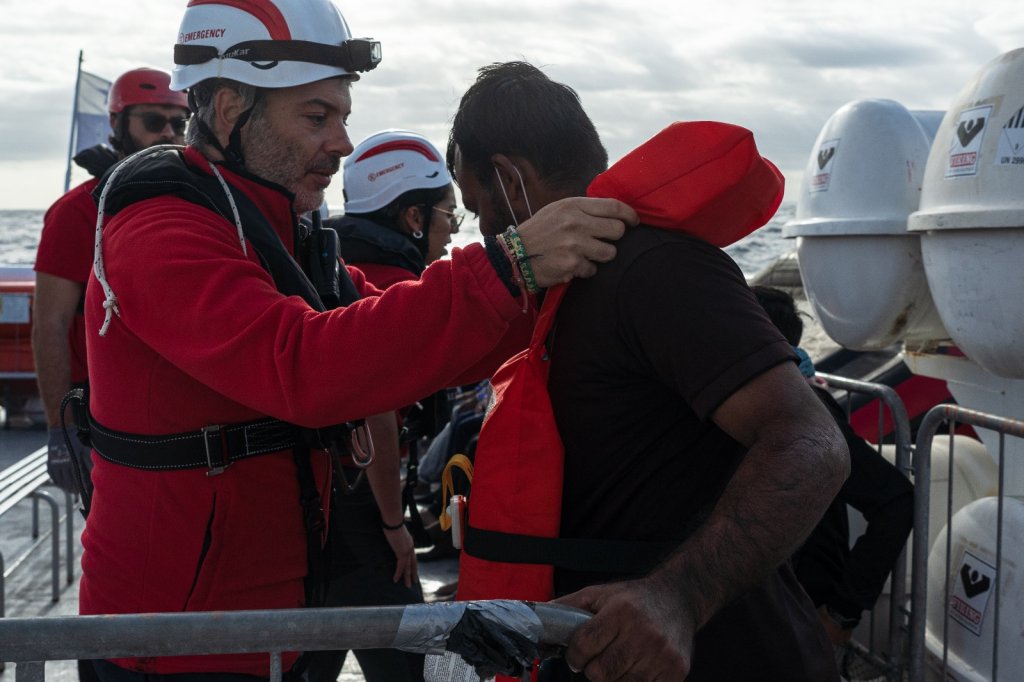
The crew of private rescue ship Life Support saved dozens of people after their flimsy vessels started taking on water due to three meters high waves. The humanitarian ship now has a 46-hour journey to reach its assigned port in Brindisi, Italy to disembark the 118 individuals.
A total of 118 people were rescued by the crew of the migrant rescue ship Life Support in two separate operations in international waters in the Maltese Search and Rescue zone between Wednesday (November 8) evening and Thursday (November 9) morning.
Crew from Life Support – run by the Milan-based humanitarian organization Emergency, – saved 77 people from a rickety boat in its first rescue, then saved 41 more individuals just hours later.
Among the migrants rescued were people from Eritrea, Ethiopia, Sudan, Bangladesh, Pakistan, Syria, Egypt and the Palestinian Territories. Four of the rescued were unaccompanied minors, including a young girl, Emergency said in a statement on Thursday.
Both boats in distress had departed from Benghazi, Libya, four and two days ago, respectively.
Three meters high waves threaten lives on board
The first boat rescued, measuring about 10 meters long, had almost run out of fuel and started taking on water – partly due to overcrowding and severe weather conditions.
The second vessel, made of fiberglass, suffered from several cracks and took on water every time a wave struck. People on board recounted they had to constantly empty the hull with buckets, Emergency said in its statement.
Of the 118 migrants rescued, none were wearing life jackets. Rescuers said the two boats could have capsized at any time, had it not been for their arrival.
"The adverse weather conditions made the operations very complex. During the second rescue, there were about three meters of waves," said Emanuele Nannini, Life Support's head of operations.
Both of the migrant boats had also nearly run out of water and food supplies.
New humanitarian boat operates in absence of government support
Italy's maritime rescue control center (MRCC) assigned the rescue crew the port of Brindisi in Italy's Apulia region – about 46 hours away from the location the last rescue was carried out.
"We will also face heavy seas in the coming days due to bad weather forecasts," Nannini warned.
Life Support had responded to the boats after receiving distress signals – the Italian MRCC and some commercial vessels had spotted the second vessel on Thursday morning at dawn.
After obtaining clearance from the relevant authorities, Life Support immediately undertook rescue operations.
Newcomer Life Support, which has only been carrying out search and rescue operations in the central Mediterranean since December 2022, has conducted 14 missions to date – rescuing a total of 1,198 people.
Read more: Italy's new sea rescue law: NGOs file complaint with EU commission
Thousands lose their lives every year in deadly Mediterranean crossing
The number of migrants attempting to cross the Mediterranean – one of the most dangerous migration routes in the world – has increased sharply this year.
The Italian interior ministry has already counted almost 142,400 people who reached Italy by boat since the beginning of January 2023. In the same period last year, the figure stood at around 82,100 by October 27.
According to the International Organization for Migration (IOM), about 2,500 people have died or gone missing during the crossing since the beginning of 2023.