
The far-right Alternative for Germany (AfD) party made strong gains in regional elections in the states of Bavaria and Hesse over the weekend, ringing alarm bells across the country. Politicians attribute the AfD's growing popularity to citizens' frustration over migration, and so are calling for a new pact to curb "uncontrolled migration."
The leader of Bavaria's center-right Christian Social Union (CSU) has called for a change in migration policy "towards a pact against uncontrolled immigration" in response to these latest developments.
In comments to German public broadcaster ZDF on Sunday (October 09), Bavaria's premier Markus Söder said the "most important thing of all" from the weekend's election results was the national task of changing Germany's migration policy.
"That, I believe, is the real mission we can draw from (the result of) the two state elections," he said.
A changing political landscape
State elections in Bavaria over the weekend saw the far-right party Alternative for Germany (AfD) and the conservative Free Voters party gain a wave of support. The AfD also scored its best-ever result in the western state of Hesse, which it gained second place.
Meanwhile, all three parties in German Chancellor Olaf Scholz's federal coalition – the Social Democrats, the Greens and the pro-business Free Democrats (FDP) – performed worse than they did five years ago in the two states, which together account for around a quarter of Germany's total population.
Rising migration fears and economic despair have boosted the popularity of conservative parties and of the far-right.
"Something is changing in democracy in Germany," Söder said. "We have to address these consequences."
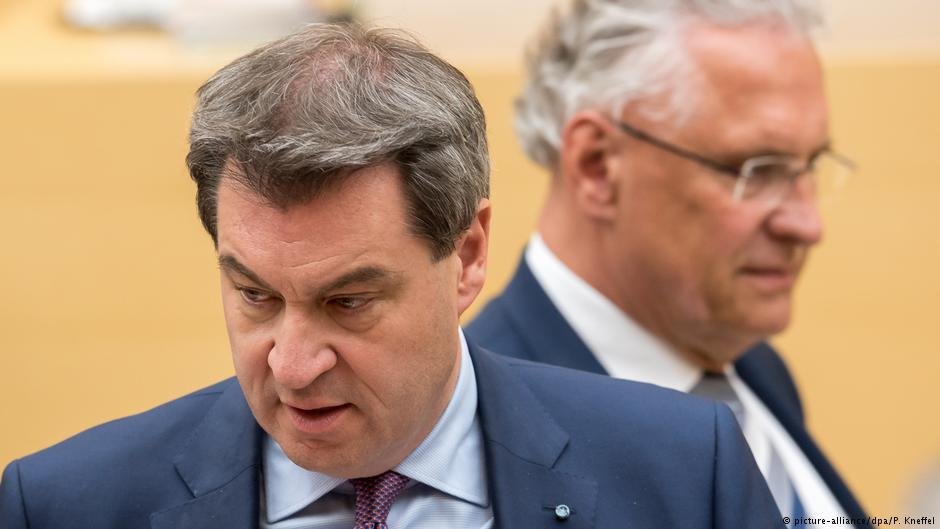
Different migration policy needed to 'reduce AfD'
Söder said on German public broadcaster ARD that his party perceives the AfD as an "extreme right-wing party," and that a different migration policy is needed to "reduce the AfD significantly."
His party, the CSU (the sister party of the Christian Democrats, or CDU) has run Bavaria since 1957, but was projected to win 37% of the vote in that state – its worst result since 1950. This may weaken Söder's chances for his candidacy for the conservative block ahead of the 2025 federal elections.
Meanwhile, Scholz's Social Democrats were projected to get less than 10% of the vote in Bavaria, which many commentators have blames on German Interior Minister Nancy Faeser's handling of a rise in irregular migrant arrivals.
'Illegal migration must be stopped'
In response to the AfD's gains in Bavaria and Hesse, CDU Secretary General Carsten Linnemann said his party is "ready to sit down constructively" and give the coalition government another change to cooperate on migration policy.
He said the goal must be the same for everyone: "Illegal migration must be stopped."
"After all, we can see that things are tilted in Germany," Linnemann said. Schools and daycare centers don't have enough staff to care for children, he stressed, adding that the social burden was also becoming evident in the healthcare system.
"That's why action must be taken," Linnemann underscored.
Jens Spahn, the vice chairman of the CDU/CSU parliamentary group, echoed similar sentiments following the elections.
"We can't manage anymore. That's what the mayors, the district councils are telling us," he told German broadcasters RTL and NTV on Monday.
With DPA, AFP and Reuters