
In Portugal, migrants cannot afford the high rents demanded by landlords as even the remotest urban neighborhoods fall victim to gentrification. Many have resorted to living in tents on the outskirts of urban areas.
On the outskirts of Lisbon, a tent city of foreigners is mushrooming. A tourism boom over the past decade has priced many out of the Portuguese capital and gentrified areas previously reserved for lower-income households.
Rents have increased some 65% since 2015, while sales prices have skyrocketed at more than twice that rate, according to local housing data specialists quoted by Reuters.
Portugal has one of Western Europe's lowest average income rates, with monthly wages hovering around €1,200. Migrants often earn even less, with Brazilians -- who make up 40% of Portugal's migrant community -- earning around 20% less, according to the Migration Observatory.
Read more: Portugal amends law to facilitate immigration
Housing: a human right
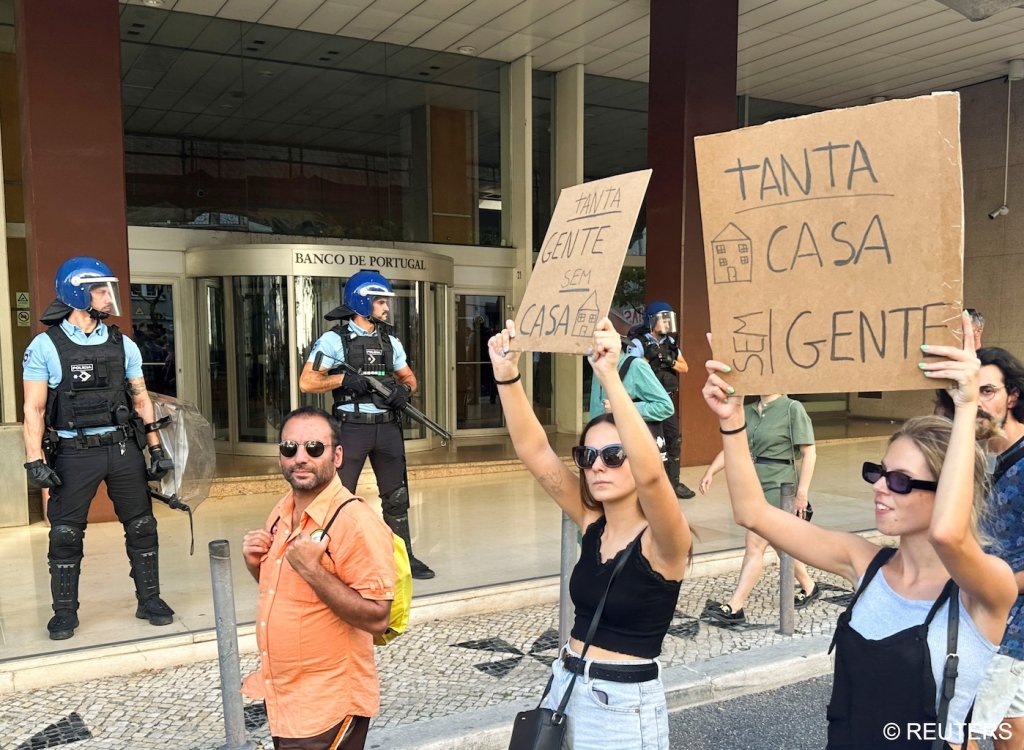
Rallies to protest this growing trend took place in Lisbon, Porto and other cities in recent days, with demonstrators carrying banners reading "Housing is a right!" and other slogans.
Their criticism is largely directed against the country's Socialist Party government: many accuse it of protecting landlords and not the people.
The government announced earlier this year that it could take some measures to ease the crisis, including curbs on private short-term holiday rentals on platforms like AirBnb. However, by its own admittance, this is not enough to reign in the problem.
During the COVID-19 pandemic, Portugal introduced emergency measures to provide migrants and refugees with emergency shelter amid successive lockdowns, moving them into hotel accommodation and empty flats. However, no follow-up solution was presented for post-pandemic conditions.
Living in a tent to save money
Among the protestors at the weekend's rallies was 43-year-old Marcia Leandro, who moved to Portugal from Brazil six months ago.
When she first arrived, she found a bunk bed in a shared room in Lisbon for €230 a month.
She came hoping to train as a chef, but had to accept a job as a cleaner. After losing that job, Leandro could no longer afford the rent. She decided to move into a tent instead.
"I'm just living here to save money ... I'm here so I can achieve my dream," she told Reuters, adding that current rent prices are "absurd."
But even if her fortunes changed, it is unclear whether Leandro could succeed in living on her own: according to Portugal's 2021 census, nearly 38% of the country's foreign population live in overcrowded households.
The main reason for this is the fact that migrants often face discrimination in access to housing, according to local rights groups. Those without official papers fare even worse.
Both migrants and locals suffering
Locals, like 31-year-old Dinis Lourenco, also joined the protests in support of more just housing solutions in the city.
"The housing situation is completely unsustainable," Lourenco said, adding that salaries would have to increase "significantly" in order for people to afford rent.
"There have to be rent controls, a solution for rising interest rates," he added.
"People are suffocating because of housing," said Marcia Leandro's neighbor Costa, who also moved to Portugal from Brazil.
Half of her monthly wage of €800 goes towards her rent. She lives in a dwelling in her landlord's garden.
Read more: Portugal to move asylum seekers to vacant tourist apartments
Housing shortages across Europe
Elsewhere in Europe, people are complaining of similar housing shortages amid a surge in migrant arrivals.
Dublin, London, Brussels and Berlin are among other European cities where migrants in particular are feeling priced out of the rental market.
With local populations competing for the same limited spaces, anger has repeatedly boiled over in Dublin in particular, with many people in Ireland demanding that foreigners be moved elsewhere.
However, many refugees, migrants and asylum seekers prefer to remain in urban areas, where they see more opportunities and access to informal economies that can help them where government support fails — which in extreme cases can extend all the way to irregular solutions for housing issues.
Read more: Ireland: Visa requirement for refugees changes
with Reuters