
A tough exchange in Germany's Parliament on the country's course in migration policy took place on Friday, with German opposition lawmakers calling for a migration crackdown. The debate took place against the backdrop of a rise in irregular migrant arrivals and increasing support in the polls for parties with tough migration policies.
On Friday (September 22), German center-right opposition lawmakers attacked federal Interior Minister Nancy Faeser during a parliamentary debate, calling for a change of course in migration policy.
In a tit for tat, CSU state group leader Alexander Dobrindt accused social democrat Faeser of torpedoing an agreement at the European level on better migration management. Faeser, on the other hand, accused the CDU and CSU Union parties of electioneering on the backs of migrants and refugees. Two key German states, Hessen and Bavaria, head to the polls next month (October 8) and so all parties are keen to position themselves ahead of these elections.
"Don't continue on the misguided path of political campaigning on the backs of people who are threatened by war and terror," Faeser said.
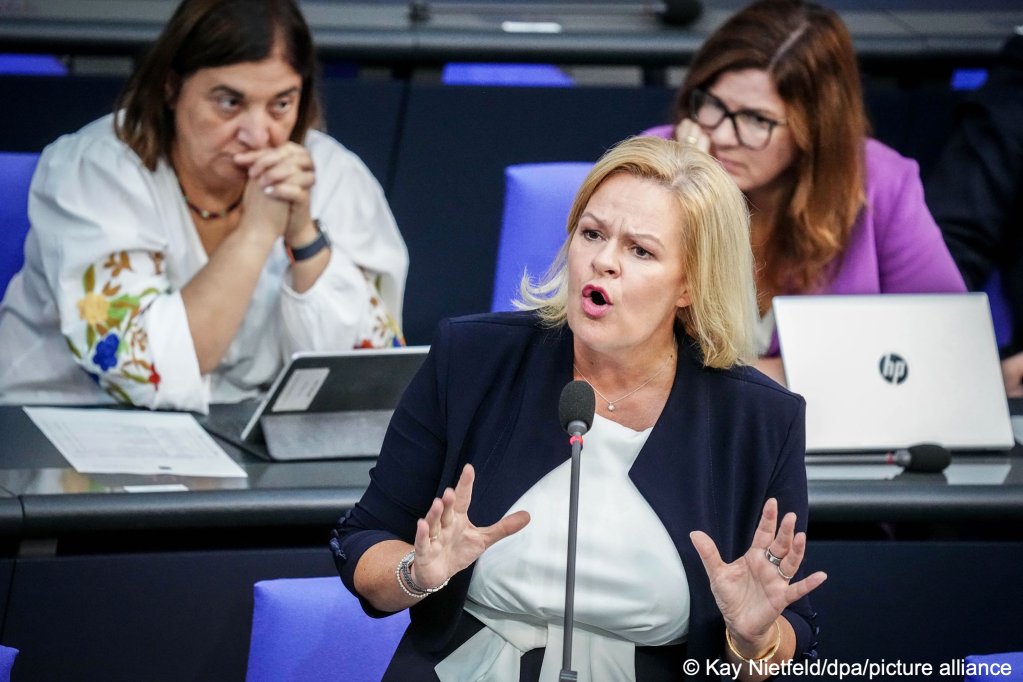
The minister also said there are no easy solutions and accused the CDU/CSU of trying to exploit debate over migration for political gain. She said a 200,000 person annual cap on migration proposed by the CDU/CSU was mere populism that only strengthens the far-right.
Several German politicians have recently proposed a cap on the annual number of migrants and asylum seekers, including conservative opposition leader Friedrich Merz.
On Friday, Germany's Federal Police reported 14,701 irregular border crossings in August, another significant increase of such unauthorized entries. This was 66% more than in the same month in 2022. According to the report, a total of 70,753 irregular entries were recorded for the first eight months of the year, up from just under 45,000 in the same period in 2022.
According to a survey commissioned by German news outlet Spiegel, 84% of Germans now think that too many people are currently coming to Germany to apply for asylum.
Faeser, ministry deny plans for family reunion
Interior Minister Faeser also rejected a press report about plans to expand family reunification for refugees.
A draft bill with new proposals for family reunification as part of the 'Family and Labor Market Integration Act' (Familien- und Arbeitsmarktintegrationsgesetz) was reported by the newspaper Welt am Sonntag and was picked up by other media outlets circulating Friday morning.
According to the media reports, Faeser was planning to make it significantly easier for migrants to reunite with their families.
But by late morning on Friday, the federal Ministry of the Interior denied the media reports, saying it wasn't currently planning any new legal regulations to facilitate family reunification for refugees.
According to a ministry spokesman, the draft cited in Welt am Sonntag was a year-old working draft from the ministry's migration department that wasn't currently being pursued further. Facilitation of family reunification is currently not a priority in view of the tense accommodation situation in the municipalities, the spokesperson added.
Also read: Germany -- crime statistics and migration
Opposition lawmakers call for migration crackdown
During Friday's debate, Germany's conservative Union parties (CDU/CSU) also called on the country's three-party coalition government to sharply limit the number of asylum seekers allowed in the country.
Members of the Christian Democratic Union (CDU) and its Bavarian sister party the Christian Social Union (CSU) introduced a proposal in Parliament that would "noticeably reduce irregular migration in order to relieve the burden on the federal, state and local governments, news agency dpa reported.
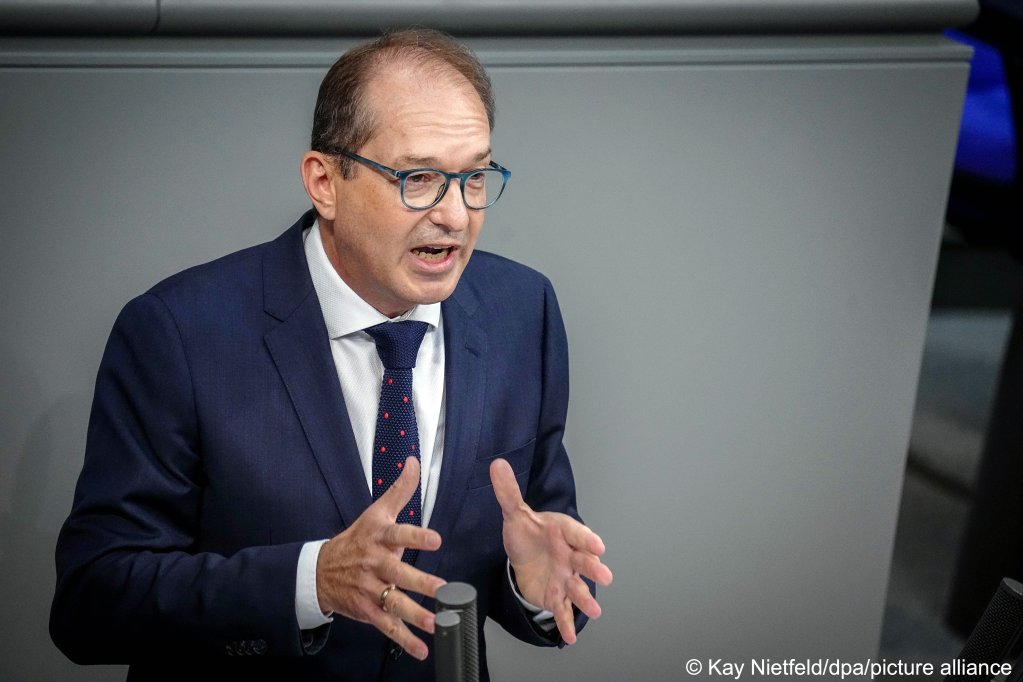
"We offer to solve this issue together, because otherwise it can develop into a major social conflict," aforementioned CSU politician Alexander Dobrindt said.
Dobrindt said asylum numbers in Germany are rising, municipalities are overburdened and social acceptance of migrants is waning.
According to official figures, Germany has received around 175,000 asylum requests in 2023 -- excluding more than one million refugees from Ukraine, who go through a special asylum process that the EU introduced in light of Russia's war.
Across the EU, the number of first-time asylum applications has also been rising significantly in June compared to the same month last year. 83,385 people applied for asylum in June, 25% more than in the same month of 2022, the EU statistics office Eurostat announced on Friday.
Germany, Spain, France and Italy accounted for 75% of all applications for protection.
The debate comes on the heels of Germany's Federal President Frank-Walter Steinmeier warning on Wednesday (September 20) that Germany has reached "a limit" when it comes to accepting more migrants.
Call for expansion of 'safe countries' list
Politician Dobrindt said the CDU/CSU proposal calls for expanding the list of so-called safe countries of origin -- which allows for accelerated asylum procedures and potentially swifter deportations -- to include Georgia, Moldova, India, Tunisia, Morocco and Algeria.
Earlier this month, representatives of both Germany's governing liberal Free Democratic Party (FDP) and the opposition CDU/CSU called for the resumption of deportations of convicted criminals to Afghanistan. The development followed another debate about designated safe countries of origin.
Dobrindt also said that Germany should work to speed up deportations of migrants whose asylum claims have been denied as well as re-establish controls along the borders with Poland, the Czech Republic and Switzerland to prevent migrants from traveling to Germany from southern and eastern Europe.
Dobrindt also accused Interior Minister Faeser of blocking needed migration reforms at the EU level.
Faeser rejected the criticism and pointed to government policies, including cooperation with Czech and Polish border guards, as evidence that "our measures are working -- we control and regulate migration."
Also read: Where Germany stands on refugees and asylum
Rise in right-wing extremist attitudes
Friday's debate took place against the backdrop of a rise in right-wing extremist and racist attitudes among Germans.
Around 8% of Germany's 83 million inhabitants have a closed right-wing extremist worldview. That's according to the latest 'Center Study' by the Friedrich Ebert Foundation, which is associated with Faeser's social democratic party (SPD).
This is a considerable increase compared to previous years, when the proportion was between 2%-3%. The proportion of people who do not clearly reject right-wing extremist attitudes and are thus open or susceptible to right-wing attitudes has also increased.
In addition, the proportion of people with racist attitudes has more than tripled since the previous survey two years ago. For example, one in four agreed with the statement: "Foreigners only come here to exploit our welfare state."
Moreover, one in two Germans said they were frightened of refugees coming to Germany; that's according to another survey from May.
This finding echoes similar concerns from 2016, when the arrival of hundreds of thousands of refugees and asylum seekers mainly from Syria triggered a xenophobic backlash, giving rise to the Alternative for Germany (AfD) as a significant political force.
The far-right, partly fascist party currently polls at 21%, second only to the CDU/CSU and ahead of the social democrats and Green parties.
Three eastern German states - Brandenburg, Saxony and Thuringia -- will vote in September 2024. In all three states, the AfD was recently ahead in the polls by more than 30%.
Read more: Hit by new record numbers, Germany and EU seek new solutions to mitigate migrant arrivals
Municipalities 'can no longer cope'
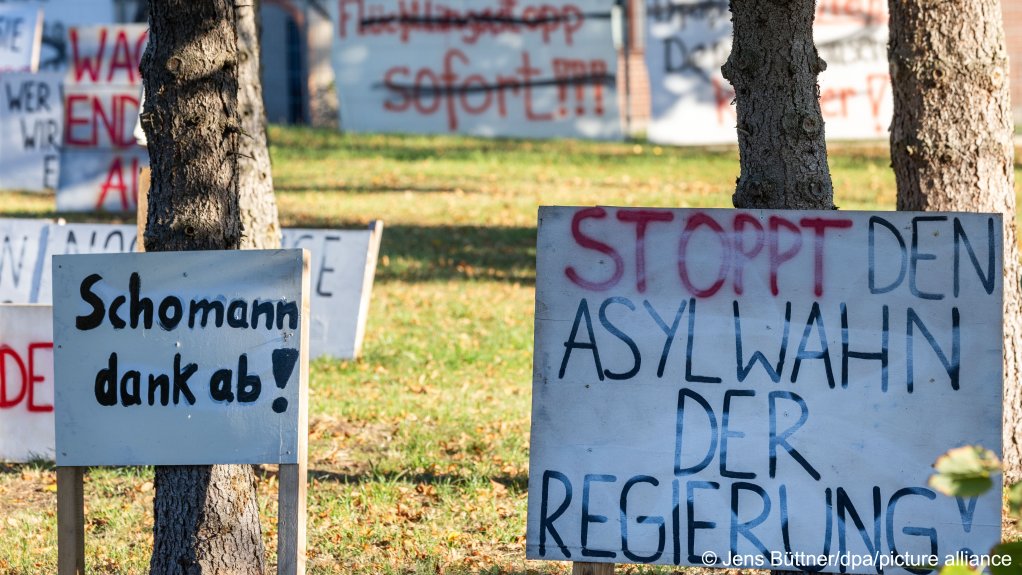
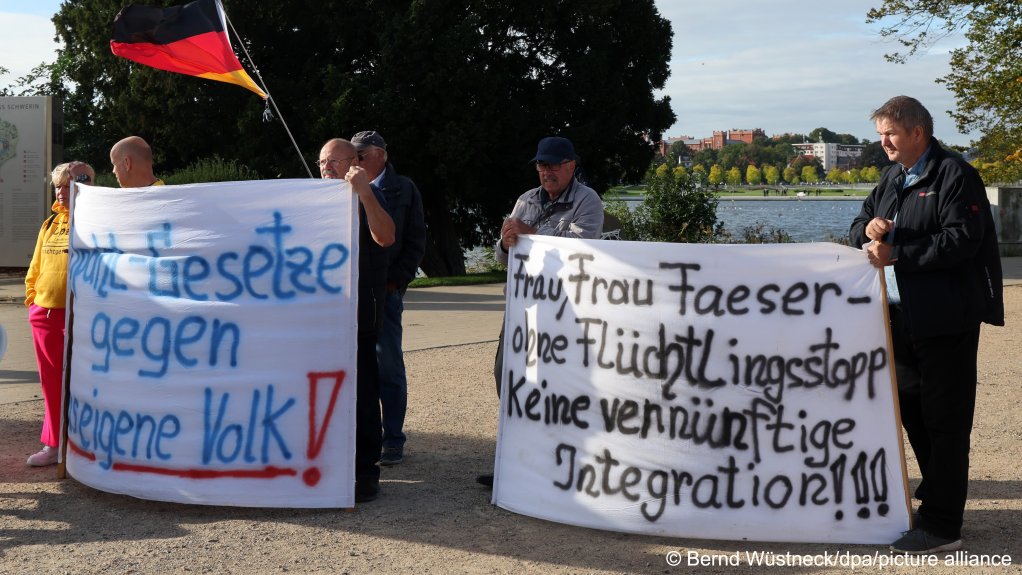
Many municipalities in Germany are finding themselves overwhelmed by the workload of taking in and integrating people who have fled their home countries. Finding housing is particularly difficult. Citizen protests have been staged in some areas, like in the north-eastern state of Mecklenburg Western Pomerania against proposals to build centers or house asylum seekers and migrants in their region.
On Friday (September 22), the Minister President of another German state Saxony-Anhalt, Reiner Haseloff, said he expected serious problems in Germany if irregular arrivals continue to increase as they have in the past.
People who are really entitled to asylum and need help can no longer be helped effectively, Haseloff claimed. In addition, municipalities and states could get into a situation "that they can no longer cope with." He added that in that situation cities, states and regions might find it difficult to guarantee accommodation, social support and schooling.
According to information from federal police, close to 15,000 refugees and migrants were detected at the 460-kilometer long border between Poland and Germany in the first seven months of this year. This is 2.5 times as many unauthorized border crossings as in the same period last year. On Monday, German police said they arrested a 15-year-old Syrian who was behind the steering wheel of a van with 27 smuggled people on board.
Meanwhile, the German government is seeking to attract migrants to fill some 2 million jobs. Lawmakers voted in June in favor of reforming the skilled work immigration law.
with KNA, dpa, AFP