
The correlation between crime and migration is often emphasized in media and political rhetoric. The latest 2022 statisics do show an overall rise in crime committed by non-Germans in Germany, but let's take a closer look.
The latest German Police Crime statistics (PKS), relating to 2022 show that the overall number of crime suspects rose by 10.7% compared to 2021. Out of the 2,093 782 crime suspects, over a million (1,309 906) had German citizenship and almost 800,000 (783 876) were suspects without German citizenship. This cateogry, notes the police also includes tourists and people entering the country specifically to commit crime.
The numbers of German crime suspects rose by 4.6% and the numbers of non-German crime suspects went up by 22.6%. Within this "non-German" category, the police say that 310,062 were migrants. They also add that the numbers of migrant crime suspects rose by 35% compared to the previous year. This includes violations of immigration law, that obviously can't be committed by Germans. If we don't count those violations, the number of migrant crime suspects rose by 11.9%
These kinds of statistics feed well into the kind of political rhetoric and media headlines that highlight a link between migration and crime rates. Yet that is not always the full story. The Migration Media Service, which describes itself as an information platform for journalists and media professionals on migration, integration, and asylum in Germany, notes that the stereotype of the criminal migrant as "young, male, delinquent" is widespread and often politicized.
Recent political debates in the country have also centered around crime committed by foreign nationals, which is said to have increased due to an influx of refugees, migrants and asylum seekers. However the service notes that in most cases, the prejudices do not correspond to the data or research conducted in this area.
Also read: 'People of Deutschland': Everyday racism in Germany
Crimes committed by non-Germans
One thing to note is that immigrants are often also more likely to be the victims of crime, especially hate crimes than German people in the country. The number of criminal offenses also include immigration violations, these are offenses that cannot be committed by Germans at all.
However, "non-German" suspects are disproportionately represented in the police crime statistics, making up only 12.7% of the total population in Germany.
One reason for overrepresentation of migrants in crime statistics are demographics such as age, gender and the socio economic situation of the suspects, as well as police behaviour towards non-Germans. For example, young men are generally more likely to commit crimes than other sections of society. Migrants in Germany are on average younger and more often male. Difficult living conditions, and a lack of access to labor and housing markets, also increases the statistical risk of committing crimes.
In addition, there is evidence that members of minority groups are more likely to be stopped by the police and to be reported by victims more often than other members of the community. In turn, minorities are less likely to trust the police and report crime themselves.
Half of crimes are immigration violations
In 2022, the number of non-German suspects was around 310,062 people. If we do not count violations of immigration law -- since these can only be committed by non-German suspects in the first place -- the number of suspects is less than half at 142,72.
Of the immigrants suspected of committing crimes in 2021, 86.4% were male. 57.7% were under 30 years old. Most immigrants in 2021 came from Syria, Afghanistan and Iraq. However, their share in the total number of suspected immigrants is disproportionately low. Therefore, people from the main countries of origin of migrants that year were involved in crime at a lower rate than the general population. On the other hand, suspects from countries such as Nigeria, Algeria and Georgia are disproportionately represented.
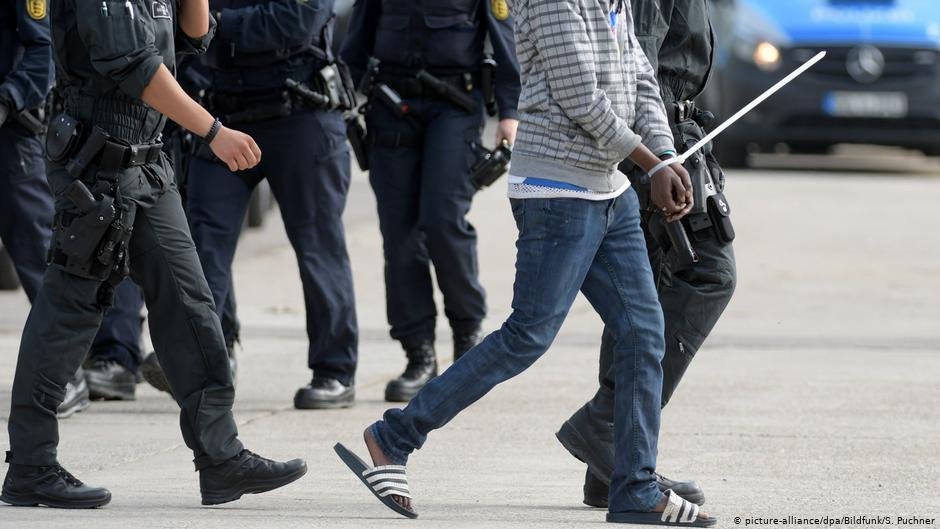
Crimes committed by refugees are not explicitly recorded in the police crime statistics. However, both the crime statistics and the federal crime report in the context of migration by the Federal Criminal Police Office (BKA) include the number of suspected "immigrants". The BKA defines "migrants" as asylum seekers, persons entitled to protection and asylum, persons with a tolerated stay status (Duldung), refugees, as well as people who are in Germany without permission. The BKA also includes people who enter Germany specifically to commit crime in the category of "migrants".
Also read: Germany halts deportation of Kurdish couple evicted from church asylum
Significance of the country of origin
We have already established that, according to the statistics, the majority of crime suspects (86.4%) are men. However, Syrian migrants are underrepresented in Germany's crime statistics. This could be due to the fact that the majority of Syrians were granted protection status in Germany and were then eligible for the possibility of family reunification. That means that many women and children were also able to join their male family members. This changes the demographics of an immigrant group significantly.
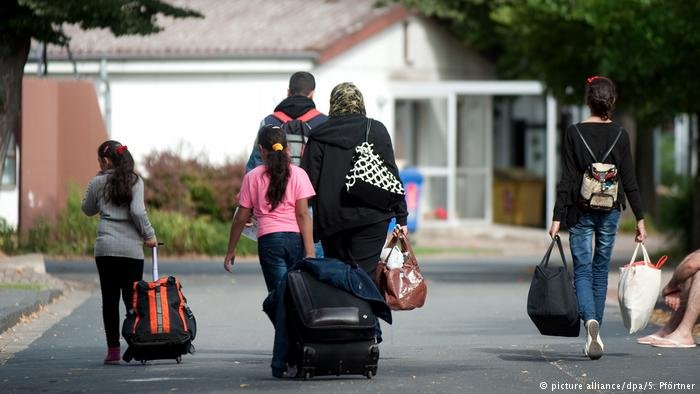
In terms of migrants who are suspected of committing crimes, according to criminologist Christian Walburg, two other explanations are being discussed in current research. One is the theory that it is not a cross-section of the population that emigrates (and migrates to Germany) from certain countries, but rather people who have a higher risk of committing a crime tend to do so more often. For example, because they tend to be more vulnerable to poverty or have experienced violence themselves in the past.
In his research paper, Walburg also provides another explanation, for example that people who are offered fewer opportunities and prospects in Germany have a higher risk of committing crime. People from countries with a good chance of obtaining a right to stay -- such as refugees from Iraq or Syria, also have better prospects for integration and employment opportunities as a result. People from countries with a lower likelihood of obtaining a right to remain in the country such as people from Algeria, Tunisia, Morocco often do not have access to the same opportunities, and therefore also might feel they have less to lose if they are caught.
Also read: Rise of Germany's far right may deter skilled workers
Charges against migrants more likely
In 2018, Christian Pfeiffer, the former director of the Criminological Research Institute of Lower Saxony, and his team published the study entitled "On the Development of Violence in Germany - Focal Points: Young People and Refugees as Perpetrators and Victims." The study concluded that if the perpetrator is unknown to the victim, the reporting rate increases. If the perpetrator is someone from the victim's social circle, victims are more reluctant to report them. This is often due to fear of having to justify the report, or even being put under pressure by the perpetrator.
A similar basic pattern emerges when the perpetrator is not only unknown to the victim but is also non-German. For migrants, this could result in an increased probability of being reported for a crime, according to another finding of the study. However, there is also a higher likelihood of reporting if the victim and the perpetrator are both non-German but from different ethnic groups.

When the victim is non-German and the perpetrator is German, victims are "significantly less likely to report the crime than other perpetrators who are ethnically foreign to them." The researchers explain that the young people from the migrant groups they surveyed "sometimes assume that the German police are partial to the German perpetrator they accuse and therefore refrain from reporting the crime, or that they generally shy away from contact with the German police."
This assessment is also shared by the Bund Deutscher Kriminalbeamter (BDK), a trade union association of police officers. On its website the BDK states "that Germans are more inclined to go to the police and file a complaint than perhaps immigrants who have just arrived here." A lack of trust towards the police, both due to past experiences in the country of origin or negative associations in Germany, as well as language barriers are likely to play a role here too.
Also read: A criminal conviction is not enough for refugee status to be revoked, ECJ
Attacks against refugees
German authorities have confirmed that the number of attacks committed against asylum seekers rose in the first quarter of 2023, compared to the same period last year.
According to preliminary data, in the first half of 2023 there were 704 attacks against refugees and 80 attacks on asylum seeker accommodation. This is significantly higher than the first half of 2022, where there were 544 attacks against refugees and 52 attacks against their homes.
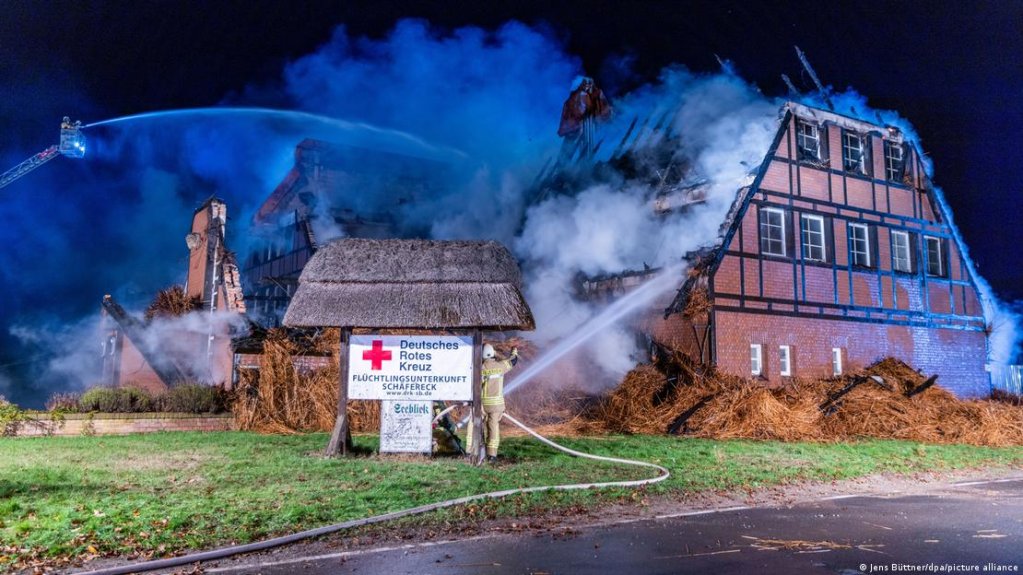
According to the German government, there were a total of 1,420 politically motivated attacks on asylum seekers and refugees in 2022. Most of these crimes (83%) were politically motivated by the far-right. With an increase of 69%, the number of crimes against asylum seeker accommodation reaching 120, these attacks increased significantly compared to the previous year. The number of violent crimes against refugees also increased, rising by 22% to 278 that year.
In 2021, there were 1,254 such politically motivated offenses, according to federal government data. A large proportion were offenses against refugees and asylum seekers outside their shelters (1,184). In all crimes, a total of 165 people were injured, including 10 children. The authorities classify most of these crimes, over 90%, as politically right-wing motivated crime.
A study by the Amadeu Antonio Foundation shows that attacks against refugees are insufficiently reported by the authorities, indicating that these offenses are not taken seriously.
A report by the German public regional broadcasters Südwestrundfunk and Bayerischer Rundfunk shows that attacks on refugee shelters are rarely prosecuted in court. Between 2015 and 2018, the interior ministries of the German states registered a total of 2,558 politically motivated attacks on asylum shelters, but only 206 cases resulted in convictions. The clearance rate is therefore less than 10%.