
The deaths of more than 60 people near Cape Verde off the West African coast have caused heartbreak in the Senegalese communities they left.
The overcast sky reflected the somber mood of the villagers in Fass Boye, a coastal town in Senegal, West Africa.
The village chief, Madiop Boye, called on the villagers to pray for those "who have gone and will never come back" as mourners clutched their prayer beads and murmured religious verses, reported the news agency Agence-France Presse (AFP).
The Senegalese foreign ministry has confirmed that on 10 July, about 101 residents of Fass Boye and its surrounding villages boarded a pirogue, the long wooden canoes that dot the coastline of Fass Boye.
The colorful boats, known to cut through the waters with agility and speed, serve as vessels for fishing as livelihood and sustenance. For those on the ill-fated pirogue, they symbolized the hope of reaching Europe.
After one month of being adrift at sea, the pirogue was spotted on Monday (14 August) in the Atlantic Ocean, about 275 kilometers from the Cape Verdean island of Sal.
Thirty-eight people, including four children aged 12 to 16, were rescued from the capsized boat by a Spanish fishing vessel operated by tuna company PEVASA. According to reports from the AP news agency, a PEVASA official said the survivors were asking for help and were in a "bad state."
The International Organization for Migration reported that more than 60 people were believed to have died. According to Cape Verdean authorities, six survivors have been hospitalized.
Massame Mbaye, head of the organization of the National Union of Senegalese Fishermen (Unapas), had 16 family members on board the Fass Boye pirogue.
"Our family is probably the most seriously affected...They embarked on this journey without even saying their farewells. A most sad situation," Mbaye told media outlet Euro Day France last week.
At the time, anxiety had been mounting among the villagers of Fass Boye who had not heard from their relatives since they had set sail the month before. The discovery of the boat on Monday confirmed their worst fears.
"Our young people have been leaving by the sea for 100 years, but this is the first time Fass Boye has experienced something like this," village chief Boye told AFP.
Bring back our sons
Boye remains in contact with survivors via WhatsApp and called on the Senegalese government to "do everything possible to repatriate our sons who are still alive, and to bring us the bodies of those who have been found dead."
Senegal's foreign ministry said it is working to repatriate survivors as quickly as possible.
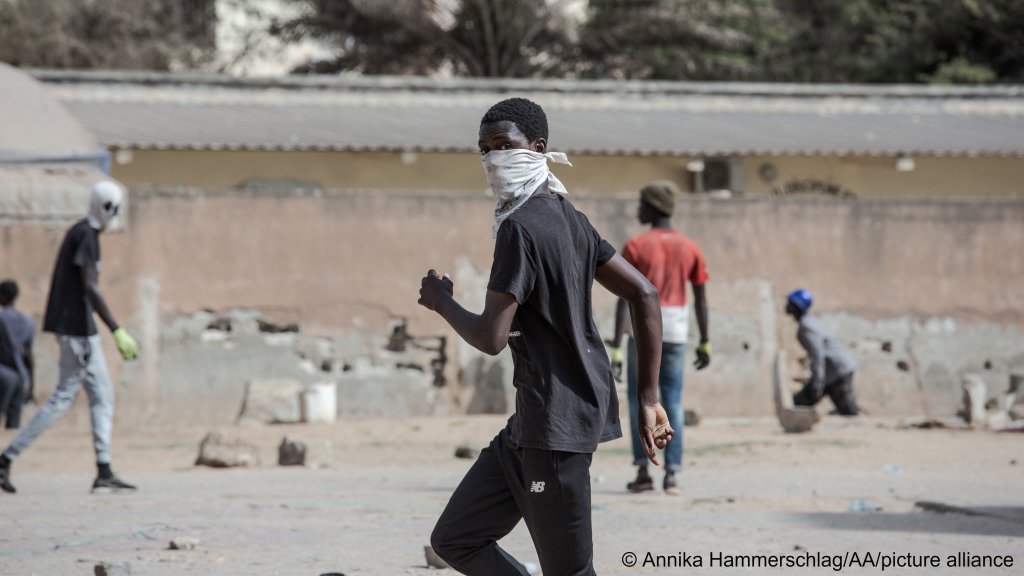
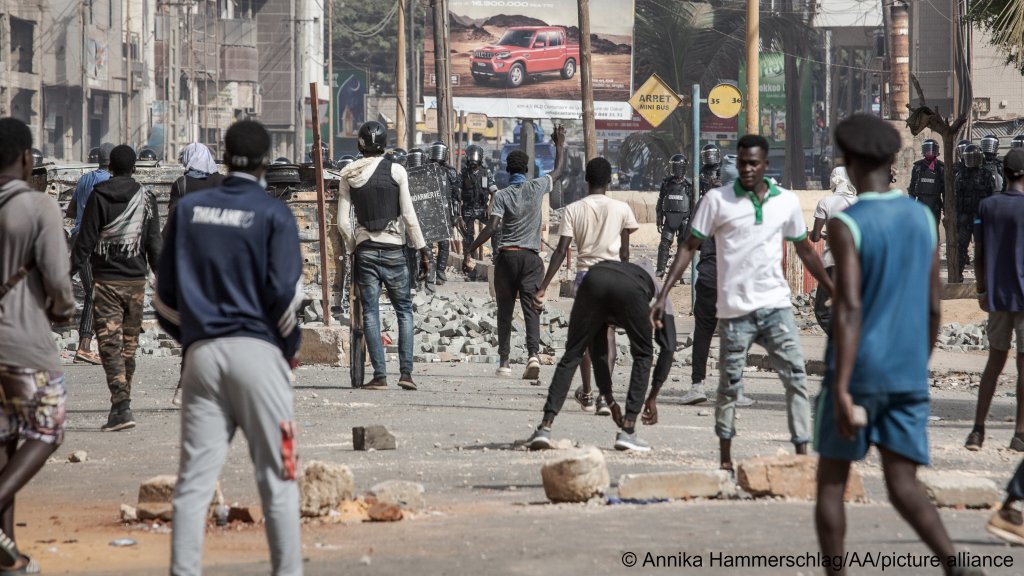
According to news reports, on Wednesday night, young people took to the streets to express their pent-up grief and anger. They burned tires and blocked the main road with tree trunks. Their resentment was targeted at authorities, whom they accused of not acting quickly enough to find the boat and save the passengers.
Tensions remained the following morning. Police vehicles parked at the town’s periphery signaled law enforcement on high alert.
The shipwrecked pirogue is the latest in a string of migrant tragedies for Senegal. On 14 July, 16 people died when their ship capsized off Dakar. A few days earlier, at least 13 reportedly died off the coast of Morocco.
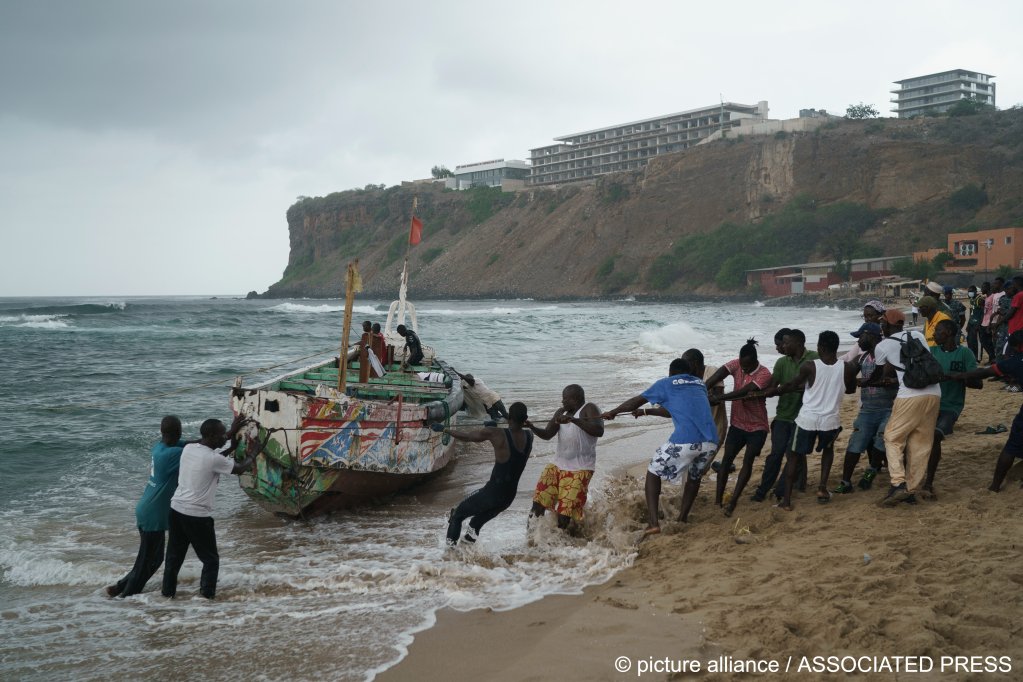
But for many Senegalese, taking to the sea is a risk willing to take for the chance to reach Europe. Some see those who have made the journey and survived as proof of the pay-off.
"Many of the youths in this village who have made it to Europe buy cars and build houses when they come back," Abdou Aziz Sene told AFP.
Sene’s 25-year-old son, who wanted the same thing for himself and his family, is among those missing.
The Western Mediterranean Route (WMR), from countries in West Africa such as Senegal towards Spain, is one of the most frequently used routes to reach Europe and also one of the most dangerous.
IOM data between January and December 2022 show that more than 15,600 people reached the Canary Islands irregularly, crossing by boats that set sail from the coasts of West Africa.
According to the IOM, the perilous journey along the WMR is taken mostly by young men who are on average about 31 years old and are mainly employed in the fishing and agricultural sector.
Transit and departure country
Senegal is both a transit country for West Africans traveling to Europe and a land of departure as thousands of Senegalese migrate, setting their sights on better economic opportunities in Europe.
Interviews with nearly 2,000 migrants in France, Italy, and Spain – the main European destinations of the Senegalese – revealed that most Senegalese viewed migration as a strategy to improve income and social standing. The interviews, conducted in 2019 by The Conversation, a non-profit online publication by academics and experts, also revealed that Europe’s labor shortage and reputed high wages were the driving factor in their decision to migrate. In addition, having relatives or friends already in Europe who could help them get settled was also a deciding factor in migrating.
About 50% of Senegal's population lives below the international standard $2.15/ day poverty rate.
In addition, the study revealed that it was not the poorest or the most affluent who were most likely to migrate. Most migrants who were interviewed had sufficient resources to pay for migration costs and had an intermediate or high level of education.
Political instability also a factor
For a long period, Senegal was seen as stable, relative to its neighboring countries.
However, the political situation in Senegal began to deteriorate around two years ago with compounded crises brought on by the COVID-19 pandemic. Since June, the country has been plagued by protests over the two-year prison sentence of opposition leader Ousmane Sonko.
Sonko, who enjoys popular support in Senegal, is the key contender in the country's presidential elections set for February 2024.
As InfoMigrants reported, the onset of the political crisis coincided with an increase in the number of migrant boats attempting the Atlantic crossing to the Canary Islands, a Spanish archipelago.
In 2022, just three boats were recorded to have left Senegal to reach the Canary Islands. Many more departed from Morocco, which is further north, to make the shorter crossing from there. Since the beginning of June, around 30 boats have attempted the longer crossing from Senegal and neighboring Gambia. Nineteen have arrived, according to Spanish daily newspaper El Pais.
Late last month, the government unveiled a ten-year plan to stem departures and human trafficking. The National Strategy to Combat Irregular Migration (SNLMI) aims to "drastically" reduce irregular migration by 2033, Interior Minister Antoine Felix Abdoulaye Diome told AFP. Funds will also be allocated for the repatriation of those who leave and their subsequent reintegration in Senegal.