
A group of around 50 Black Africans, including a four-year-old girl, say they have been imprisoned in a high school in Kebili, in southwestern Tunisia. InfoMigrants was in contact with some of them.
Since the beginning of July, Black Africans have been victims of raids by the Tunisian authorities and some have been thrown in the desert, at the border with Libya or Algeria. By mid-August after an international outcry, most have been brought back from the desert areas and sent to high schools and various other public buildings.
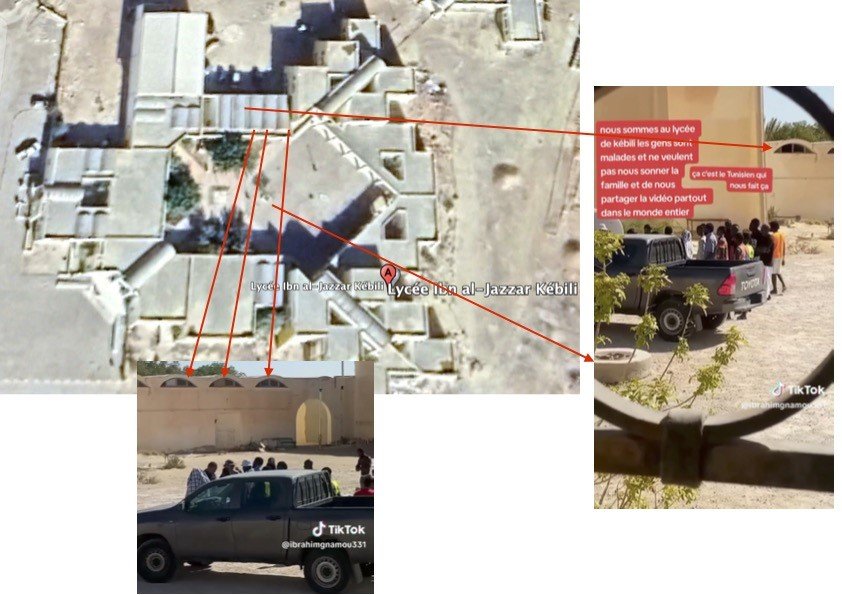
Not much news has yet emerged about the conditions in which they are living in these buildings. But InfoMigrants was able to confirm that in at least one of those high schools, in Kebili, around 50 sub-Saharans are being held against their will, with no information as to whether or not, or when they will be released.
After being alerted by videos on TikTok, InfoMigrants managed to get in touch with some of the group. "Nobody tells us anything, we don't know what's going on," Yvan-François, a 31-year-old Cameroonian from Douala, told InfoMigrants.
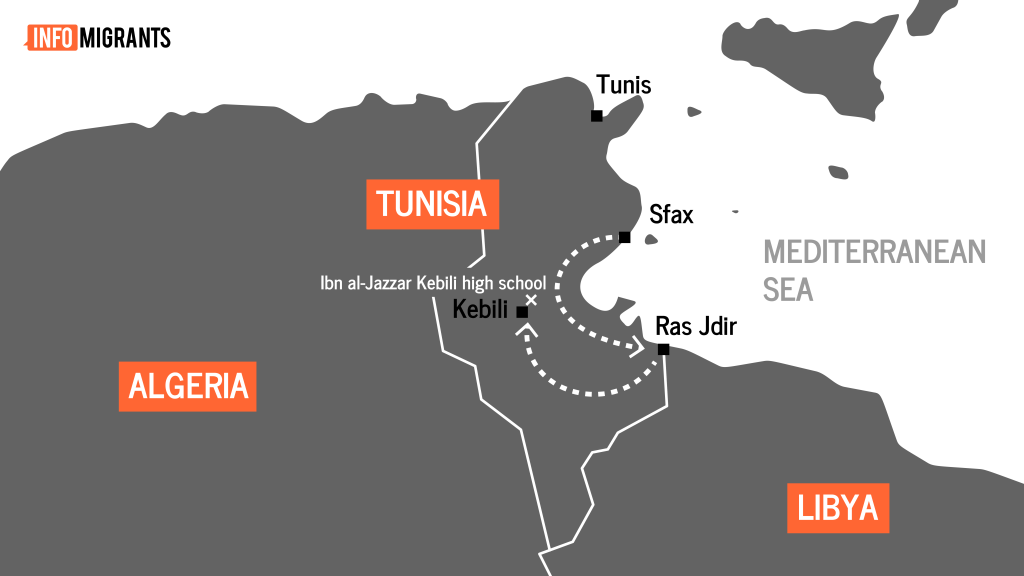
After their arrests in Sfax in early July, these 47 migrants say they were initially abandoned in the desert, at the Libyan border, for several days. Following international condemnation, on July 10, Tunisia repatriated 650 migrants from the desert area at the Libyan border. That group of about 50 sub-Saharans were repatriated by bus to the town of Kebili, about 300 kilometers west of the Libyan border. They have been held captive in the Ibn al-Jazzar high school, just outside the city limits, for a month now. Most come originally from Guinea, Senegal, Mali and Burkina Faso, as well as the Gambia. The majority of the group is male, but there are three women and a 4-year-old girl too among them.
Some of those detained say they were living in Tunisia legally before their arrest. Kadiatou Diallo, a 23-year-old Guinean student detained at the Kebili high school, is on a student visa and was getting ready to start classes next month. "I'm very worried," his mother Fatoumata Diallo tells InfoMigrants. "I didn't know that Tunisia was violent like that. I haven't slept for a month; I just watch television news about Tunisia."
'We understood that it was not worth fleeing'
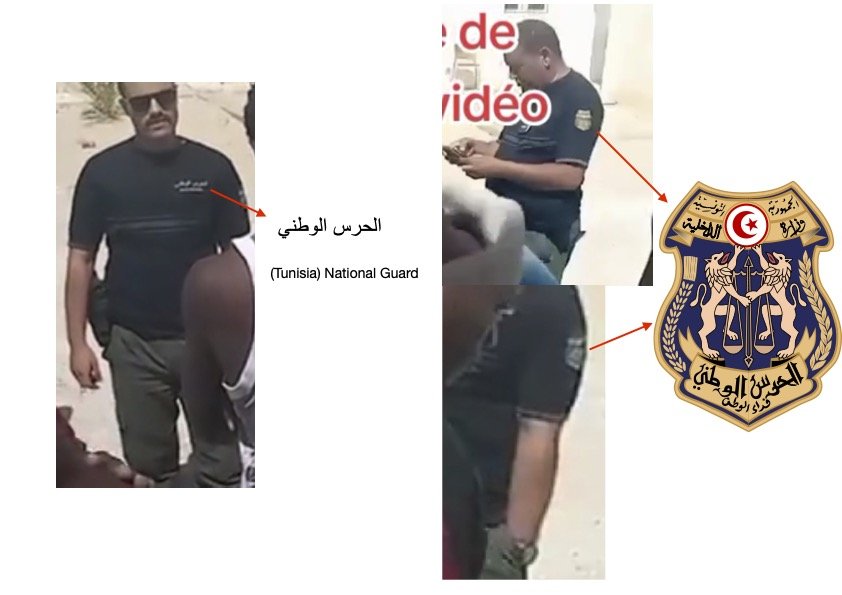
According to testimonies collected by InfoMigrants, their movements are restricted within the school grounds. The building is guarded around the clock by armed men. Through videos obtained from the detainees, InfoMigrants was able to confirm the guards are members of the Tunisian national guard.
In the videos, their uniform clearly indicates "National Guard" and bears the Tunisian National Guard’s coat of arms. Their spokesperson has not responded to our requests for comment.
"We are not allowed to walk around the courtyard. We asked them if we were in prison because we are uncomfortable. When we try to get out, they say that we do not have the right to do so. Even when we ask permission to go and buy products in a shop, we are told that it is forbidden," explains Yvan-François.
Three weeks ago, the young man tried to flee but was caught by the Tunisian guard: "We understood that it was not worth fleeing. The citizens spot us in the street and denounce us immediately. And then the thirst catches up with us quickly," he says.
Their case seems far from isolated. On July 11, the General Union of Tunisian Workers (UGTT) complained in a press release about the fate of around one hundred migrants housed in a public building in Ben Gardane, in southeastern Tunisia. "The education unions in the Ben Gardane region refuse to welcome 121 illegal migrants in the [city] Institute", the powerful union wrote. Another group of around 50 sub-Saharans was reportedly being housed for several weeks in Remada, in the governorate of Tataouine.
'Guards tried to rape women in front of us'
Yvan-François arrived legally in Tunisia five years ago, applied for asylum but was denied it. According to him, his irregular administrative situation was never an issue, until last July. In a racist speech last February, Tunisian President Kaïs Saïed accused sub-Saharan migrants of being the source of "violence, crimes and unacceptable acts", and of wanting to "change the demographic composition of the country." Since then, Black Africans have become targets of violence in public places, irrespective of their legal status.
This violence against Black people in Tunisia intensified following the night of July 3, when a Tunisian was stabbed to death by migrants. This acted as a light to the fuse of an explosive situation which had been building up since Saïed’s speech. That same evening, Yvan-François was expelled along with several hundred sub-Saharans to the desert, on the Libyan border. For eight days, they were abandoned in the buffer zone of Ras Jdir without being able to return to the Tunisian side or cross the Libyan border.
In this zone, away from the cameras, the migrants were victims of numerous acts of violence they say: their identity documents were torn up, their money stolen, some were beaten, and women were subjected to sexual violence. While defending these women from Tunisian soldiers who were trying to attack them, Yvan-François was clubbed on the ankle. "Guards tried to rape women in front of us, we tried to protect them. When you try to protect them, you get beaten with clubs. They even hit pregnant women," Yvan-François told InfoMigrants. He says he only has his shorts and shoes left on him at the high school.
Return to Tunisia
After several days in the scorching desert heat, the Tunisian guard divided the migrants into several groups and repatriated them on July 10 by bus to public buildings such as in Medenine, Tataouine and Ben Gardane, reported the French Press Agency Agence France Presse AFP.
Yvan-François' group was dropped off at the Ibn Al-Jazzar high school in Kebili. The Tunisian Red Crescent has since brought food, water and clothing to the migrants, state social reports on social media. But the migrants say it is far from enough for 50 people held up in the "boarding school." "We don't eat well. The Red Crescent brings us food that is past its sell-by-date, the water is not good. There are people who have fallen ill, who have no clothes or shoes. I myself haven't gone to the toilet for three days," Yvan-François told InfoMigrants.
In addition, one of the women in the group suffers from diabetes, say some of the group. In a video posted on TikTok, an ambulance is seen parked by the school. According to Yvan-François, this migrant saw her health deteriorate and was not able to access medical treatment for a month. "Her fingers and feet started to swell, but the guards refused to take her to the hospital, we had to go on a hunger strike for two days for them to do something. She is better since she came back from the hospital." National and local leaders of the Tunisian Red Crescent did not respond to our multiple requests for comment.
Documented sub-Saharans among those rounded up
The composition of the detainees appears to suggest that the round-ups did not just target migrants who were in the country without the correct papers. For example the case of Kadiatou Diallo illustrates that. "My daughter was going to start accountancy training," her mother told InfoMigrants. "She arrived legally with a 3-month renewable visa, she has her passport up to date, the school certificate and the school paid for." On the night of July 3 to the 4, the police came for her, at 4 a.m. while she was doing her nighttime prayers. When she explained her situation to them, they didn't want to know anything," her mother added.
The young woman does not seem to be the only one in this situation. In one of the TikTok videos shared by one of the the group, we can clearly hear one of the men shouting with frustration at a Tunisian guard: "we are students!" he says.
This situation echoes the testimonies collected by the NGO Human Rights Watch, which reported the presence of registered asylum seekers, or consular card holders among those expelled to the desert.
'I feel overwhelmed, I don't know where to go'
After a month being locked up in Kebili, Yvan-François has no idea what awaits him in the coming weeks. "If we are released tomorrow, given the situation in this country, I feel overwhelmed, I no longer know where to go. The only person I know here is my former boss in Tunis. I will have to go back up to see him," he said. Yvan-François worked until July as a painter in a shopping center in Sfax.
According to him, a general of the Tunisian National Guard showed up at the school earlier this week and implied that the situation could change in the coming days. On Wednesday, August 9, 43 migrants who had been housed for a month in a high school in Remada were transferred to two reception centers run by the International Organization for Migration (IOM), according to the Tunisie Numérique news site.
It remains unclear whether the same can be expected for other high schools like the one in Kebili. Questions also remain regarding the social and psychological state they will leave the place in and whether they will be able to resume their lives in Tunisia in the current hostile climate. The young Kadiatou is supposed to start studying in September.