
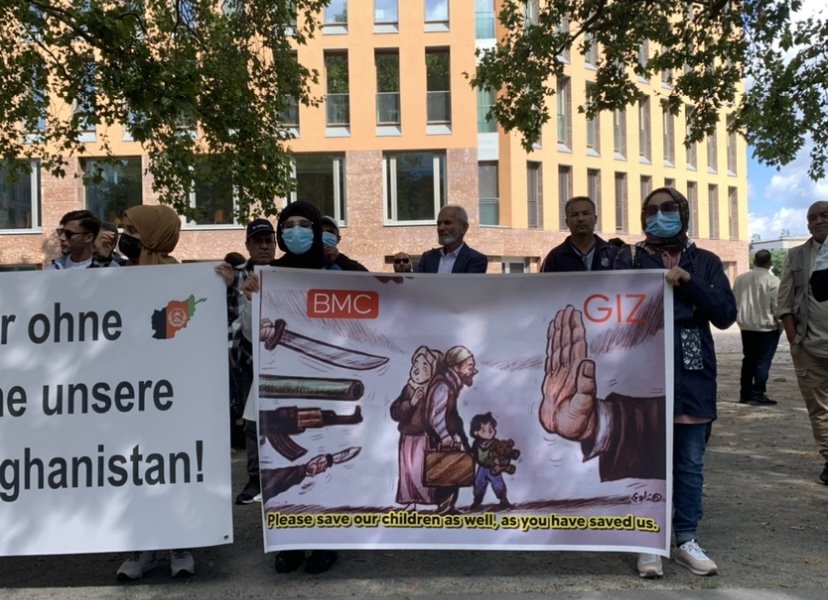
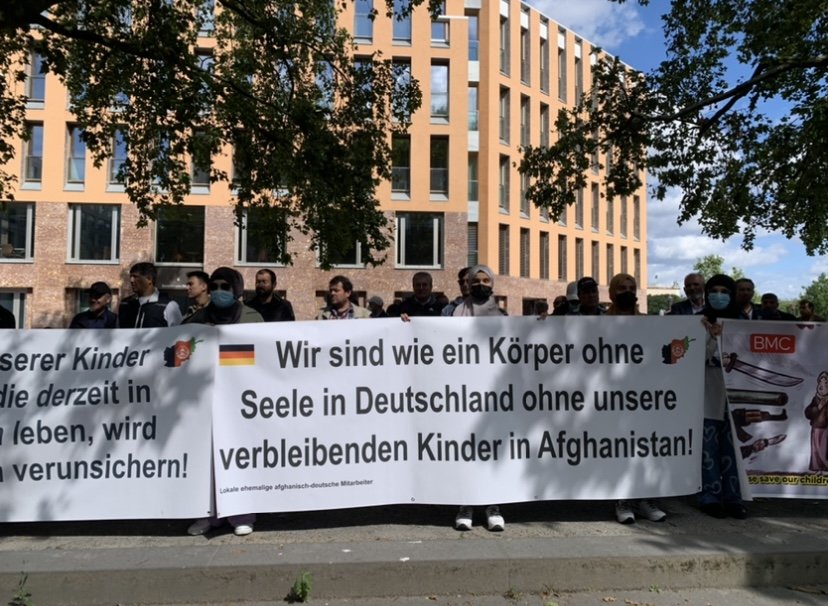
Evacuated Afghans who worked for the German government in Afghanistan protested outside the German Foreign Ministry on Wednesday (August 2). The families, who traveled from across Germany, want to be reunited with their children over the age of 18 who remain stuck in Afghanistan hiding out from the Taliban.
Basira A., her two younger sisters and her parents fled Afghanistan in September 2021. Her father worked for the German Agency for International Cooperation (GIZ) which gave them priority to be evacuated by the German government.
Although they could be considered some of the lucky ones – many German local staff remain in Afghanistan still waiting to be evacuated today, and hundreds of thousands of other Afghans sit in limbo under the Taliban regime – the evacuation nonetheless ripped Basira’s family apart.
Her three older sisters, aged 19, 20 and 22, were not allowed to be evacuated with the rest of the family due to German regulations barring family members over the age of 18 from being evacuated alongside members of local staff.
That’s despite the fact that the Taliban’s resurgence to power has stripped Afghan women of almost all their rights, prohibiting them from even being able to leave their homes to buy food for themselves.
Basira is one of over a hundred Afghans from across Germany who traveled to Berlin to protest outside the Ministry of Foreign Affairs (Auswärtiges Amt) on Wednesday (August 2). Some traveled up to 11 hours to take part in the demonstration.
Protesters thanked the German government for evacuating them from Afghanistan, but said their existence in Germany is plagued by fear and worry over the safety of their children who remain.
Also read: German evacuation program for Afghanistan mired in delays
Alone in Afghanistan
"None of my sisters have a husband," Basira told InfoMigrants. "If one of them had a husband, it would be a little better. But now, when one of my sisters is sick, they can’t go outside to go to the doctor. They aren’t allowed to go out. If one of them goes outside, the Taliban ask, 'Where is your husband? You should have a husband. Who are you? Where is your father? Where is your mother? Why are you here in the street?'"
Basira said the Taliban tried to sexually assault one of her sisters. When she refused, they beat her up, hitting her with wooden poles.
"My mother cries everyday, I cry everyday," she said. "Women’s lives in Afghanistan are terrible, terrible."
The family hasn’t received any answers from the GIZ or German authorities in response to asylum applications filed for the sisters.
17-year-old Basira said the stress is preventing her from being able to take part in German society. Her mother is so depressed she has no energy to focus on learning German, so Basira has to help her with everything, making and accompanying her to all of her appointments and any appointments for her younger sisters.
She also has to regularly visit her father, who is currently being hospitalized due to stress. She said she was offered a minijob earlier this summer to try and earn some money for the family, but couldn’t take it because caring for her family is a full-time job.
Also read: Afghan women fear for the future of their country
Constantly hiding from the Taliban
Zalmai, who was evacuated to Germany with his wife and younger children after working for the GIZ in Afghanistan for almost a decade, said his son who remains in the country lives in constant fear of the Taliban, who are targeting him because he is affiliated with someone who worked for the German government.
"Our children spend one week in one place and the next somewhere else, constantly hiding from the Taliban. This is a big problem," he said.
Zalmai said the Taliban know who his son is.
"'I cannot eat, I cannot walk, I cannot go out, because the Taliban are searching for me,'" Zalmai said his son tells him when they call each other.
Zalmai said GIZ promised to help bring the children over, but nothing has happened so far.
"Everyone here has a story like this," he told InfoMigrants, motioning to the group of over 100 Afghans.
When contacted by InfoMigrants for comment, GIZ said it is not responsible for decisions about who is allowed to be evacuated to Germany: "The federal government defines the criteria and requirements for access to the local staff procedure (OKV) – and thus its group of people. We therefore ask you to address your questions to the federal government as the responsible body."
The Ministry of Foreign Affairs did not respond to requests for comment.
Also read: Germany's Afghan refugee program 'extremely questionable,' aid groups warn
Germany’s Federal Reception Program for Afghans was temporarily halted in late March after reports of irregularities. The program was reopened in late June, but hardly anyone (around 70 people, according to German broadcasterTagesschau) has been evacuated through the program since March.
Multiple reports show the same is true for the months before March – and not only in Germany, but across the entire EU bloc.