
Almost two-thirds of Germans are against abolishing the individual right to asylum in the EU, a new survey has found. It comes on the heels of a corresponding and widely criticized proposal by a conservative German politician.
64% of Germans are in favor of keeping the individual right to asylum. That's according to a survey published on Tuesday (July 25) by the Forsa polling institute following a controversial statement last week by a conservative politician.
Only 32% of those who participated in the survey said they supported the proposal by conservative Christian-Democrat (CDU) party deputy parliamentary chairman Thorsten Frei to abolish the individual right to asylum in the European Union and replace this by setting upper limits or quotas for the admission of people in need of protection.
Only 4% said they had no opinion on the matter, according to the survey.
Last week, Frei had advocated abolishing the individual right to asylum in the EU in a guest article published in the Sunday edition of the FAZ newspaper and online, renewing the public debate on the contentious issue of asylum.
According to news agency dpa, the representative Forsa Institute surveyed 1001 German citizens for the poll on behalf of RTL Group Germany on July 20 and 21.
Also read: EU asylum reform ignores volatility of escape routes, experts say
Opposition even within Frei's own ranks
According to the Forsa survey, 88% of Green Party supporters in Germany said they were in favor of retaining the existing regulation; the figures among voters of the liberal-minded Free Democratic Party (FDP) and voters of the Social-Democrats (SPD) were at 84% and 76%, respectively.
A majority of Christian Democrat voters (56%) also rejected Frei's proposal.
Meanwhile, a majority (56%) of voters of the Alternative for Germany (AfD), a far-right populist party with a strong anti-immigration focus which currently is witnessing record-breaking support in opinion polls, said they were in favor of abolishing the individual right to asylum in the EU.
Half of all Germans hesitant about refugee influx
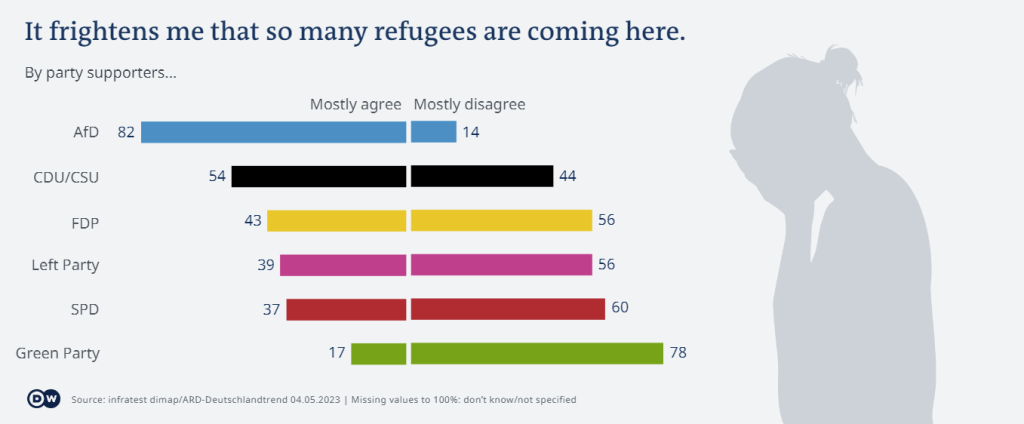
Despite a clear majority of Germans being in favor of keeping the current right to asylum regulations, one in two Germans also said they were frightened of refugees coming to Germany; that's according to another survey from May.
This finding echoes similar concerns from 2016, when the arrival of hundreds of thousands of refugees mainly from Syria triggered a xenophobic backlash, giving rise to the AfD as a significant political force.
According to Germany's Federal Office for Migration and Refugees (BAMF), more than 240,000 asylum applications were lodged in Germany last year, reaching a six-year high.
With more than 160,000 asylum requests filed in the first six months of the current year, 2023 is on track to likely surpass last year's figure.
Criticism against contentious proposal
NGOs including Pro Asyl and members of all three government parties meanwhile have strongly voiced their opposition to Frei's proposal, as immigration has become a major talking point once more with the AfD's recent rise in popularity.
Clara Bünger, spokeswoman on refugee policy for the left-wing parliamentary group, called Frei's initiative "oblivious to history."
"It is absolutely immoral to question our civilizational response to Nazi Germany, which includes precisely the right to asylum," she said on Twitter. "Protection rates are as high as they have ever been, so the vast majority of those who flee here rightly get protection status."
The individual right to seek asylum was laid down in the 1951 Geneva Refugee Convention after the collapse of National Socialism (Nazism) in Germany. It came into being at that time because other nations had failed to save more people in need of protection from Nazi persecution.
with dpa