
Crossings between Belarus and neighboring EU countries like Poland have continued despite strenuous attempts to close the border. An investigation by the Balkan Insight Investigations Team explains how smugglers are still managing to get people into the bloc.
A quick check on the Polish Border Guard’s Twitter page shows that in the last week, nearly 1,000 migrants attempted the crossing from Belarus into Poland or were discovered further into Poland, crossing the next border into Germany.
The Polish Border Guard’s Twitter page releases figures almost daily outlining the number of migrants discovered trying to cross the border with Belarus.
On July 14, the guard wrote that since the beginning of 2023, they had detained 418 people for aiding and abetting migration into Poland. The vast majority entered over the Belarusian border.
The guard detained around 400 people overall in 2022. If numbers remain steady, that number could double this year.
Also read: Poland strengthens Belarus border after Wagner chief arrival

Migrants and suspected smugglers stopped almost every day
Yesterday (July 18), for instance, border guards say they stopped two people from Turkmenistan transporting two Afghan migrants as well as a Ukrainian transporting four Indian migrants. The day before, they stopped a Polish citizen transporting five Indian migrants.
The nationalities of the migrants who have attempted the crossing are mixed. Indians, Afghanis, Bangladeshis, Pakistanis, Syrians, Iranians, Turkmens, Sri Lankans, Cameroonians, Malians, Guineans, Angolans, Gambians, Congolese, Nigerians, Senegalese, Mauritanians, Sudanese and Kurds are all listed in just the last week.
Also read: Poland to hold referendum on EU migrant relocation scheme
Belarus-Polish border crossing 'still thriving'
Although the number of attempted border crossing have been high this year, the number of detainments by the Polish border forces suggests success has been limited.
The EU has managed to make it more difficult for airlines to fly migrants in on Belarusian visas, knowing they would use this to then continue their journeys into the EU.
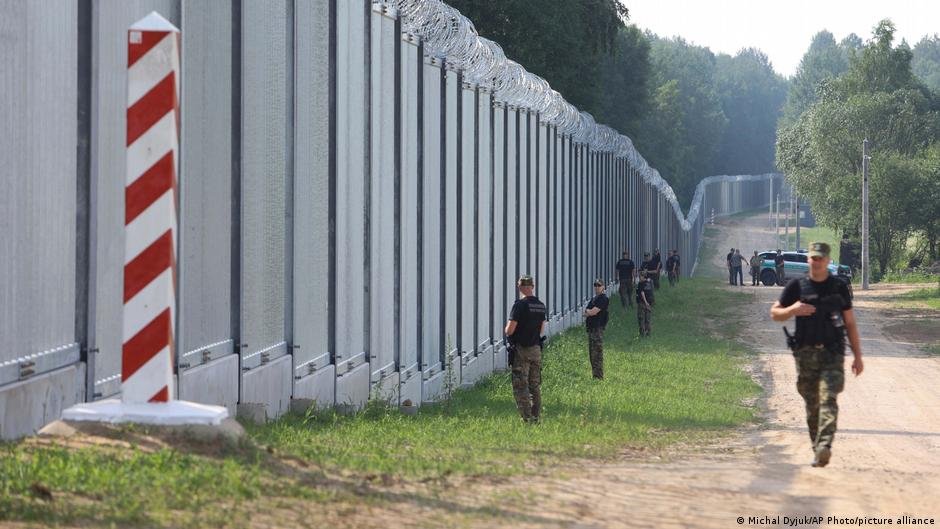
However, an investigation conducted by the Balkan news platform Balkan Insight (BIRN) reports that the business of smuggling migrants across the Belarus-Polish border is still "thriving, despite round-the-clock border patrols and a new wall."
BIRN reporters have revealed how many migrants now fly into Russia, mostly Moscow, before starting their journey toward Minsk. There are no border controls between Russia and Belarus, which has stood by Russia in its war in Ukraine.
From Minsk, migrants generally contact a second smuggler to get them across the border into Poland, and often on to Germany or other countries in Western Europe. BIRN spoke to one 36-year-old Kurdish Syrian migrant named Daryan, who is now in Germany after six months trying to cross the Belarusian border.
Daryan: Third time lucky
Daryan arrived in Poland on his third attempt to cross the border, a venture involving three different smugglers, all of whom used different guides. He eventually managed to cross via a river that forms part of the natural border between Belarus and Poland.
Previously, he attempted to scale the border fence using a ladder, and once successfully jumped over the wall only to be pushed back by the Polish border guards.
"When they [the smugglers] describe the situation, they make it sound so easy, like a picnic," Daryan told BIRN. "'Don’t think twice, just come, and in two to three days you will be in Germany,' they say."
Also read: Germany and Poland tighten border checks
Things weren’t quite so easy for Daryan.
"In the end, it took us half a year to pass through. We got beaten up by Belarusian border guards several times, and some smugglers just abandoned us in the forest when things didn’t work out," Daryan told BIRN.
Despite the difficulties, the Polish border guard told BIRN they registered between 100 and 200 crossings a day in late spring and early summer of this year.
From Moscow to Minsk and beyond
BIRN connected with multiple smuggling contacts via Telegram to reconstruct the networks moving migrants from Moscow toward Western Europe.
The migrant would need to make contact with at least two smugglers: one to get them to Belarus and another to get them to Western Europe.
To get to Belarus, the migrant would need to pay about $3,500 (about €3,119) for a Russia-based smuggler to provide them with a student or private invitation visa offering them permission to enter the country.
This money wouldn't be paid out to the smuggler until the migrant has successfully exited the Moscow airport.
Also read: Group of migrants stuck along Belarus-Polish border
From there, a taxi or car will retrieve the migrant from the airport and take them to the Belarusian capital Minsk.
This journey costs an additional $300 (about €267). One smuggler told BIRN they had enough cars to transfer more than ten people per day. Once in Minsk, migrants are taken to private accommodation, where they pay about $10 (€9) per night. BIRN notes that because the migrants don’t usually have Belarusian visas, "they tend not to be put up in regular hotels."
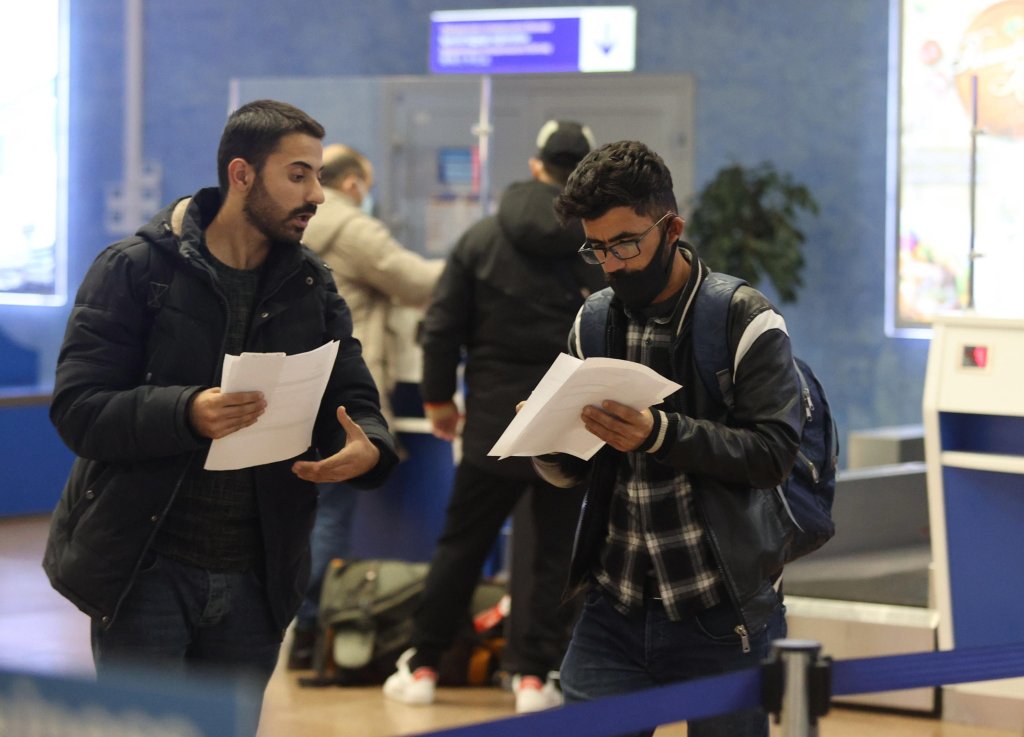
From Minsk, the migrant will contact a second smuggler, who will contact guides who promise to take the migrants from Belarus into Poland.
The migrant is required to find their way to the Belarusian-Polish border on their own.
If migrants don't want to or can't pay for a guide to take them across the border, they can pay for a geolocation pin on their phone and navigate their own way through the forest to a pick-up point in Poland, where they will be driven to Germany.
The more expensive routes involve a guide who is meant to know the forest, although Daryan’s experience suggests that many working for the smugglers may not know much more than the migrants themselves.
Most suspected smugglers appear to speak a Slavic language
Crossing the river rather than the wall costs more, BIRN found, at least with some smugglers. One demanded fees of $5,000 (about €4,458) but promised "about a 90%" success rate, because according to him, "I am the only one who has guides who work on the Polish side too."
Drivers offering to transport migrants are also recruited via Telegram, reports BIRN. The news organization found one advert offering drivers between $2,000 and $3,000 per ride (between about €1,700 and €2,600).
Also read: Several migrants found dead at border, fear over rising death toll
Videos BIRN obtained of the drivers suggest most speak a Slavic language -- generally Russian or Ukrainian, but also Polish and Czech.
This tallies with the majority of people arrested by the Polish border guard, who most often seem to be Georgian, Ukrainian or Polish.
Anna Michalska, a spokesperson for the Polish border guard, told BIRN that 174 of those arrested in 2022 for attempting to smuggle migrants were Ukrainian, 47 were Poles and 37 were Georgians. In the first half of 2023, 171 have been Ukrainian, 37 Georgian and 33 Belarusian.
This article was based largely on an investigation by Balkan Insight Investigations Team.