
The Spanish Public Prosecutor's Office has requested the opening of criminal proceedings for failure to provide assistance after at least 39 migrants died off the coast of the Canary Islands on June 21.
Last month (June 21), an inflatable boat with some 60 people on board wrecked 74 kilometers off the coast of Morocco -- around 140 kilometers from Gran Canaria -- after a severely delayed rescue effort by the Moroccan coast guard.
Moroccan rescue services didn't arrive on the scene for 12 hours, forcing the shipwrecked passengers to wait throughout the night.
A Spanish rescue boat located just one hour away did not intervene at all. The Spanish authorities have now opened an investigation into the failure and lack of coordination of the operation.
On Thursday morning (July 13), the Spanish aid organization Caminando Fronteras, which filed a complaint in the case, tweeted that the Superior Public Prosecutor's Office of the Canary Islands has asked the court to open proceedings on the shipwreck of June 21.
"This is the first time that a crime of omission of the duty to rescue has been investigated at the maritime border," the organization wrote.
According to Caminando Fronteras, the boat waited to be rescued for up to 12 hours after the Caminando Fronteras made a request to the Maritime Rescue and the Moroccan authorities.
Omission to act?
The Spanish coast guard has alleged that it did not act because the SAR (search and rescue) zone was under Moroccan jurisdiction. However, according to international law, Spain was in the best position to act and allegedly omitted to do so. The rubber dinghy sank long before the Moroccan rescue ship arrived on the scene after hours of delay.
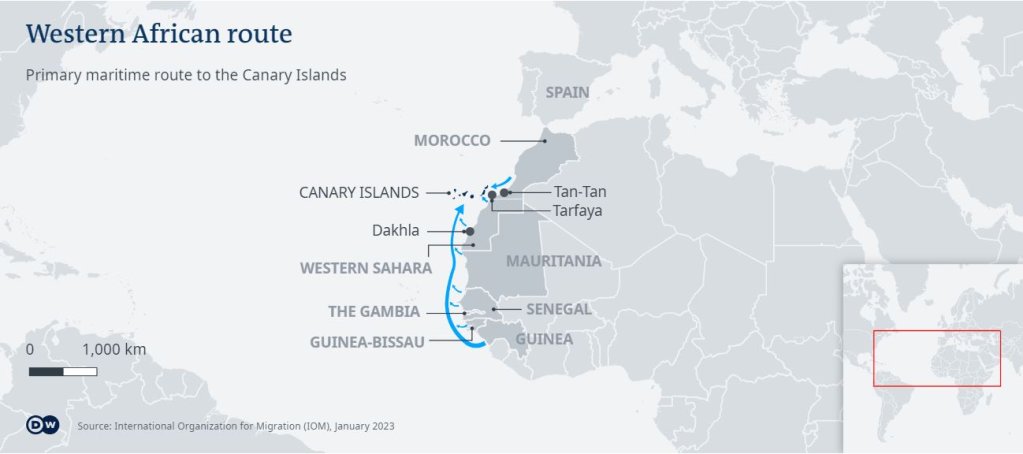
When the Moroccan rescue services arrived the following morning, they were only able to rescue 24 survivors. They also retrieved two corpses, one of them a young child. According to Caminando Fronteras, around 39 passengers died or disappeared. The public prosecutor's office in the Canary Islands did not initially respond to an inquiry.
Spanish newspaper Público reported that the Public Prosecutor's Office of the Canary Islands has asked the courts of Gran Canaria to open an investigation into a "possible crime of omission of the duty to assist", as requested by Caminando Fronteras.
The Public Prosecutor's Office has denounced the omission of rescuing the boat in distress. So far it has not been established who bears responsibility for the tragedy, however Salvamento Marítimo -- a sea search and rescue agency that coordinates the rescue of vessels in distress in the region -- is currently under scrutiny.
Salvamento Marítimo has assured Público that it is cooperating with the Public Prosecutor's Office in the open investigation. The proceedings will likely include recordings of communications between Spain and Morocco and statements from those responsible for ordering or delegating the operations.
Lack of coordination
Aid workers have once again criticized an overall lack of coordination between Spanish and Moroccan authorities in search and rescue operations.
"It only works well when it comes to fending off refugees," Maleno told Público, adding that help which has arrived much too late is not the exception, but the rule. "This is common practice at the border," he said.
A search for at least 300 missing people on three boats from Senegal is also currently underway in the maritime area between North Africa and the Canary Islands.
A plane operated by Salvamento Maritimo located the boat on the evening of June 20 around 7 p.m. near coordinates provided by Caminando Fronteras. The vessel was clearly located in the Spanish SAR zone, which covers the entire coastline of the Western Sahara territories.
The SAR zone is regulated by conventions of the UN's International Maritime Organization (IMO) and is not restricted to the territorial waters of a country. Rather, the country that claims competence in the respective SAR zone has the obligation to act to save lives.
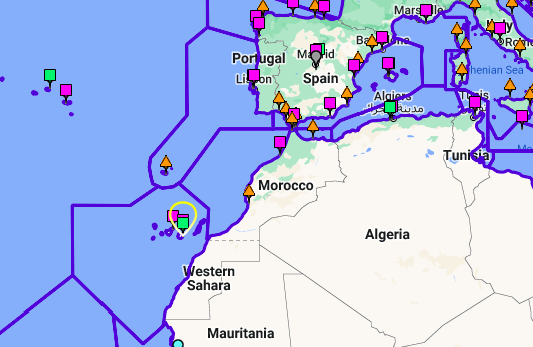
According to Salvamento Maritimo, the area where the boat was located was considered an "overlapping zone", since Morocco claims responsibility for search and rescue in this area, over which it also claims sovereignty. Because the boat in distress was closer to the African coast than to the Canary Islands, Salvamento Marítimo claims that "Morocco expressly assumed the coordination and mobilized means to proceed with the rescue".
What caused the severe delay?
Morocco confirmed it was sending help after 10 p.m. on June 20. However, its patrol boat did not arrive on the scene at 6:30 a.m. on June 21, more than 12 hours later. The reasons for the long delay in rescue are unknown. At approximately 10 a.m., the coordination center in Morocco's capital Rabat contacted the Canary Islands to request assistance.
By the time the rescue ship arrived, the migrant boat had capsized and only 24 occupants could be rescued. A Salvamento Maritimo helicopter flew to the scene but could only recover the lifeless body of a young girl.
When the Salvamento Marítimo plane located the boat on the afternoon of June 20, the Spanish rescue ship the M/V Calíope was 40 nautical miles (74 kilometers) from the vessel. It had carried out another rescue of 63 people, but could have reached the location in just one hour.
In a communiqué, Salvamento Marítimo specified that the ship set course for Gran Canaria rather than carrying out a further rescue mission because several of the persons rescued by the Calíope needed medical attention.