
Despite a huge need across the EU for more skilled migrants, there are still barriers that prevent highly-qualified foreigners coming to Europe for work. InfoMigrants spoke with experts, migrant entrepreneurs and policy makers about what can be done to address the problem.
"Above-average commitment, performance and creative power, stamina -- and, of course, the courage to start up and be self-employed."
These are the qualities that Franziska Giffey, Berlin's Senator for Economy, Energy and Enterprise, credited to migrant entrepreneurs during an award ceremony in the city last week.
Two of the migrants honored for their entrepreneurial success at the event on Wednesday (June 28) in Berlin's city hall were Boreal Light co-founders Hamed Beheshti and Ali Al-Hakim, who were born in Iran and Iraq respectively.
While Beheshti initially came to Germany to pursue a PhD, Al-Hakim has been in Germany since he fled with his family from Iran to Germany via Turkey and Spain in the mid-1990s.
"It's good that the entire German community is getting familiar with the work migrants are bringing to Germany," Beheshti told InfoMigrants after the award ceremony. "We established a business with several millions of euros in revenue and hired close to 30 people here. I'm glad that this award shines a light on the benefits of migrant entrepreneurship."
Beheshti and Al-Hakim develop and build solar-powered water desalination systems that produce drinking and irrigation water directly from high seawater and brackish water resources. Boreal Light, which currently employs 25 people from 14 different countries in Berlin as well as more than 300 people in Africa, has its systems installed in 18 countries including Ukraine, Yemen and in the Kalobeyei and Kakuma refugee camps in Kenya.
Numerous studies have shown that people with a migration background are more entrepreneurial and willing to take risks.
According to the latest Global Entrepreneurship Monitor, published on June 30, the entrepreneurial activity of individuals with a migration background in Germany is more than twice that of those without such a background for the second year in a row.
Read more: People with migrant background rule Germany's start-up scene
'Race for talent'?
Highly qualified immigrants like Beheshti and Al-Hakim are a boon to the economy of their new countries, and their skills are also desperately needed: Germany alone, which passed its new skilled labor migration law at the end of June, lacks 400,000 skilled workers, according to estimates.
Around six million jobs are currently up for grabs across the European Union's 27 member states, European Commissioner for Competition Margrethe Vestager said at an event in Berlin last week.
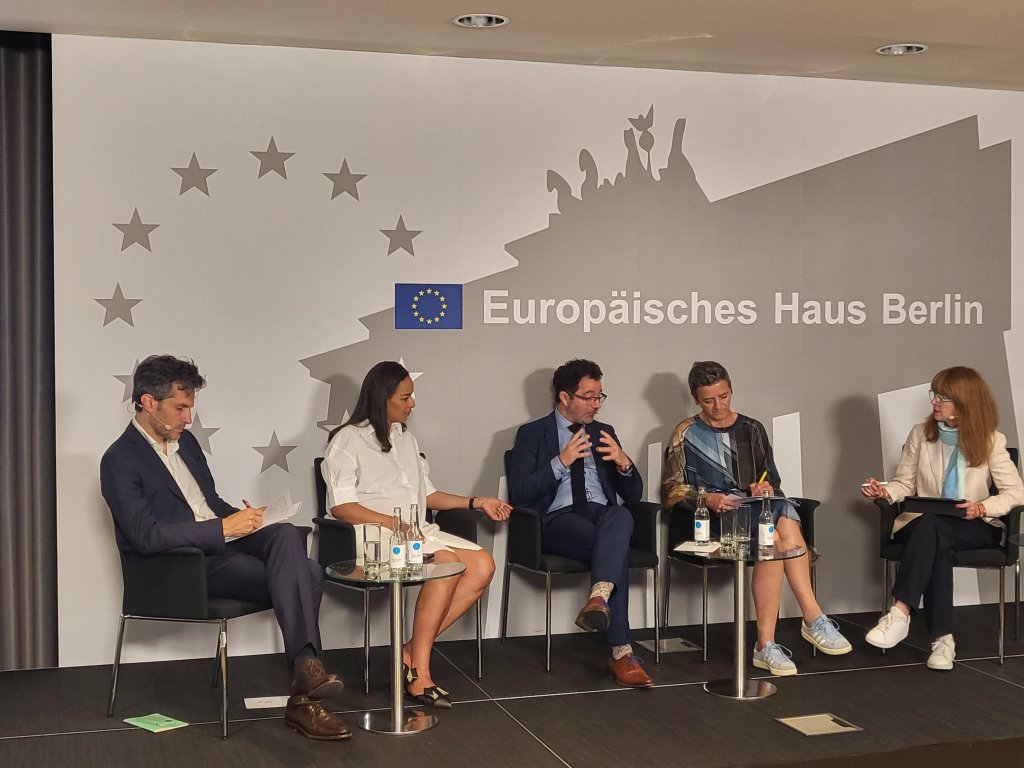
David Kipp, a researcher with the German Institute for International and Security Affairs (SWP), says there should be a greater focus on the contributions refugees make to economies. "Half the refugees who arrived in the EU 2015/16 are now in labor. They can help reduce the gap in skilled workers," Kipp said.
Judith Dada, General Partner at La Famiglia VC, called for a redefinition of 'talent' and a new way of looking at people's willingness to work and apply themselves to problems.
"There's much more to labor migration than the cutting-edge research scientist," Dada told InfoMigrants after her panel discussion. "Many migrants who sometimes fled horrible situations or are just looking for better economic opportunities are more willing to work hard, learn and get upskilled than some within the native populations. Any migrant can bring this ambition, drive, hunger, no matter the reason they come to Europe."
Allowing people to improve or learn new skills and start to work sooner after arriving in Germany -- both migrants arriving regularly and irregularly -- is the best way to tap into these talent pools and enabling migrants to become productive members of society.
In 2021, around three million people arrived via labor, educational and other regular migration pathways in the EU, more than twenty times as many people who arrived in the bloc irregularly.
Read more: Changes to Germany's skilled labor migration law -- what's in it for migrants?
Key bottlenecks hampering labor migration
Immigration lawyer Bettina Offer considers Germany's "whole immigration management infrastructure" a bottleneck. According to Offer, the very long waiting times at visa sections of German consulates and embassies in migrants' home countries as well as at labor authorities, which deal with labor market access, foreigners' offices and naturalization authorities in Germany are particularly problematic.
"If you're a skilled migrant standing in front of an immigration office at five in the morning and don't get an appointment, of course you'll tell their friends, family members and colleagues; 'Don't come to Germany, it's awful," Offer told InfoMigrants.
Barriers like these mean some migrants choose Canada or the Netherlands, where visa procedures are more efficient, says Offer.
Yet Germany remains the third-most popular destination country for highly skilled foreigners, the most recent Gallup World Poll found, behind only Canada and the US.
That's despite Germany's failing to make the top ten OECD countries with the most attractive framework conditions for highly qualified specialists, entrepreneurs and startup founders from abroad.
According to OECD migration expert Thomas Liebig, Germany's labor migration management infrastructure can only handle a fraction of the 400,000 newcomers the country of 83 million actually needs to fill the skilled workers gap.
The two main ways to improve the immigration infrastructure, he says, are digitizing visa and other procedures and hiring more specialized staff.
Liebig, whose team recently surveyed 30,000 skilled labor migrants interested in coming to Germany worldwide, points out that attracting and retaining foreign talent requires more than just getting your visa approved in a timely manner.
"It's not only about the economy. It's also about the education and health care system, security, the ability to bring family members with them, and other things."
A welcoming culture?
Given the importance of these social factors, SWP researcher Kipp warns against differentiating between 'good' skilled migrants and 'bad' unskilled irregular migrants.
"The protection space is shrinking, Europe is becoming tougher on preventing irregular migration," he said. "Either you have a welcoming culture, or you have problems with xenophobia and racism, which also affects the legal migration system. You cannot have a partly welcoming culture."
Johannes Reck, CEO and co-founder at GetYourGuide, said creating and nurturing an hospitable environment are critical to attracting and retaining skilled foreign workers, who should run the gamut from "the AI researcher to the plumber."
GetYourGuide, launched in 2009, currently employs around 800 people worldwide. Out of the 550 people who work for the online travel agency in Berlin, according to Reck, only 15% have a German passport. "If we solely relied on the German labor market, we'd be out of business," he said.
Reck's three key recommendations to make it easier for German companies to attract and retain non-EU talent are doing away with bureaucratic hurdles, especially getting degrees recognized and visas approved faster; reducing the "local hassle", such as finding affordable housing and dealing with authorities; and enhancing the attractiveness of the German labor market by allowing stock option programs for employees, among other things.
According to Reck, his staff spends around 1,000 hours a year on getting permanent resident status for 100-150 new employees.
Read more: Rise of Germany's far right may deter skilled workers
A 'valuable service'
Legal, regular pathways are the "future" of labor migration to the EU, says Spanish Migration Minister, José Luis Escrivá Belmonte. But, he added, discussions about creating more legal pathways are "primarily rhetoric."
"Labor market considerations are not sufficiently the focus of the discussion at the policy level. It is very much dominated by security considerations," he said, adding that this prevents Europe from cooperating in this matter with countries of origin.
Hamed Beheshti, who received the award last week, wishes Germany would speed up the naturalization process for self-employed foreigners like himself. But overall, he says the situation in Germany has improved significantly since he founded Boreal Light in 2014.
"When hundreds of thousands of people arrived in Germany in 2015/16, my wife asked me: 'How do you see Germany's future?' My answer was that I see it much brighter, and a stronger Germany," he said.
"In the long run, migrants do their new home a valuable service through innovation and new opportunities. When the door is open, you see a shift in the success of a country."
Also read: EU asylum reform ignores volatility of escape routes, experts say