
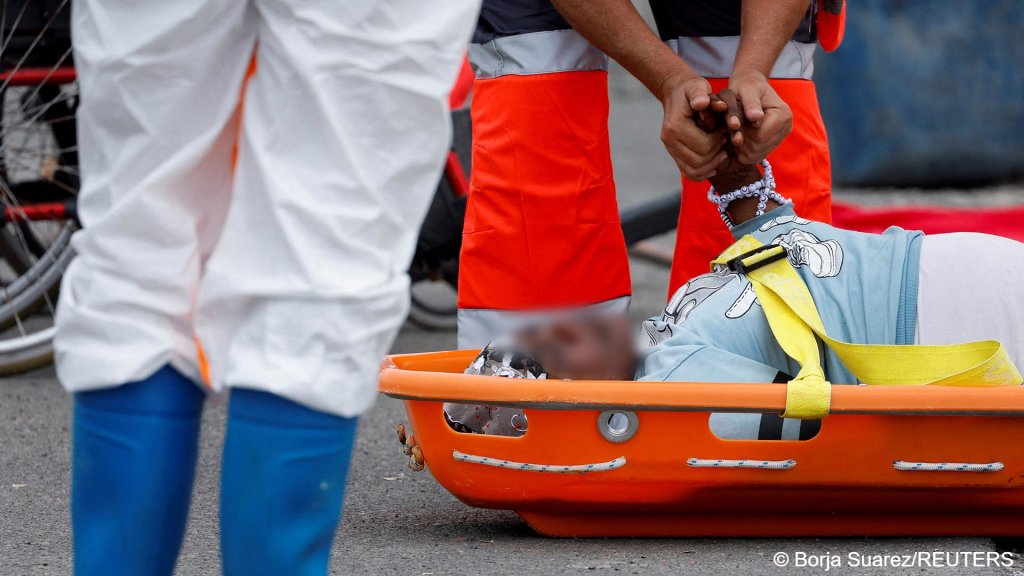
The body of a pregnant woman has been found in a rubber boat used to transport around 50 migrants from the coasts of northwest Africa to the Spanish Canary Islands in the Atlantic Ocean.
The boat was discovered by people fishing near a beach on the Spanish Canary Island of Lanzarote in the Atlantic Ocean, according to French news agency Agence France Presse (AFP).
No exact cause of death has been reported. The rest of the migrants aboard the vessel were taken to land in Arrecife, the main town on Lanzarote.
The migrants were discovered on Monday morning near Lanzarote, according to local news portal Canarias 7. A picture of the boat alongside the Spanish coast guard and rescue service Salvamento Maritimo shows a very overcrowded vessel, with several of the migrants sitting on the sides with one leg in the water.
Second boat arrives on Lanzarote
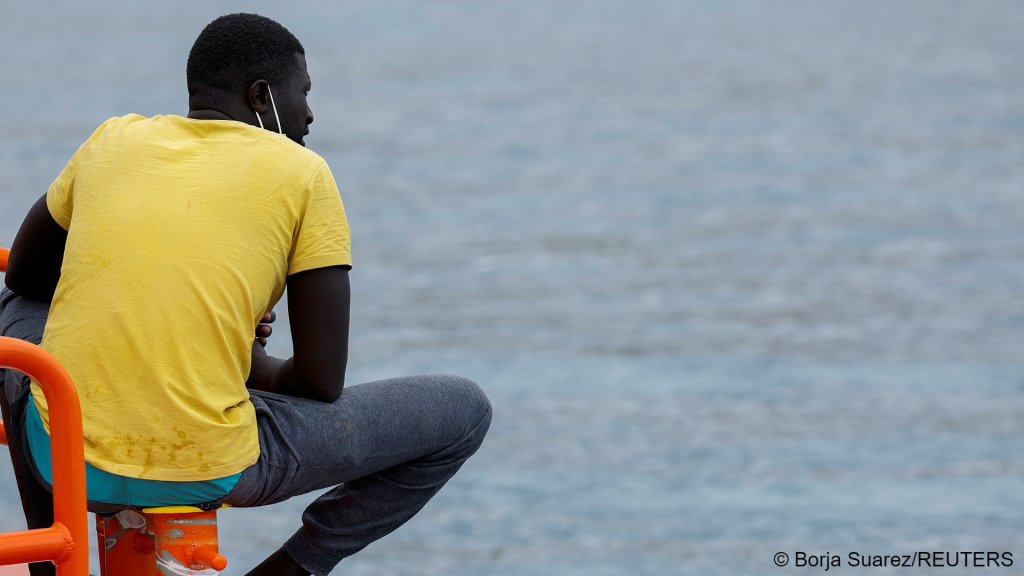
The migrants on board the boat were from North Africa and sub-Saharan Africa, according to Canarias 7. Most appeared to be in a "good state of health," according to a Salvamento Maritimo spokesperson.
Also read: Spanish police arrest suspected members of migrant smuggling network
A second boat also containing around 50 people, including 10 women and one minor, arrived near Lanzarote on Tuesday morning, according to Canarias 7. Good conditions at sea have led to a recent increase in arrivals, reported the news portal.
According to the latest figures from the Spanish Interior Ministry (last updated on June 15), almost 6,000 migrants have arrived on one of the Canary Islands since the beginning of the year. That represents a 31.5% decrease compared with the same time period last year, reported AFP. However, Canarias 7 points out that the first half of June accounts for about a quarter of all those who have arrived on the Canaries this year.
Increase in arrivals in June due to good weather
Between May 15 and June 15, around 2,530 people have arrived to the islands -- around 42% of the total yearly arrivals so far.
On June 19, the Spanish Commission for Refugees (CEAR) released its annual report, which revealed that a record number of claims for refugee status and international protection were made in Spain in 2022.
Also read: The most important thing for Madrid is that migrants remain in Morocco
In spite of the rise in applications, CEAR mentioned "serious difficulties" with the asylum process in the country. According to the NGO, the Spanish government rejected more claims for asylum on average than some of its fellow European countries.
The NGO criticized the current asylum system for condemning thousands of people to a "legal limbo", forcing them to wait between six and eight months on average for the results of their request for international protection.
Asylum system in Spain
In 2022, around 118,840 people sought asylum in Spain, according to CEAR, but that was nothing in comparison with the thousands of "invisibles" who had not been granted asylum but were still living in Spain, often without the correct papers, leaving them vulnerable to exploitative housing and working conditions.
Also read: Deaths en route to the Canary Islands
In fact, said CEAR, Spain came third after Germany and France for the number of asylum applications lodged in 2022, but third from the bottom -- ahead of only Malta and Cyprus -- in terms of the number of applications actually processed and granted.
Spain’s favorable grant rate stood at 16.5% last year, far below the European average of 38%, according to the NGO.
More than 122,000 files are still awaiting resolution, noted CEAR.
The NGO wrote that on July 1 of this year, Spain will take over the rotating presidency of the European Union, offering an opportunity for the country to start implementing a different migration policy that better recognizes the human rights of migrants, asylum seekers and refugees.
Also read: Migrants arrive on Canary Islands, at least one found dead
With AP and AFP