
In 2022, Spain and Morocco resumed diplomatic relations after a year of interruption and stepped up border controls with the aim of reducing arrivals in the Canaries. But many who wish to reach Europe continue to take to the sea and risk their lives.
"Although it's not perfect here, it's much better than anything I've experienced."
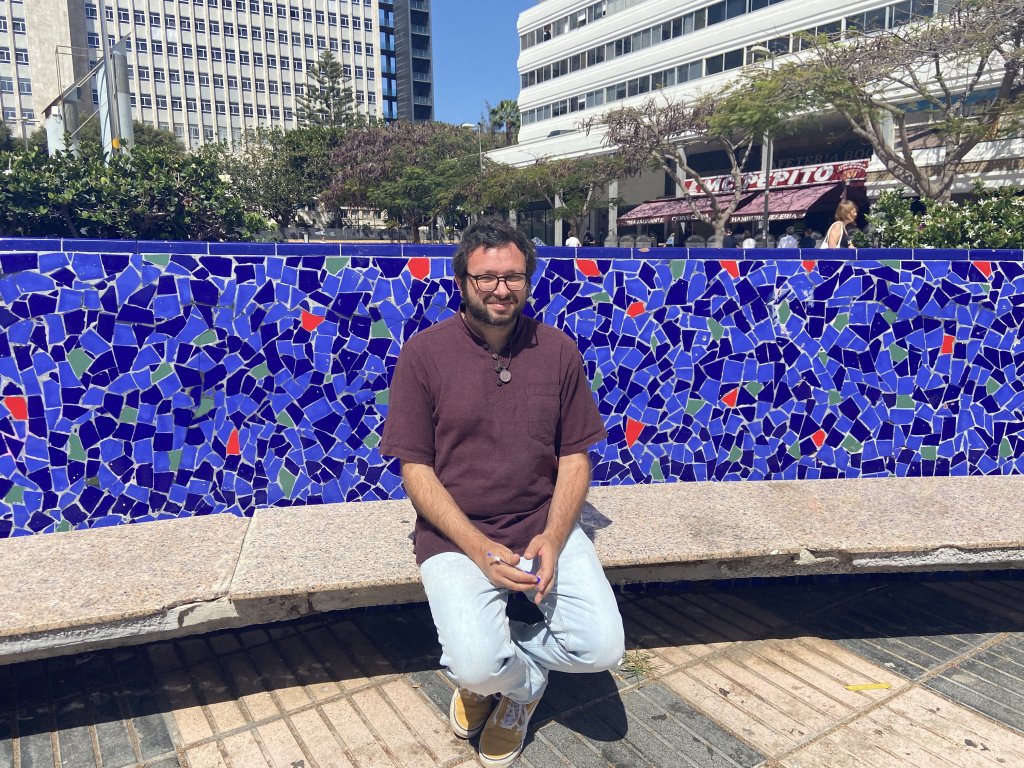
Keïta*, 27, is smiling this Thursday afternoon, in the streets of Las Palmas de Gran Canaria. This Malian arrived a week ago on the island of Fuerteventura and was transferred to the Canaria 50 camp, on Gran Canaria, three days later.
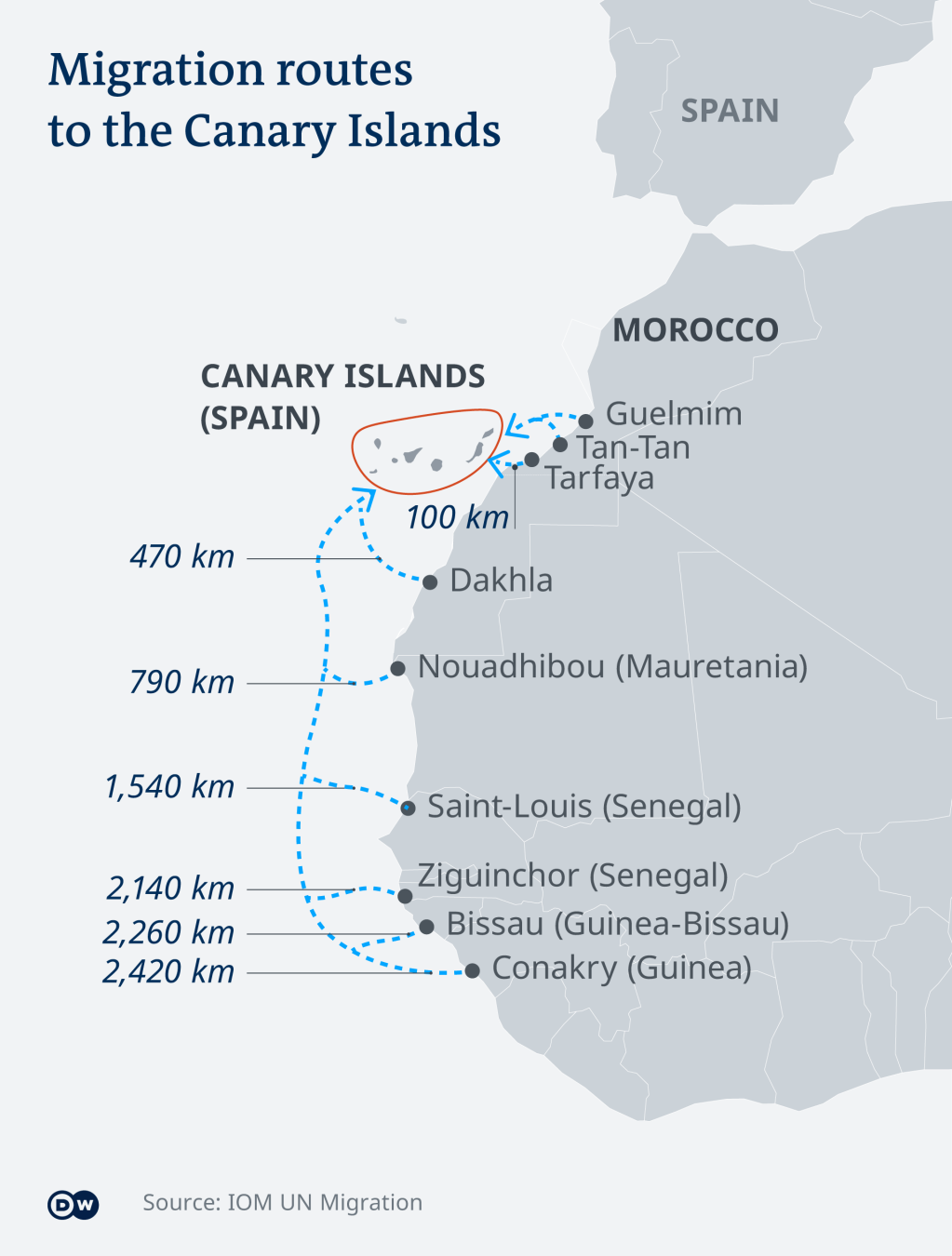
For this young man, the Spanish archipelago of the Canary Islands is a base, a long-awaited shelter. Keïta left Mali two years ago, lived in Libya then Algeria, before arriving in Morocco in February 2022. There, he tried different options to get to Spain.
"I went to Melilla but I was deported to Morocco. A few months later I entered Ceuta but I was also deported. So I left for Tan-Tan. There, I worked and I ended up getting on a boat to reach the Canary Islands," he explained to InfoMigrants, surrounded by a group of friends.
Fewer arrivals
There are two main shelters for single men in the Canary Islands: Canaria 50 in Gran Canaria and Las Raices in Tenerife. They are full of young men from sub-Saharan Africa, like Keïta, and Moroccans who wanted to escape the hardships of their country.
Some 445 people arrived during the week of April 17 on several islands in the archipelago. An increase from previous weeks and which may be related to the end of Ramadan and good weather conditions. But this increase is temporary. The overall number of migrant boats landing in the Canary Islands is decreasing.
In early April, a report from the Spanish Interior Ministry indicated that the number of arrivals to the Canary Islands had fallen by 63% in the first quarter of 2023 compared to the same period in 2022.
Also read: Record high number of migrants are dying on the way to the Canary Islands
New relationship
For Txema Santana, journalist and migration advisor to the Canary Islands vice-presidency, this decrease started back in March 2022. When Spain announced that it would officially support Morocco's position on Western Sahara, it put an end to a diplomatic quarrel which had lasted for a year and blocked Madrid's attempt to make advances on immigration negotiations.
Rabat and Madrid made peace. And this new friendship means more surveillance at the border: Morocco pledged to strengthen Moroccan navy patrols and closely monitor the enclaves of Ceuta and Melilla. On the Moroccan coast, Rabat is to intercept migrants likely to set sail, and send them back inland, in the region of Ouarzazate, far from the beaches.
The Moroccan authorities are therefore fulfilling their part of the contract: preventing migrants from reaching Spain. But this has a price, on land and at sea. "Unlike the Spanish Salvamento Maritimo, which is a real rescue service, the Moroccan navy is not intended to save lives," Santana told InfoMigrants.
While the navy regularly intercepts hundreds of migrants at sea, many boats also disappear in the immense Atlantic Ocean. One of these "ghost boats" was found in May 2021 on the Caribbean island of Tobago.
Also read: Canary Islands: How the Spanish Red Cross works to identify shipwreck victims
"According to the International Organization for Migration, at least 1,109 people died or disappeared on the Atlantic route in 2021 […], as reported by The Associated Press. Other estimates put the number higher. Caminando Fronteras recorded more than 4,000 dead or missing people on the same route in 2021, with at least 20 boats missing after leaving Mauritania."
In the Canary Islands, many migrant rights advocates are worried about the abuses that the new Spain-Morocco relationship could cause. "The Moroccan authorities are insatiable in their demands, on Western Sahara, on trade agreements, on financial compensation... And Spain accepts,” Juan Carlos Lorenzo, coordinator of the Spanish Commission for Refugees (CEAR) in the Canary Islands, told InfoMigrants. "The most important thing for Spain is that migrants stay in Morocco, whatever the cost," Lorenzo said.
Also read: Spain's Canary Islands – still a magnet for migrants
'Initially, I did not think of leaving'
However, attempts by young Sub-Saharans and Moroccans to leave Moroccan coasts have anything but ceased. Sub-Saharans point to increasingly difficult living conditions in Morocco driving them out.
Outside the Las Raices accommodation center on the island of Tenerife, Oumar, a 27-year-old Guinean, says racism and attacks on Black people are on the rise in Morocco.
"I spent 3, 4 years in Morocco. I worked in a call center […] At the beginning, I did not think of leaving but life really became more difficult there. The day before my departure, a child spat in my face in the street," he told InfoMigrants, in the shade of the large eucalyptus trees surrounding the shelter.
"We left Tan-Tan and stayed in the boat for two days. Water was coming in, we ran out of fuel. I didn't think the crossing was going to be like this. I think about it all the time when I sleep," the young computer graduate told InfoMigrants. He had to leave his country in 2017, where he was threatened for being gay.
Yassine and Saïd wanted to "better their lives." The two young Moroccans worked in the fruit business in their country and decided to leave without telling their families. They left the Moroccan coast, near Laayoune, and arrived in the Canary Islands after five days at sea.
As the procedure goes in the archipelago, they first spent 72 hours in the Temporary Reception Center for Foreigners. There, they were questioned by police about their journey and the presence of a smuggler on board or not. They were then sent to the Las Raices accommodation center where they are spending several months before being able to reach mainland Spain.
But some Moroccan and Senegalese migrants are sent to an detention center for foreigners to be deported to their countries of origin. "Only these two nationalities are targeted," explained Txema Santana who denounced the fact that there is no clear criteria determining which people are to be sent there. "Women and children are not sent to [those centers]. For the others, it depends on your nationality and if there are places available," he said.
In Tenerife, Yassine and Saïd avoided being sent to these detention centers. But the hardships continue. "I am aware that I will have to live a few years of suffering here,” Yassine told InfoMigrants, "but after that, I hope that a new life can begin."
*all interviewees wished to be referred to by their first name only
Also watch: Canary Islands: Looking for new ways of living together (video report)