
The British government has released new statistics which suggest that the numbers of Modern slavery referrals rose in the first quarter of 2023. Figures from the previous year, which were published in March, also showed a 33% increase compared to the numbers of referrals in 2021.
Between January and March 2023, the British Home Office (Interior Ministry) said that 4,746 potential victims of modern slavery had been referred to it. This is, reports The Guardian newspaper and the BBC, a rise of more than a quarter compared to the same quarter last year, and "the highest levels since records began [in 2009]," according to national statistics.
This sharp rise is particularly relevant at the moment, as the upper house of parliament, the House of Lords, is currently debating the so-called 'Illegal Migration bill.'
Some critics of the bill say that if it is passed, the bill would make it harder to rescue victims of modern slavery -- which often includes migrants. They are hoping to make some amendments to the bill during this debate process, to make sure that potential victims of modern slavery remain protected.
Cracking down on migration remains one of the British Prime Minister Rishi Sunak's top priorities.
Also read: Modern slavery in the UK
New bill could cease to protect potential victims
Critics of the bill say that the new legislation could lead to potential victims of modern slavery being removed from the UK before their cases have been properly assessed. Those who are being exploited but are unregistered in the UK might also be deterred from approaching the authorities for fear that they could be deported.
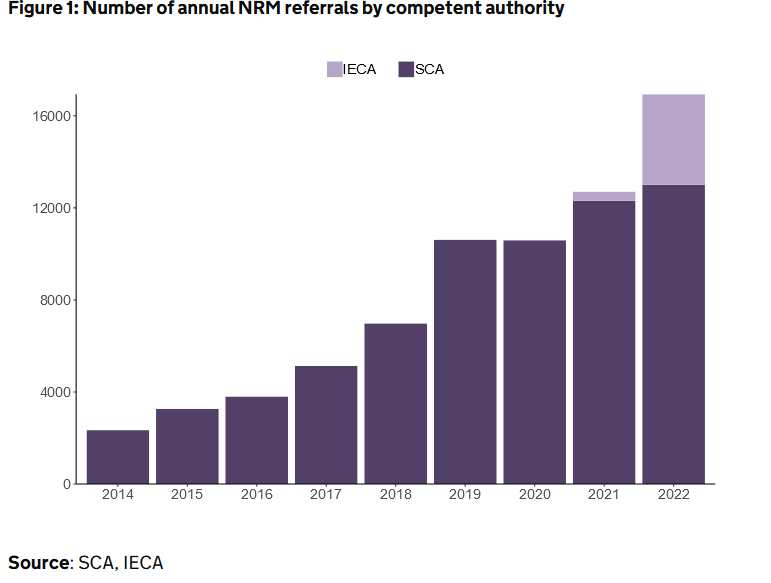
In March, the government published its latest figures on modern slavery referrals for 2022. During that year, stated the Home Office, there were 16,938 potential victims of modern slavery, which represented a 33% increase compared to figures in 2021.
2022 also represented the highest annual number of referrals since the National Referral Mechanism NRM began in 2009.
According to the government, the rise in 2022 was partly driven by so-called first responders, which are charged with examining potential cases of modern slavery. The government suggested in its analysis of the statistics that this rise in reporting "could be linked to the increase in detection at the border, and particularly, the large increase in small boats arrivals."
Albanian nationals leading statistics
Both in 2022 and 2023, a large proportion of those referrals was made up of Albanian nationals. In 2022, Albanian nationals overtook UK nationals as the most commonly referred nationality, with Eritrean nationals being the third most referred, stated the government statistics.
In the first quarter of 2023, Albanian nationals accounted for almost a third (31%) of all potential victims of modern slavery, reported the Guardian. In a slight change to 2022 figures, Sudanese nationals are now the third group most commonly reported, with British nationals still coming in second.
UK Home Secretary Suella Braverman has said several times that she believes some people are exploiting the mechanism, making false claims of exploitation in order to stay in the UK. In October, the Guardian reported that she said "the hard truth is that our modern slavery laws are being abused by people gaming the system. We've seen a 450% increase in modern slavery claims since 2014."
Her claims though are contradicted by the vast majority of positive decisions, laid out in the government's own statistics, as well as by the Gangmasters and Labour Abuse Authority.
Returned to Albania
One of the national groups which has come under the most criticism from Braverman are Albanians, who are deemed to come from a safe country of origin. This has even caused several rows between the two nations.
However despite these disagreements, at the end of April, the UK and Albanian governments concluded another deal to try to crack down on Albanian migration to the UK.
Also read: Albanian migrants back in focus in UK
In the agreement, the UK and Albanian authorities agreed to work together to "make it difficult for illegal migrants to arrive and stay in the UK," stated a UK government press release from April 25.
From December 2022 to April 2023, the UK government says that over 1,000 Albanian nationals were returned to Albania. This figure, the press release states "is a combination of failed asylum seekers, foreign national offenders and voluntary returns." However, there is no specific mention of people who might have received a negative response to their claim to be victims of modern slavery.
Overall in 2022, 1,888 Albanian nationals were returned to Albania from the UK. Just over half of these (51%) were forced returns while 49% were voluntary returns.
The two countries have also intensified checks at the border and have set up a joint migration task force.
Postitive decisions
The majority of all modern slavery referrals considered in 2022 resulted in a positive decision, i.e. those applicants did qualify for protection under the modern slavery act. 88% of those considered to have "reasonable grounds" for referral in the first instance and 89% of those who were considered to have "conclusive grounds" in later instances were ultimately judged positively.
The UK government defines modern slavery as including "any form of human trafficking, slavery, servitude or forced labor, as set out in the Modern Slavery Act 2015." Depending on the case, victims could be entitled to accommodation, subsistence, legal aid and counselling.
Any child found to be the victim of modern slavery will also be supported by the local authorities.

Specialists at the Home Office decide who is -- and who isn't -- recognized, based on a series of interviews and assessments. If a person receives a negative decision on their application, they are issued with nine days of "move on" support, before exiting the modern slavery support mechanism.
A negative decision can, however, be appealed and re-presented for more thorough examination.
Exploited children
According to Conservative MP Peter Bone, who chairs the cross-party parliamentary group on human trafficking and the parliamentary advisory group on modern slavery and the supply chain, almost 80% of UK nationals who are referred as victims of modern slavery are actually still children.
In a debate in parliament on the subject at the end of March, he said they are "exploited for criminal, labor and sexual purposes in their own country."
He concluded that "one in five -- 3,337 -- of the potential victims found in the UK last year was a British child."
According to the police, examples of victims of modern slavery may include those who have been trafficked or exploited, which often includes migrants. They can be found working in construction, agriculture, the sex industry, in nail bars, car washes and cannabis farms among other places.
Worldwide, the International Labour Organisation (ILO) estimated that there are over 50 million victims of modern slavery throughout the world. In the UK alone, the Global Slavery Index estimates that there are 136,000 victims of modern slavery.