
A group of refugees who said they were violently assaulted and pushed back by Croatian border officials have taken their case to Croatia's highest court, claiming authorities have failed to investigate the incident.
It has been almost two-and-a-half years since five Afghans filed a complaint against Croatian authorities, claiming they had been the victims of a brutal pushback from Croatia to Bosnia which included severe violence and sexual assault. Two of them were minors at the time.
Despite the law requiring the State Attorney to reach a decision within six months on the offences allegedly committed against the migrants, no investigation has even begun.
The Center for Peace Studies (CPS), a Croatian NGO based in Zagreb that deals with human rights issues, drew attention to the case in recent days again, tweeting that "more than two years" after "refugee victims of the pushback filed a complaint with the Constitutional Court of the Republic of Croatia," the case remained open "without an effective investigation."
Beatings and sexual assault
The asylum seekers involved in the case, who now are living in Germany, had reportedly entered Croatia from Bosnia in 2020. They say they were arrested across the border from the Bosnian town of Šiljkovača, where there is a tent camp of about 700 migrants.
One of the migrants managed to escape, while the other four were detained at a police station for two days without being given any food and with only limited access to the toilet.
According to CPS, they were then taken to testify against the fifth member of the group, who had since been caught and charged with people smuggling.
In accounts documented by the Danish Refugee Council and reported in The Guardian daily newspaper in October 2020, the migrants were taken to an unknown location, where they were put in a van with ten armed people, who were dressed in black and with their faces hidden behind balaclavas.
They say they were robbed, forced to strip down to their underwear, beaten and whipped. A doctor in Velika Kladuša, Bosnia, said one of the men whom he had examined later, had clearly suffered sexual violence, according The Guardian report.
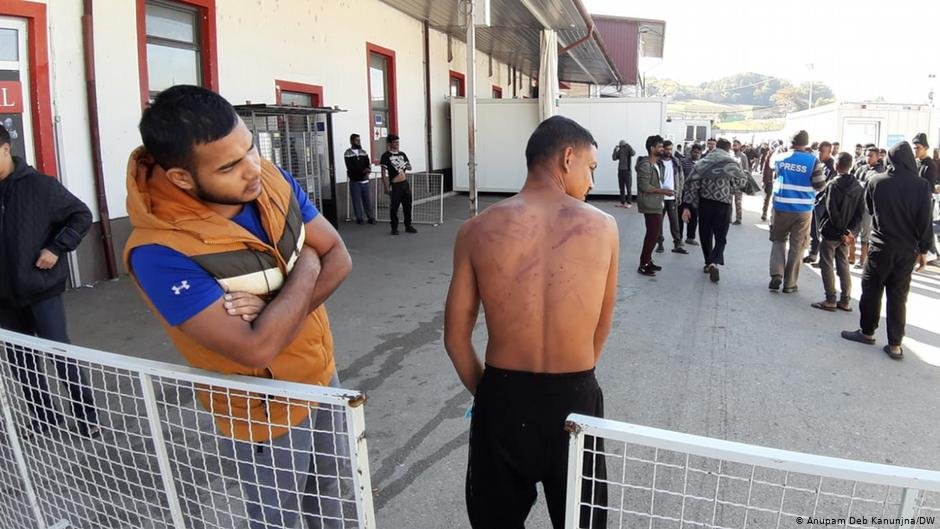
Continuing impunity
The Center for Peace Studies, which filed the initial complaint in December 2020 on behalf of the victims, said the masked, armed men were probably members of a special operation in Croatia called 'Corridor.' In July 2020, the CPS had called for an investigation into collusion between the Croatian police and units of Corridor.
Along the border between Croatia and Bosnia – the longest internal border in the EU – armed security officers are able to commit such severe violations against migrants with 'continuing impunity,' according to the European Center for Constitutional and Human Rights, a legal non-profit group supporting the Afghan asylum seekers together with the refugee rights organization Pro Asyl.
Not for the first time, Croatia's Constitutional Court will now need to examine whether there has been an effective and adequate investigation into these allegations. In recent years, Croatia has faced many complaints related to violence and human rights violations committed against migrants by Croatian authorities, as well as a lack of independent and effective investigations into the alleged violations.
Afghan families suffering repeatedly
In August, 2021, The Guardian reported that around 60 illegal pushbacks were alleged to have been committed over a period of two weeks by Croatian police against Afghan families in Bosnia trying to reach Europe. The incidents included violence, degrading treatment and theft. Half of those pushed back were minors.
Pushback refers to the illegal practice of expulsion without any possibility to apply for international protection, creating the risk of 'refoulement,' meaning that a person is sent back to a place where they might face persecution.
In 2018, the European Court of Human Rights found that Croatia had failed to conduct an effective investigation into the death of a six-year-old Afghan child who was hit by a train after her family had been ordered to return to Serbia by following the train tracks.