
Intense clashes between Sudan's military and the country's main paramilitary force have left over a hundred dead, including three aid workers. Humanitarian agencies warn that the health system is on the brink of collapse, and that a displacement crisis could ensue.
Fighting between the Sudanese Armed Forces (SAF) and the Rapid Support Forces (RSF) in Khartoum and other parts of Sudan broke out last Saturday, 15 April. The clashes are part of a power struggle that has roots in the 2019 uprising which ousted longterm autocratic ruler Omar al-Bashir.
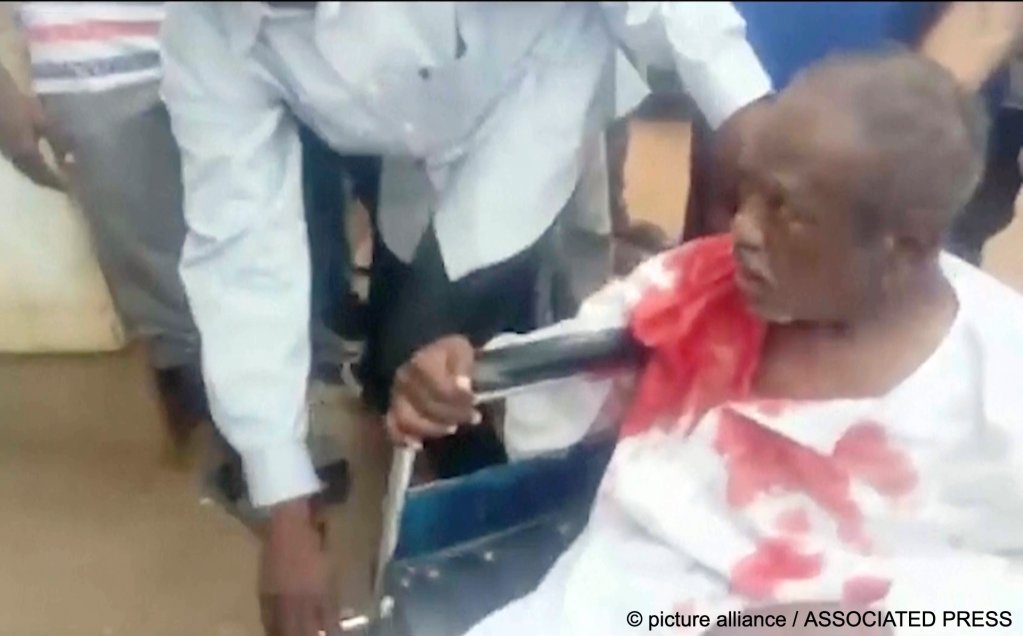
The Associated Press reported that the fighting has left over a hundred people dead and thousands injured as hostilities involving tanks and heavy artillery broke out in densely populated areas. People fear that the country might collapse, and that they might suffer displacement on a grand scale.
The World Food Programme (WFP) has had to temporarily suspend its operations in Sudan after three of its employees were killed in Kabkabiya, North Darfur on Saturday.
"WFP is committed to assisting the Sudanese people facing dire food insecurity but we cannot do our lifesaving work if the safety and security of our teams and partners is not guaranteed," WFP Executive Director Cindy McCain said in a statement.
Health services at risk of collapse
The Reuters news agency reported the International Federation of Red Cross and Red Crescent Societies as saying on Tuesday that it was nearly impossible to provide humanitarian services around the Sudanese capital Khartoum, and warned the country's health system in particular was at risk of collapse.
Humanitarian organization Doctors Without Borders (MSF) has reportedly received a total of 136 wounded patients in a hospital in El Fasher, North Darfur, which until Saturday afternoon had no surgical capacity. As a result, 11 people died from their injuries in the first 48 hours of the conflict.
In a statement, Cyrus Paye, MSF Project Coordinator in El Fasher, said that the majority of the wounded were civilians who had been caught in the crossfire; many of them reportedly were children.
"All other hospitals in North Darfur have had to close, either due to their proximity to the fighting, or due to the inability of staff to get to the facilities because of the violence," said Paye.
MSF warned of dwindling medicines, medical supplies, and blood donations to treat survivors. Furthermore, the hospital has been running on a generator since the fighting in the city led to a power outage.
Fuel supplies to keep the generator going are also running low.
No ambulances allowed
MSF said it is seeking to establish a safe corridor to transport these vital supplies to the hospital.
"Due to the conflict, the airport has been closed since Saturday, and it is vital that it is re-opened so that we can bring in additional medical supplies and possibly an MSF surgical team to support the surgeons who are currently at work," said Paye.
MSF reported that even ambulances were being turned back: Medical teams are apparently not even permitted to pass to retrieve the bodies of the dead from the streets nor to transport those who have been injured to the hospital.
Humanitarian needs at 'record levels'
The ongoing hostilities threaten to further exacerbate the dire humanitarian situation in Sudan.
The United Nations Office for the Coordination of Humanitarian Affairs (OCHA) reported humanitarian needs across Sudan were at "record levels".
About 15.8 million people – about a third of the country's population – are in need of humanitarian assistance, and could suffer serious displacement
Migrants and refugees at particular danger
In addition, the northeastern African country hosts more than 1 million refugees -- one of the largest refugee populations in Africa.
People from neighboring South Sudan make up the majority of the refugees in the country, but others are fleeing violence and persecution in neighboring countries like Eritrea, the Central African Republic, Ethiopia, and Chad are also there.
Most refugees live in out-of-camp settlements, host communities, and urban areas, where they might be subjected to the realities of the violent clashes that are still unfolding.
Many migrants and refugees -- especially coming from the Middle East, the Arabian Peninsula and Southeast Asia -- also pass through parts of Sudan before reaching Northern African countries like Libya and Tunisia, from where they attempt to cross over into Europe.
"Failure to cease hostilities, and — at a minimum — allow access for humanitarian agencies, will have catastrophic consequences that will reverberate throughout the region," Refugees International said in a statement.