
In France, all children are required to attend school, regardless of their administrative status. That means some migrant and refugee children arrive to class after spending the night on the streets due to the country's shortage of public refugee and migrant housing. The number of homeless migrant children is expected to rise as the weather gets warmer.
Linda's* path to education has been an obstacle course. Over the past few months, the 13-year-old has been forced to overcome many abnormal difficulties in order to attend school.
Since arriving in France from Angola in 2019, Linda, her parents and her three and one-year-old siblings have jumped from accommodation to accommodation, sometimes ending up on the streets.
After enduring years of nights spent in tents and parking lots, the fear of being attacked, hunger and lack of hygiene, the family currently lives in a home in Yvelines.
Adding to the horrors of homelessness, Linda has often attended class on an empty stomach, causing fatigue making it difficult to concentrate. She's been bullied by her classmates and, without proper accommodation, has struggled through difficult homework assignments.
But for the young girl who smiles often and wears her hair in fine braids, education is a priority.
Read more: 'I believe you have forgotten us,' minor appeals to French president
Precarious accommodation interrupts schooling
One afternoon in mid-March, seated in front of a Coca Cola after the end of her school day, she despaired over the fact that her average grade had dropped to "below sufficient."
"I can't study, I don't have time and I'm too tired", she said, before proudly recalling she had achieved a "good" average grade only a few years ago.
At that time, Linda and her family were living in relative stability in a reception center for asylum seekers in Bordeaux while waiting for the answer to their asylum request.
When they were denied protection, the family had to leave the center. After a few months living in squats, they arrived in Paris, thinking that it would be easier to find accommodation in the French capital.
Unfortunately, things didn't turn out as planned.
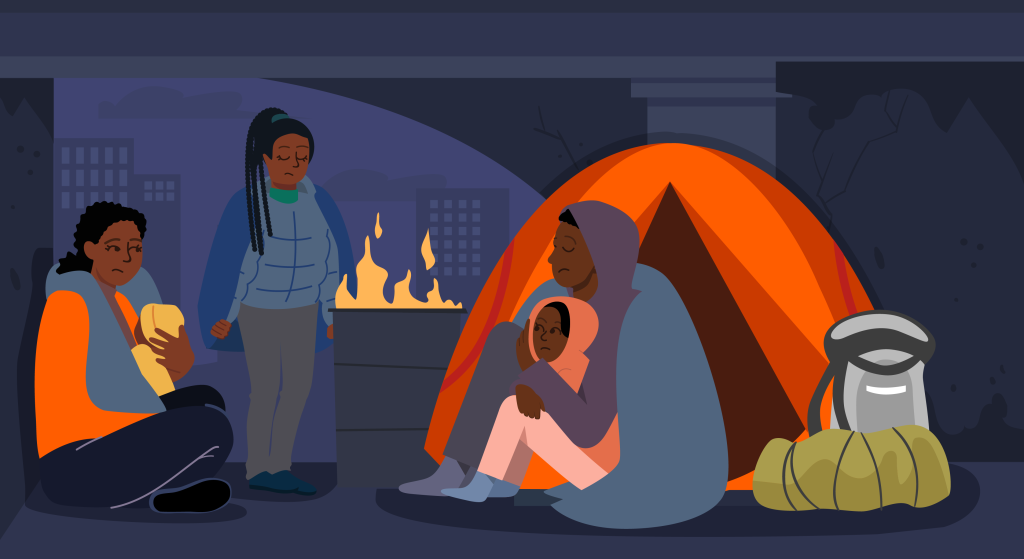
Once they arrived last September, Linda and her family found themselves stuck in a completely saturated system, forced to spend more than three months on the street.
“Sometimes we slept at the hotel for two or three nights,” said Linda.
The teenager suffers from a small speech problem. When emotions overwhelm her, she begins to stutter. Out of breath, she slowly tells the story of this infernal period.
"In the morning, after sleeping in a tent, we would wake up," she said. "Feeling very cold, I would grab my clothes and brush my teeth before going to school".
More than 1,600 homeless children
Linda is one of some 1,658 homeless children and adolescents in France, according to the latest survey by UNICEF and the Federation of Actors of Solidarity (FAS).
The figure corresponds with the number of children whose families called 115 (France's social emergency number) on the night of August 22 to 23, 2022 without obtaining accommodation.
"These figures are not exhaustive because many homeless families do not call 115," UNICEF said in its press release. "Moreover, they do not allow us to see the specific situation of unaccompanied minors living on the street. However, they indicate the scale of a housing and accommodation crisis which persists and of which children are collateral victims."
Among these children without fixed addresses, many come from families that are undocumented or who have been refused asylum in France. Whatever their situation, "we have an obligation to send these children to school as soon as possible after their arrival", said Emmanuel Deschamps, director of the Academic Center for the Education of Newcomers and Traveling Children (CASNAV).
Its teams have noted an increase in the number of registrations of exiled students in Parisian schools in recent months.
The director linked the increase to the rise in asylum applications in France (up by 31% in 2022 compared to 2021).
Half of these applications were filed in Ile-de-France. In addition, migrant families often have 'domiciliation spots' where they can receive their mail. These 'addresses' do not correspond to their place of residence -- their temporary accommodation often depends on the housing provided by the 115.
"In Paris, there are almost 100,000 ‘domiciliation spots’. Most of these addresses are in the 18th and 19th arrondissements", said Emmanuel Deschamps.
The director mentioned ongoing debate about how to help locate migrant families closer to schools. “We cannot welcome all the wandering families of Ile-de-France [in Parisian schools]", he said.
Read more: 'We're worried about doing more harm', say French homeless hotline responders
'Smoothing out the rough edges'
Most homeless students are supported by teachers and school administrators who try, on a case-by-case basis, to help them.
“My middle school principal and her deputy used to give me cookies in the morning when I was really hungry while waiting for lunch. They also gave me soap so that I could wash myself during the first hour of class,” Linda said.
Calls for donations of clothes, toys and food for homeless students have been launched by management at a school in the 15th arrondissement of Paris.
When asked by InfoMigrants how her team manages the situation of these students on a daily basis, the school director declined to respond, calling the subject "very sensitive".
In his third grade class at a school in the 18th arrondissement of Paris, Marc R. does his best to ensure his homeless students have the most normal experience possible.

In the fall, two new students arrived.
“The first slept mainly in a group of tents at the metro station La Chapelle and that changed several times […]," explained the teacher. "The second student arrived in early November from Cameroon. Her father was French, so she had French nationality. The family was preparing to come and live in France, but her father died of illness a few weeks before the departure […] When the little girl and her mother arrived, they slept in the Gare du Nord train station for a year and a half."
The first weeks of school were very difficult for the 8-year-old girl, especially since she was grieving her father.
"She slept in a place with the lights on and her mother made rounds around her to protect her from junkies. She was exhausted, she fell asleep several times at her desk," said Marc R.
For both students, the teacher tried to "smooth out the rough edges" of their existence so they would not have additional difficulties.
"I don't give homework, just things to reread. We prepare everything so they have supplies and swimming equipment. We choose work groups to foster friendships with kind children,” he explained. "Yet we still consider them as students among others."
For these two students, school is "a place where they can live their life as little girls", said the teacher.
Read more: France: Lack of housing puts migrant women at risk of falling into prostitution
The school as a protector
Hala Kerbage knows how important school is for migrant children. The Montpellier University Hospital child psychiatrist regularly treats children who have arrived in France with their parents to seek asylum.
"Being in school is a protective factor for migrant children," she said. "It helps them to have landmarks, a structure, to be in a community and to have friends. There are sometimes language or integration problems if the children are not French-speaking or if they have been uprooted from their community. In general, schooling always has a positive effect on the migrant child."
For those without fixed accommodation, school represents an element of stability and continuity, essential to the development of the child, Dr. Kerbage said.
An additional challenge presented to these students is the difficulty of relating to others, which is not always easy to manage. Someone different can easily be rejected. In the 15th arrondissement, the daughter of a single mother on the street consulted by InfoMigrants sometimes left school feeling sad because the others did not want to play with her.
As for Linda, she was teased because of her clothes "which weren’t the right brand." The 13-year-old girl dreams of clothes from Zara, but for now she has to be satisfied with donations.
Linda's classmates are unaware of her situation. The teenager thinks it is better this way, but worries one day they will figure it out.
"I'm afraid they'll tell me 'You sleep outside, you're a migrant'," she said.
Between hours spent in transport and the repeated moves, the teenager has begun losing hope.
"I don't like to be sad, so when things are not going well, I think about my future. I imagine myself in a house with my two children and my job. I want to become a childcare worker," she said, smiling.
This week, she took a step toward building her future when she obtained permission from her parents to babysit for the families staying in their home.
* Name has been changed
Read more: Paris: 'Requisitioning' accommodation for the homeless at a city hospital