
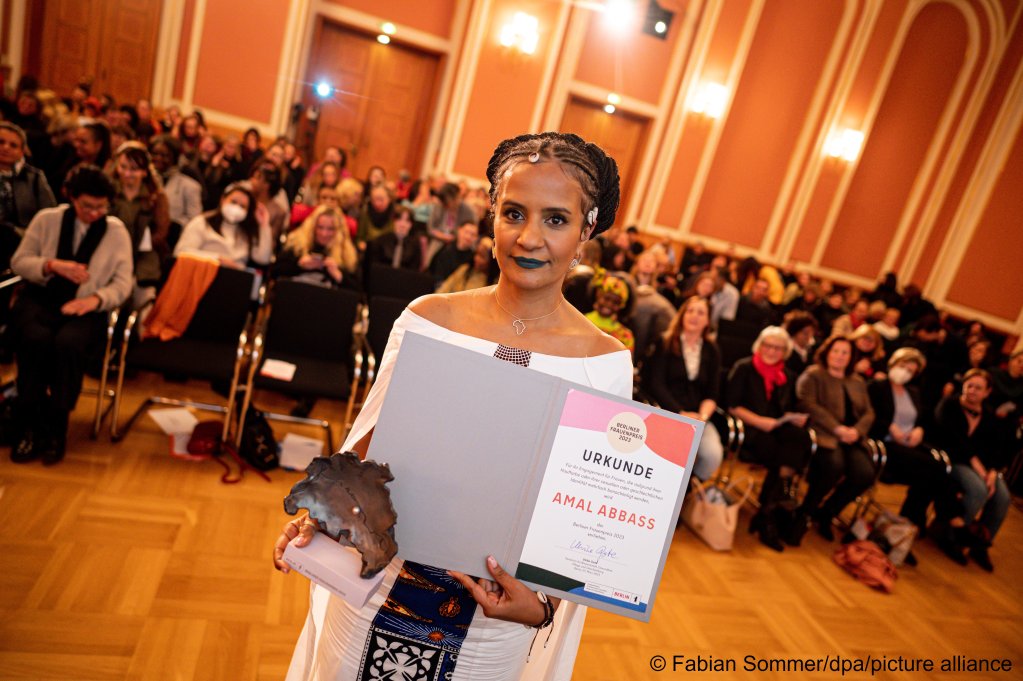
Psychotherapist and social entrepreneur Amal Abbass has been awarded this year's Women's Prize in Berlin on the eve of International Women's Day. The German of Sudanese descent has been working against discrimination for decades.
"As a queer person of African-German descent, my life's work rests on the shoulders of those who came before me," Amal Abbass said during her award speech at Berlin's city hall.
Abbass received this year's Berlin Women's Prize for her many years of commitment to the equality of women exposed to unique disadvantages due to the color of their skin or their sexual or gender identity.
The award ceremony, which took place Tuesday (March 7) evening in Berlin's city hall ahead of International Women's Day, was attended by some 200 people and featured song and dance performances by Black artists.
"To me, International Women's Day is a day to celebrate the beauty of women, in particular all those women who are never on a podium receiving prizes," Abbas told InfoMigrants after the ceremony. "The women cleaning the toilets, who are doing night shifts and care work at home. Their work should be valued a lot more than it is."
Since 1987, the Berlin Women's Prize has been awarded to female personalities of the city of Berlin who have made an outstanding contribution to the emancipation of the sexes through their commitment. The prize is endowed with €5,000 and a sculpture. All citizens are entitled to nominate candidates.
Champion of refugee rights
Abbass, a German native with a Sudanese background, has been working as a transcultural psychotherapist and social entrepreneur supporting people with BIPoC and LGBTQIA+ backgrounds for three decades.
At the award ceremony, Berlin's Equality Senator Ulrike Gote honored Abbass' "tireless commitment" for equality and against discrimination.
"Abbass has been fighting multiple discrimination for many years and actively contributes to more equality in the city," Gote said. "As early as the 1990s, she triggered debates about racism, queer hostility and sexism."
Born in 1973 in the eastern German city of Dresden to a Sudanese father and a Jewish-German mother, Abbass said she experienced intense racism growing up, including several life-threatening situations.
At the age of 16, she moved to Berlin, where she later studied psychotherapy. Abbass has six children, three of them foster children.
Fact check: Does the EU prioritize Ukrainian refugees?
Drawing attention to multiple discrimination
Abbass works as an advocate for Black women and their children, using her networks across the country to help them integrate. She also works to raise awareness of the unique hurdles they face.
Her most recent work has centered around supporting Black women who have fled Ukraine, many of whom have encountered racially motivated resistance and discrimination upon their arrival in Germany.
To better advocate for these women, Abbass co-founded the Tubman Network (stylized tubman.network), a coalition of Black organizations and individuals, shortly after Russia's invasion of Ukraine.
Abbass and her supporters have been providing third-country nationals (TCNs) who fled Ukraine with temporary accommodation, hot meals, hygiene items, legal advice and medical consultations since February 2022.
"They must have access to information that article 24 [Section 24 of Germany's Residence Act] is a right that should be given to all, and not to be forced into asylum applications that lead to nowhere," Abbass said. "We also need more hosts, adequate accommodation and more child care as well as an environment free of racism."
Read more: What changes beyond August 31 for third-country nationals in Germany who fled Ukraine?
Gender equality '300 years away'
On Monday (March 6), United Nations secretary general António Guterres warned that global progress on women's rights is "vanishing before our eyes".
"Gender equality is growing more distant. On the current track, UN Women puts it 300 years away," Guterres said in a general assembly speech in New York.