
The shipwreck off the Calabrian coast of Italy on February 26 was one of the worst of the decade. Many say Italy's strict immigration policy is to blame.
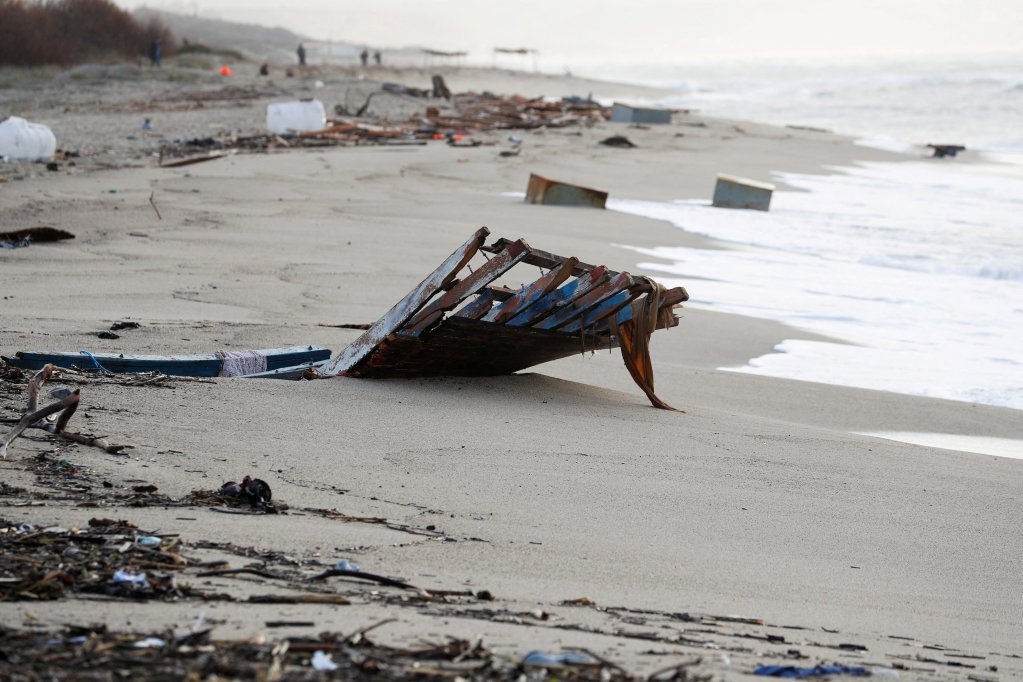
Bodies and debris litter the coast of Calabria in southern Italy.
Two days after a boat carrying between 150 and 200 migrants broke up after days at sea, the death toll rose to 67 people on March 1, including 16 children.
Only 80 survivors — from Afghanistan, Pakistan, Somalia and Syria — escaped the tragedy, and many passengers are still missing.
The catastrophe is rare in a region where thousands of migrants from Tunisia, Libya, Turkey and Lebanon arrive each year.
"In Italy, we haven't seen anything like this since October 3, 2013," said Sara Prestianni, who leads the Migration and Asylum program at the NGO EuroMed Rights, in an interview with InfoMigrants.
On that day, a boat from Libya carrying around 500 people sank less than a kilometer off the coast of the Italian island of Lampedusa, killing 368.
Read more: Tunisia: Three bodies found, 248 migrants rescued
Many other shipwrecks in recent years have been more discreet and, in some cases, even invisible.
At least 25,000 people have died trying to cross the Mediterranean between October 2013 and October 2022, according to several UN agencies: UNHCR (United Nations High Commissioner for Refugees), IOM (International Organization for Migration) and UNICEF (United Nations Children’s Fund).
Out of this total, nearly 20,000 died while trying to cross the central Mediterranean.
“It is very difficult to say where exactly these shipwrecks occurred," said Sara Prestianni.
Unlike the many migrants who have died at sea out of sight, the tragedy off the Calabrian coast was highly visible. For many, it highlights the consequences of Rome's strict policies attempting to counter illegal immigration.
Read more: Charged with saving migrants' lives – rescuers facing criminal prosecution
'The result of the damage caused by Italian and European policies'
Just days before the shipwreck on Sunday, Italy’s parliament passed a government decree into law requiring humanitarian ships to perform one rescue at a time and then continue on to a designated port.
The law essentially requires humanitarian workers to leave maritime areas where migrant boat crossings are frequent, and where no other rescue options exist, immediately after facilitating a rescue.
In addition, a court in Catania, Sicily, judged another decree allowing vulnerable migrants to disembark at an Italian port illegal in mid-February.
The latest show of hostility towards those who rescue migrants involved the humanitarian ship Geo Barents run by Doctors Without Borders (MSF). Italian authorities detained the ship in a Sicilian port on February 23 for 20 days and fined it 10,000 euros, accusing rescuers aboard of failing to provide required information.
Read more: Italian court declares government decree on sea rescue unlawful
"Three factors caused the shipwreck on Sunday: the absence of responses at sea, the few legal routes available to access Italian territory and the criminalization of solidarity", said Sara Prestianni, who predicts "other shipwrecks to come".
"Italy and the rest of Europe are highly responsible, because they do not favor rescue policies which could help avoid these tragedies. These authorities rely on a strategy of managing migration and outsourcing; both strategies have been proven ineffective in the past."
Other NGOs agree.
“We need to return to a coordinated system that does not confuse rescue at sea with the fight against illegal immigration,” said Marco Bertotto, programmes director at MSF Italy, after the shipwreck, in comments reported on Twitter. "These tragedies are the result of the collateral damage caused by Italian and European policies, which protect borders and limit safe access to Europe."
Migrants crossed the eastern Mediterranean
While he also denounces the anti-migrant policy pursued by Italy, Maurice Stierl, activist and member of Alarm Phone, an emergency telephone platform at sea, said the impact of the new restrictions on rescue operations may not be fully to blame for the shipwreck off Calabria.
"We do not know the exact route of the [wrecked] boat, but the path it took is not one where NGOs carry out rescues, at first glance. These migrants crossed the eastern Mediterranean and NGOs are saving lives in the central Mediterranean [off the coast Libya and Tunisia]", he said.
The boat traveled along the "Calabria route", which extends from the Turkish coast to the Italian peninsula.
This migratory route is increasingly common, despite being very dangerous: travelers remain at sea five to seven days on average in an area markedly absent of humanitarian workers.
Read more: Lampedusa: Baby girl among three dead in shipwreck
Mostly sailboats or wooden fishing boats set off on this route from the Turkish coasts. The crossings are extremely perilous but sometimes rated "first class" because of the type of boat used and the amount paid to smugglers: around 10,000 euros for an adult and 4,500 euros for a child.
"[Migrants] prefer to avoid [illegal] pushbacks in Greece and the Balkan route [where countries have tightened border controls in recent years]", said Giovanni Perna, MSF field coordinator in Calabria and Sicily in an interview with InfoMigrants last October.
“We have even recently seen people on boats pass Lampedusa without stopping. They have heard of mistreatment there and of the inability of some migrants to leave the center located on the island. They decided to set sail for Calabria from the beginning,” he said.
According to the Italian Ministry of the Interior, nearly 14,000 migrants have landed in Italy since the beginning of the year, compared to around 5,200 during the same period last year and 4,200 in 2021.
Read more: Calabria, the land across the Mediterranean where migrants are 'treated well'