
In southeastern Spain around 200 migrant workers were evacuated on Monday when the camp where they were living was engulfed by fire. The blaze happened on the same day authorities planned to demolish the site.
El Walili camp in south-eastern Spain, in the region of Almeria, was in fact due to be demolished, following an order from the local Nijar city council, which deemed it dangerous and abusive.
However, on Monday, January 30, the ad-hoc camp, home to around 500 migrant workers, was engulfed by fire, reports the news agency Associated Press (AP). Pictures shared on social media showed billowing flames and clouds of smoke rising above the makeshift shacks and plastic sheeting, as firefighters trained hoses on the fire.
It is unclear how the fire started, reports AP. Most of the residents of the camp came originally from Morocco and sub-Saharan Africa. The camp had existed for about 15 years and had grown from a number of huts, being expanded with plastic tarpaulins similar to that used in the local greenhouses where most of the men worked. There were no connections for electricity or running water.
Evacuated by bus
Those residents who were in the camp at the time of the fire were evacuated by bus and helped by local charities. AP reported that around 60 people were taken to a nearby warehouse.
The president of the local branch of Doctors of the World (Medecins du Monde), Carmen Dominguez, told AP that the camp had been built to offer temporary accommodation while new housing was constructed. However, one Senegalese resident told AP he had already been at the camp for two years.
Also read: Forgotten migrant workers in southern Spain speak out about conditions
The man, who gave his name as Abdulai, told AP: "Now everybody will be out in the street, outside right now that it’s very cold, very cold, that’s going to be very hard."
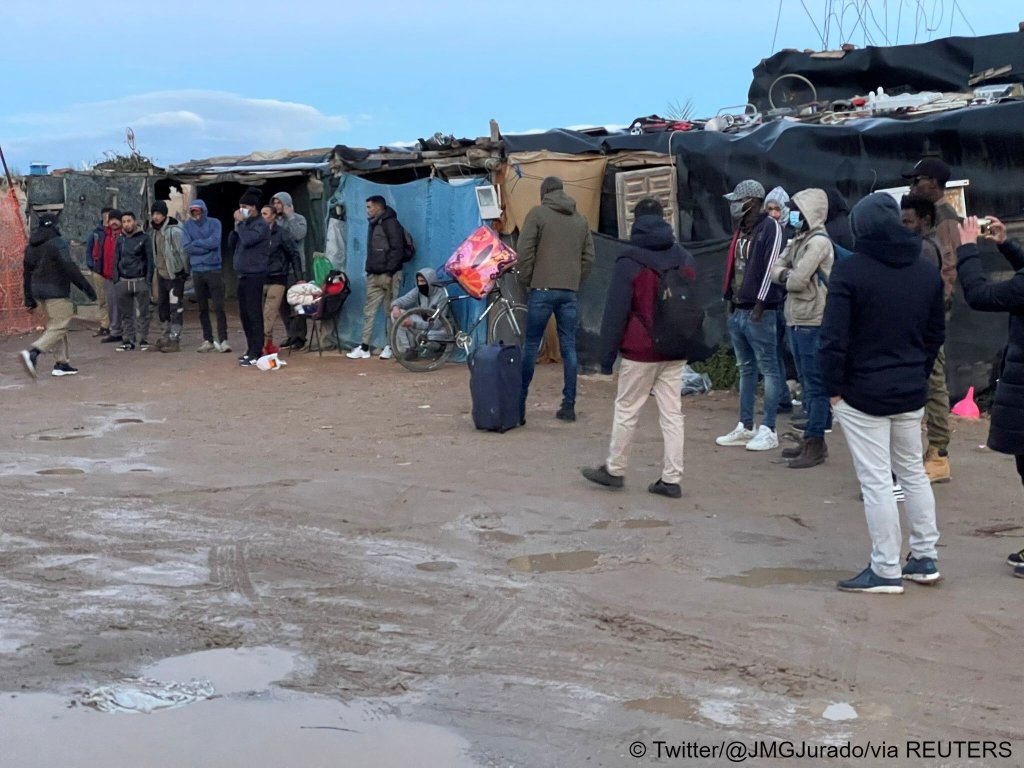
Local organizations working with migrants had already petitioned the city council to delay the final eviction of the camp until the weather warmed up. One human rights group, APDHA, told AP that "authorities had no appropriate relocation plans for the migrants."
'Chaos and confusion'
The Turkish news agency Anadolu reported that the authorities had already begun the eviction when the fire started and that there was "chaos and confusion" over events on Monday. AP added that the authorities had not responded to their requests for clarification of events on Monday.
However, Anadolu Agency wrote that "dozens of police officers converged on the settlements as helicopters flew overhead to control the eviction of residents from places some had called home for years."
Also read: Harassment and rape, migrant women abused in European fields
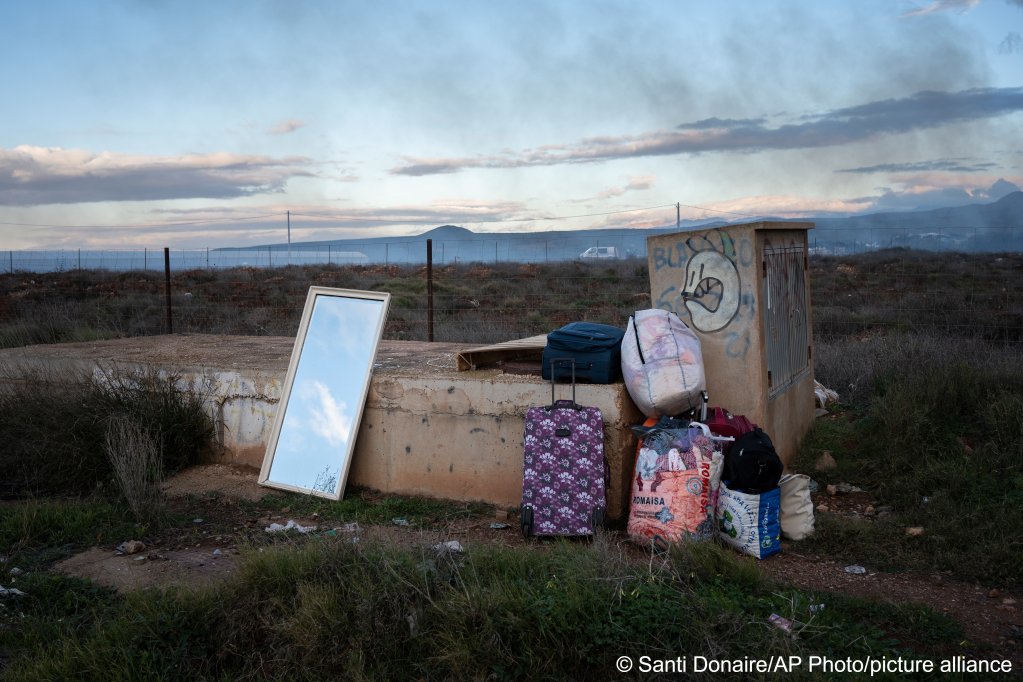
One man, calling himself Abdul, told the Spanish daily newspaper El Pais that all his belongings were gathered in the plastic bag with which he fled the camp. The man claimed to have been living there since 2015.
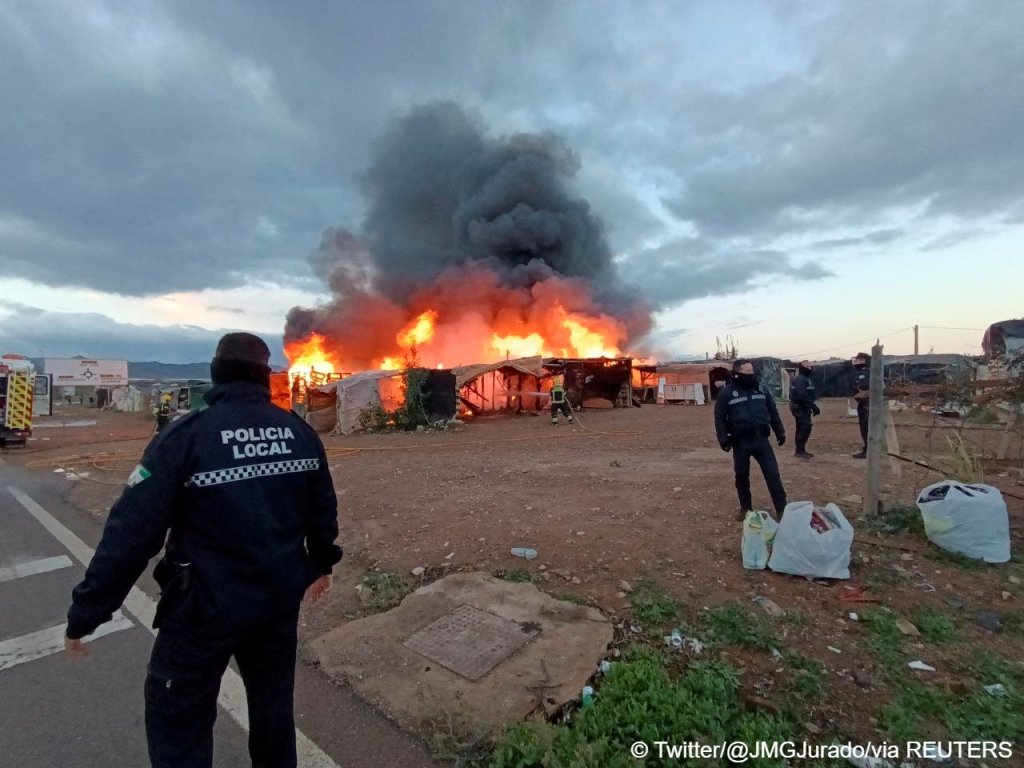
One politician, originally from Senegal, who was at the scene, Serigne Mbaye, told local media that he thought the fire was "more than a coincidence," according to Anadolu.
'Immigrants are exploited, used and thrown away'
Mbaye told local media: "This was clearly a strategy to make people have to leave because they were in danger. This is not humane. Immigrants are exploited, used, and thrown away," reported Anadolu.
El Pais added that the authorities have guaranteed emergency shelter to the camp's evacuated residents for up to two months.
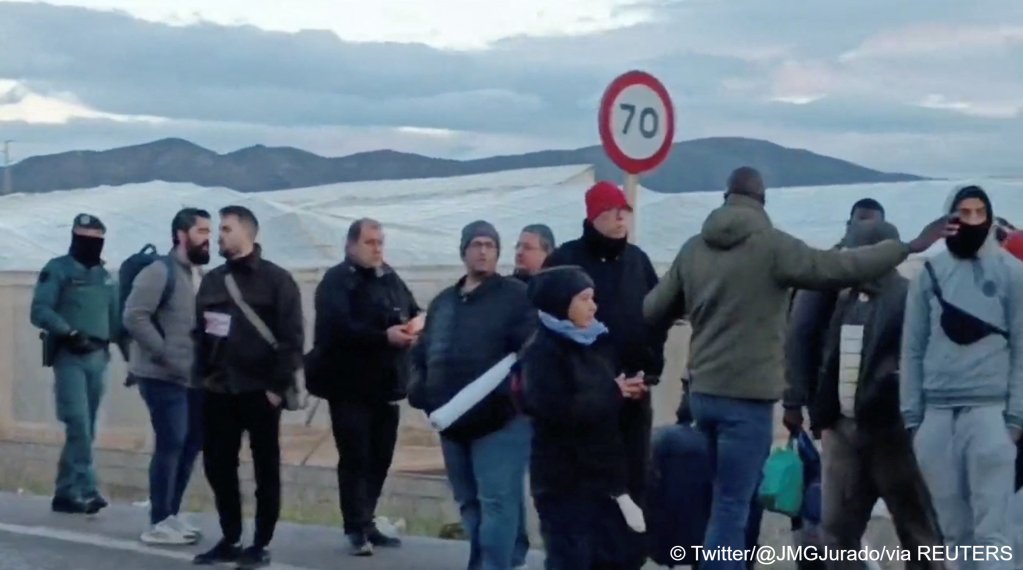
El Walili was not the only migrant camp in the area. However, a spokesperson for APDHA, Fernando Plaza, told Anadolu that he believed El Walili attracted the attention of the authorities because it’s visible, right off the highway, and "gets in the way of tourists' views."
Fernando Plaza told Spanish news site El Salto Diario that he felt the authorities were not being supportive enough of those who had lost their homes. Plaza told the newspaper that "only the police have come, no one from social services has come, the bus has not come to pick up the people who said they were coming to transfer them to that emergency relocation."
Further from the fields
The emergency accommodation is also situated several kilometers from the fields where the majority of migrants work, in nearby Los Grillos, reported El Salto Diario, which could make it difficult for workers to arrive at the fields for their shifts.
In addition, Plaza pointed out that other camps that actually house twice as many migrant workers as El Walili have not yet attracted the attention of the authorities. In Plaza’s view this is because they are nowhere near the national park that the Almeria region hopes to promote in its latest tourist plans presented on January 17.
The area of Andalucia, in particular Almeria, provide much of Europe’s and the world’s fruit and vegetables. According to Anadolu Agency, many of the greenhouses near the El Walili camp were actually dedicated to growing organic produce.
Conditions for the migrant workers who labor in the greenhouses have often been held up as inhumane and problematic. In 2020, the UN’s Special Rapporteur on Extreme Poverty, Philip Alston, said that conditions he witnessed in one migrant camp in southern Spain "rival the worst I have seen anywhere in the world. Many have lived there for years and can afford to pay rent, but said no one will accept them as tenants. They are earning as little as €30 per day, and have almost no access to any form of government support."
Expanded demand, no services
Miquel Carmona, a representative of the Spanish SAT union, told El Salto Diario that people were afraid of losing their jobs if they could not longer live near the fields. The union has called a strike of farm workers to stand in solidarity with those who have lost their homes in the fire and the evictions, the paper reported.
In the last 20 years the area around Nijar where El Walili is situated has almost doubled the number of hectares covered in greenhouses to more than 6,500 hectares in 2022, according to El Salto Diario. But, it adds, this expansion has not gone hand in hand with adequate housing and services for the additional migrant workers needed to sustain the greenhouses and harvest the produce.
Also read: Spain's sea of plastic, where Europe gets its produce, migrants get exploited
Mbaye, the Senegalese politician in Madrid, told El Salto Diario that he wanted to lift the lid on what was going on in southern Spain. He said many of the workers found themselves in a "legal limbo," being exploited. He said his aim was to make sure that "all of Europe knows that slavery continues to exist in Europe and the products that they receive from Spain, from the countryside, many come from the people affected by this slavery."
With AP and Anadolu Agency