
18-year-old Abdullah from Darfur was held south of Tripoli by a smuggler who tortured him to try to get a ransom. When the money did not arrive, the smuggler covered the Sudanese teenager with gasoline and set him on fire, InfoMigrants was told. Abdullah is now in hospital in Tripoli in a serious condition.
Abdullah's body is completely bandaged. Only his face and hands are not covered with bandages. In his hospital bed, the 18-year-old Sudanese boy is on morphine to limit his pain. "The doctors say he should hopefully be able to leave in three months," said Hassan Zakaria, a Sudanese man who has been taking care of the young man since his arrival in Tripoli, speaking with InfoMigrants.
Abdullah was attacked in Sebbah, nearly 800 kilometers south of Tripoli. This large city in central Libya is a crossroads of the migration routes that cross the country. It is here that people coming from Sudan, Chad, Niger or Algeria reach the cities of Tripoli, but also of Sirte and Misrata.
Abdullah is from Darfur, a region in western Sudan that has been ravaged by war for nearly 20 years. Like many other young Sudanese, Abdullah paid a smuggler in Sudan to cross the border into Libya. He made the journey from Sudan to Sebbah with his friend Bashir.
The two young men hoped to continue their journey to Tripoli and later, eventually, to Europe. But when they arrived in Sebbah, they were kidnapped by a smuggler who controlled the south of the city. The man wanted to extort money from them and tortured them to pressure their families to pay ransoms.
Read more: Posting photos of migrants on Facebook is the latest ransom method by Libyan jailers
'Punish him and scare the others'
But when the money didn't arrive, "the smuggler doused Abdullah with gasoline and set him on fire, to punish him and also to scare everyone else," explains Zakaria, who translates Abdullah's story to InfoMigrants from his hospital room.
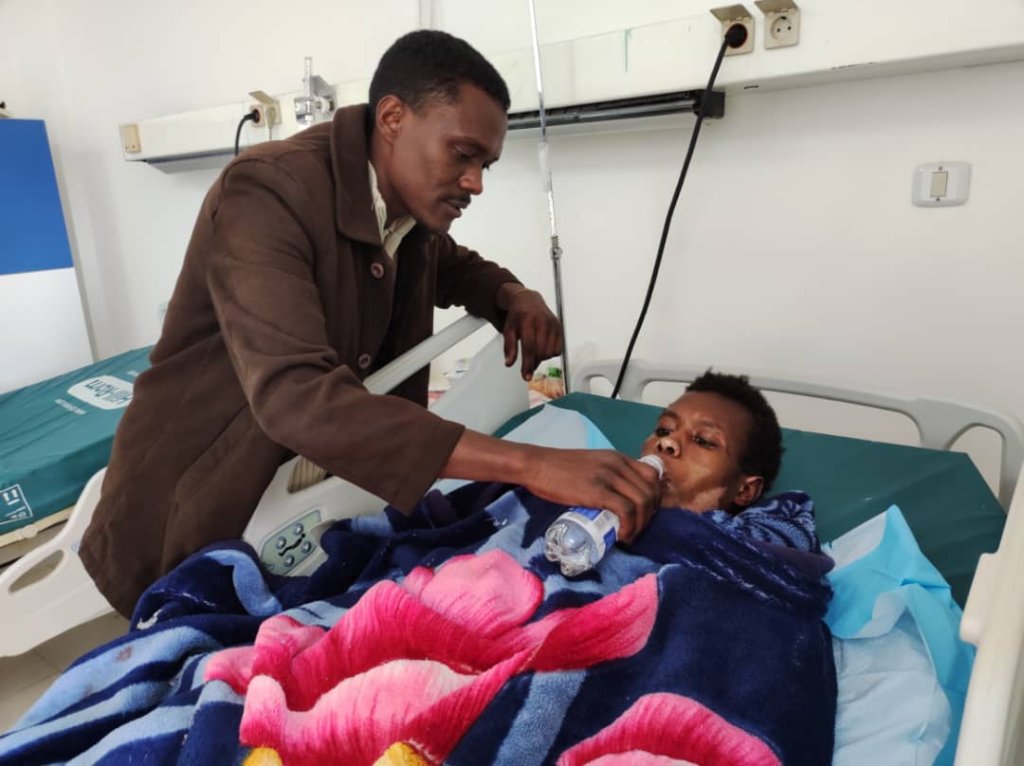
With severe burns all over his body, Abdullah was hospitalized for ten days in Sebbah hospital. "The police visited him there," reports Zakaria. They told him they were looking for the smuggler who had assaulted him but they couldn't find him because nobody knew him."
Abdullah was then transferred to Tripoli, to a hospital specializing in the treatment of severe burns. The young man is still being treated there and his life is no longer in danger, but his health remains extremely fragile.
When asked by InfoMigrants about the attack, the United Nations High Commissioner for Refugees (UNHCR) said "we do not comment on individual situations for reasons of protection and respect for the privacy [of individuals]. Cases of people being abused at the hands of traffickers or criminal gangs are unfortunately well documented," the agency added.
Discrimination and xenophobic attacks
In its December 2021 report, the U.N. Coordination of Humanitarian Affairs (OCHA) for Libya noted that "migrants and refugees from sub-Saharan countries and the Horn of Africa continue to face discrimination and xenophobic attacks."
Since the summer of 2021, cases of violence against migrants have significantly increased in Libya. And the perpetrators can be police officers as well as simple passers-by. A number of migrants have told InfoMigrants that they were shot in the middle of the street, "without reason".
This increase in abuses can be explained by the end of the fighting in Libya after the ceasefire of October 2020. "The armed groups are no longer fighting and no longer have income from the war. So they turn to migrants to try to extort money from them," explained Liam Kelly, of the Danish Refugee Council, last July.
Read more: Jean: 'I was kidnapped in Tripoli'
Prison hell
Since the fall of Libyan dictator Muammar Gaddafi in 2011, Libya has become a preferred route for tens of thousands of migrants seeking to reach Europe. But many are stuck there, in prisons described by the exiles as a "real hell". One of the most common solutions to get out is to pay a ransom, a practice revealed to InfoMigrants by many migrants. "I was no longer useful, so the guards agreed to exchange me for money. It was a friend who paid to free me," explains Assane*, who was locked up in a secret prison near Zaouïa.
Read more: Raped 'every night' in Libyan prison until she gave birth: Sarah
Daouda*, another 19-year-old migrant from Guinea, also had to ask his father for money to get out of prison. "But by the time [he] got the money together, it was already too late," says his sister. The young man died in prison, shot by the guards during an escape attempt.
Salif*, who has tried to cross the Mediterranean from Libya six times, explains that "when migrants are sent back to a Libyan port, they are transferred to a detention center. When this happens, you have to pay to get out. The sum is 3,000 Libyan dinars [about €550, editor's note]. Besides, the first thing the guards ask us when we arrive is: 'Who has money to get out of prison?'."
*First names have been changed